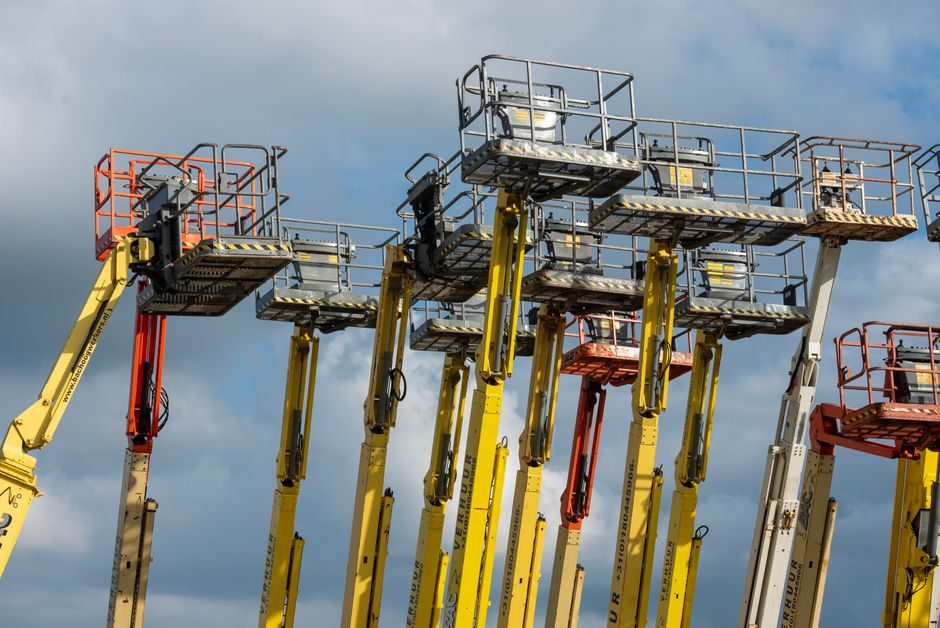
Aerial work platforms (AWPs) replace ladders, scaffolding and rope access with a levelled, guarded work basket, but the spec list is wide enough that "the best one" rarely exists — only the right family for the job envelope [S1]. The HYNEE product line published 2026-07-02 demonstrates the breadth, covering push-around single-mast lifts, self-propelled single-mast lifts with jibs, forklift-style mast lifts, and mast boom lifts up to roughly 11.65 m working height (model HI13) [S1].
For the rest of this reference, the trade-off analysis below breaks the equipment into four decision axes — indoor vs outdoor, working height vs basket footprint, self-propelled vs pushed, and truck-mounted vs trailer — and lines them up against the criteria a process or maintenance engineer can actually measure on a purchase order.
What an aerial work platform actually does on a spec sheet
An AWP is defined by three numbers on the data plate: maximum working height, platform capacity (typically 120–250 kg for single-man mast units), and the chassis envelope. HYNEE's GTWY1 push-around single-man lift and AMWP1100 self-propelled single-mast lift sit at the entry level, while the HI11T self-propelled vertical mast lift adds a jib for offset reach [S1]. CE, ANSI and CSA certification marks appear on the manufacturer's published 2026 specification page, which is the baseline compliance set a rental fleet or a contractor should require before acceptance [S1].
Because the platform replaces a ladder, the working height is measured to the floor of the basket, not to a handhold — a 10 m mast lift therefore matches roughly a 12 ft scaffold tower in usable reach, and that gap is the single most common procurement error in indoor maintenance contracts. When the application is process-pipe routing, warehouse racking or façade lighting, a vertical mast lift is the lower-weight, lower-cost default; when the application is outdoor steel erection or tree work, an aerial work truck or boom lift is the right call because of the tilt sensor, outrigger load chart and wind-rating envelope.
Pros: where aerial work platforms pay back faster than ladders or scaffolding
Speed-to-height is the headline benefit. A self-propelled mast lift is in position and elevated inside a minute, versus a tower scaffold that needs 30–90 minutes of assembly by a trained two-person crew. The HI12N1 forklift-style mast lift with jib and the HI11T self-propelled jib unit both drive through a standard industrial doorway and elevate in one continuous motion, which collapses the labour cost of a single 8-hour maintenance shift by a measurable margin [S1].
Safety, when the equipment is inspected, is the second benefit. A guarded basket with a toe-board, mid-rail and self-closing gate removes the dominant cause of fatal falls on construction sites — unguarded edges — and replaces it with a tilt-limited, capacity-limited engineered system. CE / ANSI A92.20 / CSA B354 compliance is the audit trail, and HYNEE explicitly states the entire 2026 product line carries those three marks [S1]. The factory design feature worth flagging is serviceability: the hydraulic cylinder can be swapped without disassembling the mast, and the chain is accessible for direct visual inspection, which compresses preventive-maintenance downtime from a half-day to under an hour per unit [S1].
Versus fixed scaffold, a self-propelled AWP is a single asset that can be redeployed between bays in the same shift, which suits multi-tenant warehouses, mechanical-room contractors, and event-rigging crews that bill by the day, not by the linear metre of scaffold. Procurement life-cycle cost should be modelled against the alternative of suspended platforms for façade work — those are cheaper per metre but require roof anchorage, rigging certification, and a separate rescue plan.
Cons: where aerial work platforms cost time, money or both
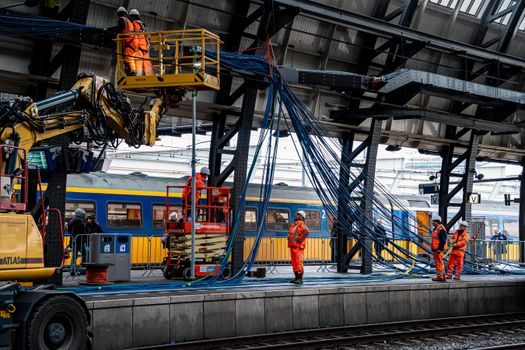
Ground-bearing load is the most under-reported limitation. A 10 m scissor lift can impose 1,200–1,800 kg of point load through four small wheels, and a single mast lift with an outrigger still concentrates the basket plus operator plus mast mass into a footprint smaller than 1 m². Suspended or waffle-slab floors, mezzanine decks rated under 5 kN/m², and any landscaped or paved surface that hides a service trench can refuse the unit. The 2026 sourcing notes for aerial work platform truck suppliers explicitly highlight safe and efficient high-altitude work as the purchase driver, but they are silent on ground prep, which is the installer's responsibility [S4].
Outdoor wind and slope ratings are the second constraint. Most vertical mast lifts are rated for indoor use or calm-wind outdoor use only, with a typical tilt limit of 1.5–3°. Boom lifts and truck-mounted units extend the outdoor envelope but introduce outrigger setup, load-chart sign-off, and a daily function-test that adds 20–40 minutes of non-productive time per shift. None of the HYNEE mast-lift models published 2026-07-02 are advertised as wind-rated beyond a standard light-breeze indoor/outdoor crossover [S1].
Operator training, inspection cost and battery/charger infrastructure are the third drag. Even a single-mast push-around unit needs a competent person to complete a pre-use check; self-propelled and boom units need a formal operator card (e.g. IPAF in the EU, OSHA-compliant training in the US) and a 6–12 month thorough inspection. Electric units need a dedicated charging bay with a 230 V single-phase outlet, a ventilation check if the chemistry is lead-acid, and a rotation discipline so no unit sits at 0% state of charge — a cost line that frequently surprises first-time buyers. The third limitation is procurement: as the Industrial Rubber Advantages and Disadvantages reference notes for elastomer choices, every spec trade-off has a maintenance tail, and AWPs are no exception — seals, hoses, batteries and load-bearing pins all carry an effective service life that should be priced in.
Selection criteria: matching chassis family to jobsite envelope
For a 4–8 m indoor maintenance job on a level concrete floor with a 230 V outlet within 30 m, the lowest-cost correct answer is a push-around single-mast lift such as the HYNEE GTWY1, because the operator does not need a driving licence, the unit weighs under 400 kg, and there is no battery to manage [S1].
For an 8–12 m indoor job with multiple bays to cover in one shift, a self-propelled single-mast lift with jib (AMWP1100 or HI11T) is the right step up: drive speed of 3–5 km/h, proportional joystick lift/lower, and a jib that adds roughly 0.5–1 m of offset reach for working over obstructions [S1].
For a 10–14 m outdoor job on rough ground, a boom lift or truck-mounted unit becomes necessary because of the wider outrigger base, the wind rating, and the articulated or telescopic jib envelope. At this point a buyer should compare a towable boom against a self-drive boom, and weight the question of whether a platform trolley or a forklift-style mast lift (HI12N1) would in fact clear the same envelope at a lower total acquisition cost [S1].
For process-engineering buyers who already spec weighing equipment, the platform scale reference is a useful analogy: just as a scale must be selected by capacity, accuracy class and environment — not by maximum displayed digits — an AWP must be selected by working height, basket load, and ground/slope envelope — not by the largest model on the dealer's price list.
Standards, certification and what to verify on a 2026 PO
Three certification marks separate a compliant AWP from a generic lift on a 2026 purchase order: CE marking under the Machinery Directive for the European market, ANSI A92.20 (design) and A92.22 (operator training) for the North American market, and CSA B354 for the Canadian market. HYNEE's 2026 manufacturer page lists all three, which is the spec baseline a rental fleet or a multi-site contractor should require [S1].
Pre-delivery inspection should include: nameplate working height and basket capacity, tilt-sensor calibration date, hydraulic-cylinder serial and last service date, chain elongation measurement, emergency-descent function test, and overload-cutout verification. The 2026 manufacturer copy stresses that the hydraulic cylinder is replaceable without mast disassembly and the chain is visually inspectable — both of which directly shorten the periodic inspection cycle and reduce the cost of compliance [S1].
Two trackable signals to watch over the next two quarters: the publication of the next revision of the EN 280 family of standards for mobile elevating work platforms, and the expansion of the HYNEE dealer network into markets where ANSI/CSA acceptance is the procurement gate. The cross-discipline engineering spec reference at Engineering Plastic Advantages and Disadvantages uses the same trade-off mapping technique and is a useful template if an internal buying committee needs a side-by-side decision matrix.