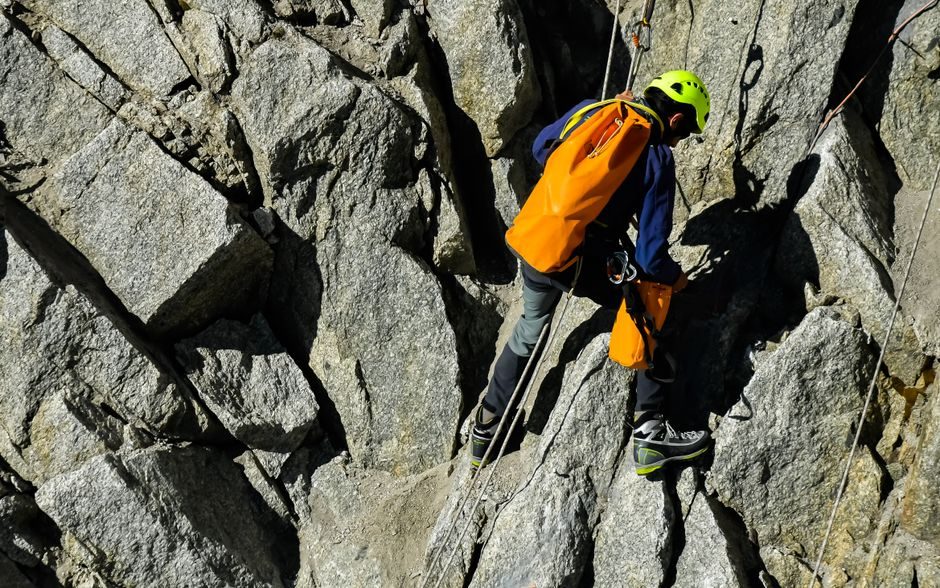
A fall-arrest full-body harness is engineered to distribute arresting loads across the thighs, pelvis, chest and shoulders via webbing and D-ring anchorage points, while a safety helmet is a rigid-shell head protector designed to absorb impact and resist penetration. The two items solve different hazards — fall-arrest harnesses arrest a free fall from height, safety helmets manage falling objects, swinging loads and impact against fixed structures [S1][S2].
Both are routine PPE on construction, tower, MEWP and rope-access sites, but EN standards treat them as separate product families with separate type-examination routes. Specifying one as a substitute for the other is not equivalent protection, and most European site risk assessments now call for both as baseline kit for any task above 2 m where a fall hazard exists.
What Each Item Actually Does, and the EN Standard Behind It
Full-body fall-arrest harnesses are certified to EN 361, with work-positioning variants also tested to EN 358 and rope-access models extended by EN 813 [S2]. The Edelweiss HERCULES EVO-2, for example, is a full-body harness with lateral D-ring fixation points and EN 361 / EN 358 marking, designed to be worn continuously during rope-access work [S2]. The IRUDEK SEKURALT WIND BLUE series adds chest, shoulder and leg webbing with automatic buckles for quick donning, and exposes back and front anchorage points for fall arrest [S1].
Safety helmets, by contrast, fall under EN 397 (industrial safety helmets), EN 12492 (mountaineering helmets, with a stronger chin-strap retention requirement and lower penetration force limit) or ANSI Z89.1 in North America. EN 397 calls for shock absorption at 50 J impact transmitted to the head form below 5 kN, plus an optional electrical insulation class rated to 440 V or 1000 V and an optional temperature range down to –20 °C or –30 °C. A harness does none of this; a helmet does not arrest a fall. Confusing the two standards is one of the most common PPE audit findings on European tower sites.
Side-by-Side Comparison on 4 Decision Criteria
Hazard zone protected: harness covers torso, pelvis and thighs via load distribution through D-rings (rear, front and lateral) [S1][S2]; helmet covers the cranium and partial neck impact zone only. Test energy: EN 361 verifies a 100 kg test mass arrested from a 4 m free-fall with peak arrest force below 6 kN on the body; EN 397 verifies a 5 kg striker dropped from 1 m onto the helmet shell, with transmitted force below 5 kN. Weight: a full-body harness typically lands between 0.9 kg and 1.6 kg depending on padding and steel-vs-aluminium D-rings; an EN 397 industrial helmet with chin strap runs 0.35 kg to 0.5 kg in ABS or HDPE shell form.
Service life: most harness manufacturers stamp a 5-year maximum useful life from first use, with annual mandatory inspection; helmets generally carry a 5-year shell life in industrial service (UV degradation of the shell is the dominant end-of-life mechanism), with replacement after any significant impact. Both items are consumables, not capital equipment, and should be tracked individually by serial number on a site register.
Selection Criteria: When You Need a Harness, When You Need a Helmet, When You Need Both
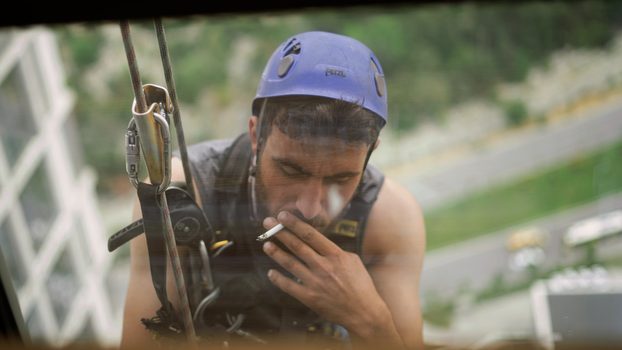
If the worker is exposed to a free-fall hazard from height — leading edge work on steel, MEWP operation, tower climbing, scaffold erection, roof work without collective edge protection — a harness plus an EN 362 connector and an energy-absorbing lanyard (EN 355) or self-retracting lifeline (EN 360) is the minimum compliant kit [S5]. Helmet selection in these tasks follows separately: EN 397 for general construction, EN 12492 for rope-access technicians who need stronger chin-strap retention during inverted suspension, and ANSI Z89.1 Class E (electrical, 20 kV rated) for live-line work.
If the primary hazard is a falling or swinging object, overhead crane load handling, or low-clearance impact against fixed steel — a safety helmet is the right primary control and a harness is not required. Examples: forklift charging bays, formwork stripping, hoist landing zones, rig-floor pipe handling. Standards call this out implicitly: EN 397 specifies penetration resistance against a 3 kg pointed striker dropped from 1 m, a hazard class the harness was never designed to mitigate.
For tasks that are genuinely mixed — tower erection, structural steel, blade work, transmission line access, scaffold inspection at height — the kit is harness + helmet used together, not one substituting the other. UK distributor Safety Harness Direct lists 3-point full-body harnesses, fall-arrest blocks and rescue harnesses alongside the same category pages that would host EN 397/EN 12492 helmets in a complete PPE shop, reflecting the combined spec-out reality on site [S9].
Real-Use Cases: Construction, Rope Access, MEWP and Tower Work
Rope-access technicians (IRATA-style work) typically use an EN 361 + EN 358 + EN 813 combination harness with a reinforced polyethylene padding insert, designed for sustained suspension comfort during long descents [S2]. The harness here also serves as the work-positioning seat, so the chest and sit-strap D-rings are load-bearing during the task, not just during a fall.
Construction and MEWP work generally uses a lighter 2-point EN 361 harness with a rear D-ring only, paired with a shock-absorbing lanyard or SRL. UK stock ranges such as the G-Force 3-point full-body harness at £104.38 inc VAT and the Kratos FA1010600 2-point rescue harness at £50.36 inc VAT show the typical price band for compliant commodity kit in mid-2026 [S9]. A 1.75 m restraint lanyard with karabiner each end is around £22.58 inc VAT at the same outlet — meaning a complete harness + lanyard + helmet rig is frequently sub-£200 for EN-compliant specification.
UK-made passive fall-arrest systems such as Fall-Pac's polystyrene-and-air-pocket mats sit alongside PPE in the same category but address a different problem: protecting workers on the ground from tools or components dropped from height, or attenuating fall forces at the source rather than through the harness. These are often specified on steel-frame and residential build sites where harness anchorage is impractical [S4].
Limitations, Failure Modes and Inspection Triggers

Harness failure modes are dominated by webbing abrasion, stitch degradation, D-ring deformation and buckle corrosion. A harness that has arrested a fall must be withdrawn from service immediately and destroyed, regardless of visible damage — the arrest energy is the trigger, not the appearance. Annual inspection by a competent person is mandatory under EN 365; field operators are expected to do a pre-use visual and tactile check on webbing, stitch lines and metalwork [S5].
Helmet failure modes are dominated by shell UV embrittlement, suspension cradle fatigue and chin-strap failure. A helmet that has taken a significant impact must be replaced even if no crack is visible, because the EPS or polypropylene liner absorbs the energy through permanent deformation. Chin-strap on EN 397 helmets is the weak retention point on many tower sites; EN 12492 specifies a stronger chin-strap release load (15–25 N range) for a reason — at height, a helmet that slides off is functionally no helmet at all.
For both, manufacturer guidance is the controlling document: service life stamped on the harness label, shell date code on the helmet shell. A worker wearing a 7-year-old harness with intact webbing is, technically, wearing out-of-spec PPE. A common safety barrier spec mistake is conflating edge-protection systems (EN 13374) with PPE — they are collective protection, not personal, and sit upstream of the harness-vs-helmet choice.
Standards, Sourcing and 2026 Vendor Landscape
EN 361, EN 358, EN 813, EN 355, EN 354, EN 360, EN 362 and EN 365 form the European harness ecosystem; EN 397, EN 14052 (high-performance industrial), EN 12492, and ANSI Z89.1 / CSA Z94.1 form the helmet ecosystem. OSHA 1926.501 / 1926.502 is the US regulatory hook for fall protection in construction, requiring body harnesses above 1.8 m (6 ft) in most cases and head protection wherever falling-object hazards exist. UK supply routes run through distributors like RS and Safety Harness Direct [S5][S9]; Chinese OEM routes through Zhejiang/Jiangsu clusters (Donghao Textile, XingSheng) account for a large share of private-label harness volume [S6][S7][S8].
For procurement, the practical checklist is: confirm EN number and Notified Body four-digit code on the harness label, confirm D-ring material (aluminium for lightweight, steel for hot work), confirm lanyard energy-absorber pack is rated to the user mass range, and confirm helmet shell date code is within 5 years and not stored in direct sunlight. Pairing a compliant harness with a safety helmet matched to the actual head-impact hazard — falling objects vs overhead swing vs electrical contact — is the audit-passing baseline. For eye and hand protection in the same PPE spec conversation, safety glasses and safety gloves round out the kit, but they do not enter the harness-vs-helmet decision itself.
For related coverage, see Mesh Belt Conveyor vs Belt Conveyor: Spec Cut for Heat, Load and Duty.