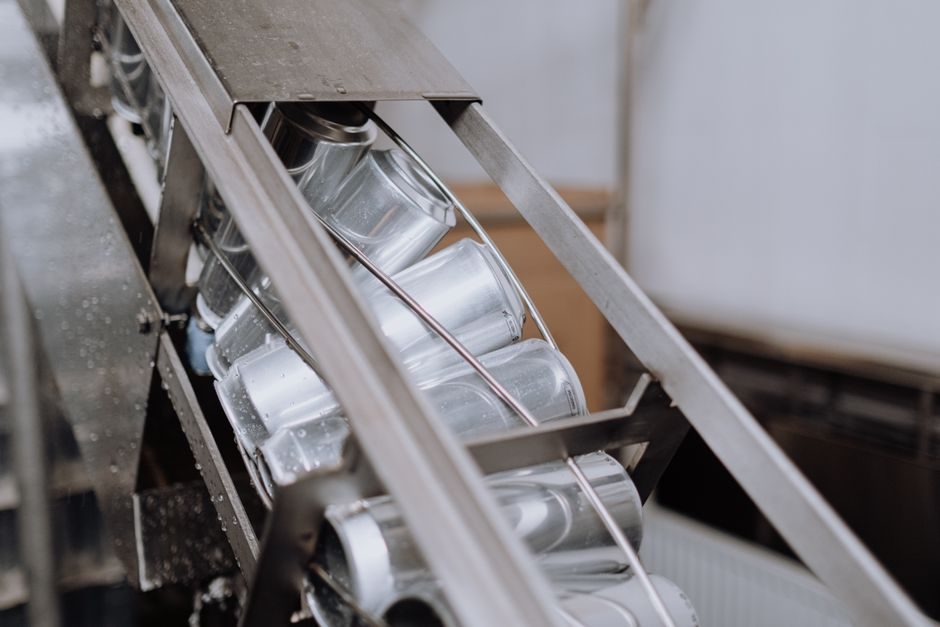
Mesh belt conveyors use a woven, spiral or balanced-weave metal wire surface, while belt conveyors run a continuous elastomer, PVC, PVG or PU belt over idlers and a drive pulley [S1][S2].
For 2026 sourcing runs in food dehydration, solar-cell firing, heat treatment, frying, and parts washing, Chinese factory listings continue to push mesh-belt build prices into a tighter band than for solid-surface belts of equal width [S3][S4].
Construction and Materials: Why the Two Belts Behave Differently
A standard flat belt is a textile carcass (polyester / EP / NN) with a top cover of PVC (T1–T4 grades), PVG, PU, or rubber, typically 4–10 mm thick and rated by tensile strength in N/mm (e.g. 630, 800, 1000, 1250, 1600, 2000 N/mm) per common DIN/GB factory convention [S1]. The closed, impermeable surface means the belt itself can be the product carrier without through-flow of air, water, or oil.
A mesh belt is a metal assembly — spiral coils with crimped cross-rods, balanced weave, flat wire, or chain-edge with wire mesh on the carry side — produced in stainless steel (AISI 304 / 304L / 316 / 316L), carbon steel, or galvanised wire [S2][S5]. Pitch (coil spacing) and wire diameter (commonly 0.8–3.0 mm for spirals, 1.0–5.0 mm for flat-wire) set the open area, which is typically 40–80 % depending on weave type. For a primer on the metal media itself see steel mesh; for the broader conveyor category see belt conveyor and mesh-belt conveyor.
Operating Limits: Temperature, Oil, Washdown and Atmosphere
Mesh belts survive sustained metal-on-metal contact temperatures from roughly -100 °C (cryogenic) to about 1100 °C (austenitic stainless in continuous furnace service), with short excursions higher in alloy builds [S5][S6]. The open area of 40–80 % is the engineering reason they are specified for drying, frying, quenching, pasteurising, annealing, brazing and sintering lines, where through-flow of hot air, oil, or water is part of the process [S3][S4].
Standard textile/rubber belts are typically limited to a cover temperature of about 60–80 °C for PVC, up to ~90–100 °C for PVG, and roughly 150–180 °C for heat-resistant rubber; beyond that the carcass delaminates and the cover cracks [S1]. They handle dust, granular, and packaged loads in ambient or mildly heated environments, and tolerate inclines up to about 18–22 ° with chevron or cleated profiles, whereas a spiral mesh belt can be specified for high-angle or Z-shape paths if the drive system supports it.
Load, Speed and Centre Distance
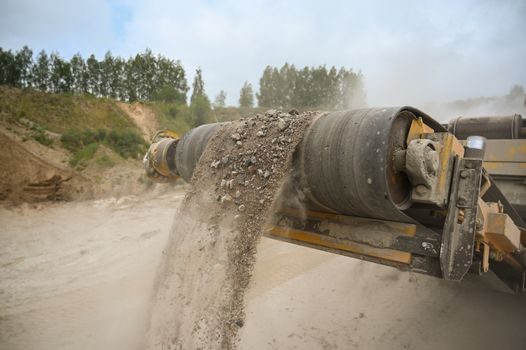
Flat belt conveyors dominate long-centre bulk handling: fabric-carcass belts at 1.0–3.5 m/s can stretch a single drive span to 100–500 m in overland bulk applications, with idler spacing of 0.4–1.5 m and troughing angles of 20°–45° [S1]. The low belt mass (typically 5–25 kg/m² for fabric belts) keeps drive power in the 1.5–11 kW range for most 500–1500 mm wide lines.
Mesh belts are heavier — a stainless 304 spiral at 10 mm pitch, 1.6 mm wire, 1000 mm wide weighs roughly 12–18 kg/m² before chain edge — so drive power and shaft load both climb [S2][S5]. Centre distances are normally shorter (commonly 2–25 m) because of belt weight, sprocket diameter limits, and tension behaviour, although chain-edge balanced-weave belts can run longer spans in furnace service [S6]. Drive speed is typically 0.1–1.0 m/s in heat treatment, 0.3–2.0 m/s in washing/frying, and up to 2.5 m/s in light packaging duty.
Selection Criteria: Mesh vs Belt in 4 Dimensions
Use the following comparison to shortlist the type, then drill into belt-tension, belt tensioner type, and tracking method. The four criteria that most often decide the line are duty temperature, open area requirement, total length of run, and per-metre capital cost. [S1]
On duty temperature: mesh stainless 304/316 belt covers ambient cryogenic to roughly 1100 °C [S5][S6]; standard PVC belt tops out near 60–80 °C cover temperature; PVG and PU raise the ceiling modestly. On open area: mesh belts deliver 40–80 % airflow/drainage, fabric belts are effectively 0 %. On length of run: flat fabric belts routinely span 100–500 m with a single drive; mesh belts stay inside ~2–25 m unless chain-edge balanced weave is used in furnace service. On per-metre capital (2026 China factory listings, 1000 mm width class): a PVC 800 N/mm belt lands near USD 15–40/m, an EP 1000 N/mm rubber belt near USD 30–70/m, a stainless 304 spiral mesh belt near USD 60–180/m, and a chain-edge balanced-weave 310S mesh belt for furnaces near USD 150–420/m [S3][S4][S6].
Where Each Type Earns Its Place
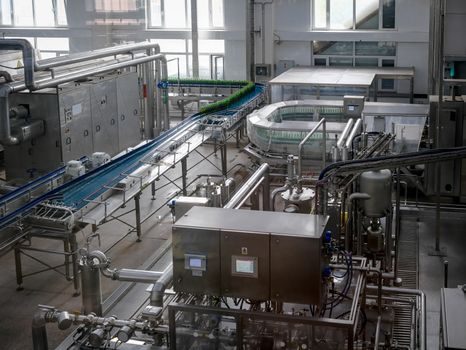
Specify a mesh-belt conveyor for: continuous heat-treatment furnaces (annealing, sintering, brazing, tempering) where the belt must survive 600–1100 °C; food drying, frying, and cooling lines where through-flow of hot air or oil is part of the recipe; parts washing and shot-blast return runs where drainage and chemical resistance matter; and solar cell firing where cleanliness and dimensional stability at temperature are non-negotiable [S3][S4].
Specify a flat-belt or troughed-belt conveyor for: long-centre bulk handling (coal, grain, ore, aggregate, fertiliser) over 50–500 m; general packaging and parcel handling at 0.5–2.5 m/s; incline conveying up to ~18–22° with cleats or chevron; and any application where belt edge tracking, low noise, and minimum product damage are required and heat is not present [S1]. For related cross-industry spec work, ribbed-belt drive selection is covered separately for the power-transmission side of the same drivetrain.
Failure Modes, Maintenance and Sourcing Reality
Flat-belt failure modes are cover wear, edge damage, splice peel, and idler-journal seizure; the telltales are mistracking, slip, and cover gouging. Mesh-belt failure modes are wire fatigue at crossover points, coil stretch under load, edge wire unravelling, and sprocket tooth wear; telltales are elongation beyond take-up travel, surface deformation at the drive sprocket, and uneven pitch. Chinese factory listings from 2026 (Shuke Metal, Hebei Risen, Ningjin Runfeng, Yangzhou Leneng) all publish lead times of roughly 10–25 working days for standard spiral and balanced-weave mesh belts and 5–15 days for fabric belts, with MOQ of one roll or one belt common for export packaging [S4][S5][S6][S1].
For 2026 sourcing, the practical signal to watch is stainless wire price (304/316 grade) versus polyester-cord carcass price: when the spread narrows under ~2×, a process engineer can usually justify a mesh-belt retrofit for any new line that requires through-flow or >150 °C service, because the lifecycle delta closes inside 18–24 months. Related spec-driven buying, including Storage Cage Buying Guide 2026: Mesh, Load, Finish and MOQ Levers, uses the same mesh-grade and MOQ logic that drives mesh-belt sourcing.