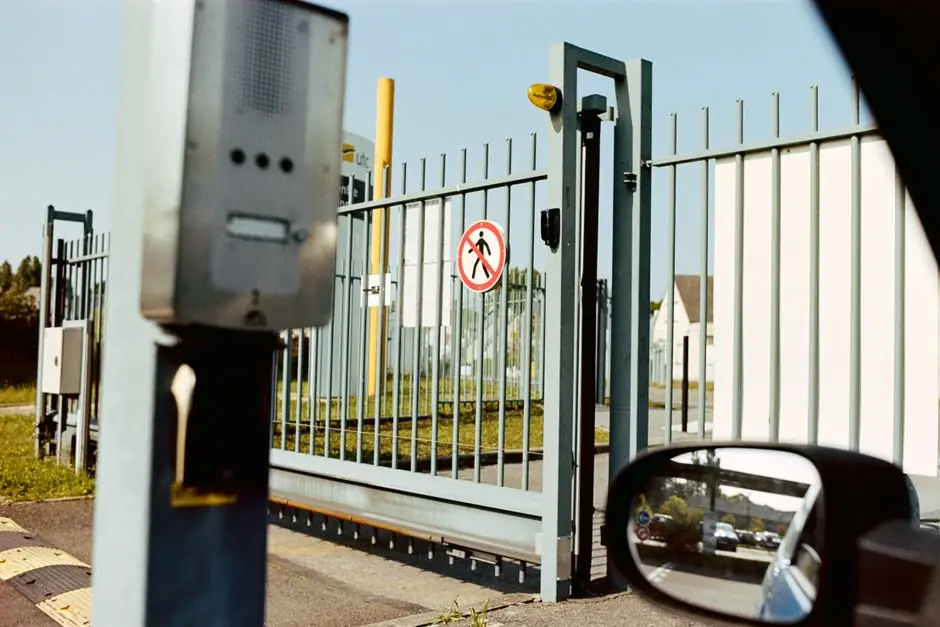
Fence-mounted vibration sensors detect climbing, cutting, and lifting directly on an existing fence, while buried seismic sensors detect movement before the boundary is crossed. The decisive differences are installation, visibility, environmental sensitivity, and the area each layer can protect.
Fence systems are generally the faster retrofit where a sound fence already exists; buried cable systems are stronger choices for concealed, open-boundary protection. Neither technology alone provides complete defense without alarms, video verification, access control, and a defined response procedure.
Detection Principle and Boundary Coverage
Fence-mounted sensors use accelerometers, piezoelectric elements, or microphonic cable to identify mechanical energy transferred through the fence. Systems such as FiberPatrol FP400 are designed to report climbing, cutting, or lifting, while FlexZone detects and locates attempts to cut, climb, or otherwise break through a fence [S2].
Buried sensors read ground vibration from footsteps, vehicle movement, digging, and attempts to cross the perimeter. Buried seismic sensors can locate movement as people and vehicles approach or cross the perimeter, providing early warning before an intruder reaches the protected area [S1][S6]. Distributed acoustic sensing can use a continuous buried fiber to distinguish footsteps, digging, vehicles, and tampering from microvibrations along the cable [S3].
The physical boundary differs. A fence sensor protects the fence line itself and may not detect an intruder approaching through open ground or crossing between protected zones. A buried system detects activity approaching or crossing the protected boundary, but its detection performance depends on burial depth, soil compaction, cable-to-fence distance, and local ground activity [S1][S3][S6].
Installation, Retrofit, and Operating Effort
Fence-mounted vibration sensors normally clip to or attach to existing fence fabric, mesh, or posts. Installation is non-trenching and can be completed quickly where a fence already exists, which reduces civil work and shortens commissioning time [S1][S3].
Buried seismic cable requires excavation, cable placement, backfill, and site restoration. Buried-sensor detection performance is affected by installation conditions, including burial quality and soil conditions [S1][S3]. An open site without a continuous physical fence therefore favors a buried detection layer if early warning is required.
Maintenance burden also differs. Fence sensors must be inspected after fence damage, fence tension changes, vegetation contact, or impact. Buried systems avoid visible hardware and direct exposure to wind and rain, but locating cable faults or replacing a damaged section requires excavation. Neither category removes the need for periodic functional testing and alarm-path verification.
Environmental Performance and False-Alarm Risk
Buried detectors have a structural environmental advantage because they are shielded from wind, rain, fog, and direct sunlight. The principal nuisance sources are nearby livestock, vehicles, agricultural equipment, digging, and surface activity, which must be handled through site-specific tuning and classification [S1][S3].
Fence-mounted sensors are exposed to mechanical noise generated by the fence and its surroundings. Loose fabric, broken ties, missing tension wire, worn fittings, wind, and vegetation can produce signals that complicate discrimination [S3]. A fence with poor condition also provides a weaker physical delay, so remediation of the barrier should precede sensor installation rather than being delegated to signal processing.
Buried sensors are not automatically immune to false alarms, and fence systems are not inherently unreliable. The practical comparison is whether the operator can control the dominant environmental noise source: soil and surface activity for buried systems, or fence condition and vegetation for fence-mounted systems [S1][S3].
Security Performance, Location, and Integration
Fence-mounted systems provide an event tied directly to a physical attack point. A cable-based system such as FlexZone locates attempts along the fence, and FiberPatrol FP1500 covers up to 5 km per processor in a cut-immune configuration while locating intrusions to within ±3 m [S2].
Buried systems can detect an approach before contact with the fence, providing earlier warning for response teams. Their value rises when the protected asset lies beyond the detection boundary because they can increase the delay between ingress and attack. A PIDS design should therefore link detection, location, camera assessment, alarm communication, and response force into one operating sequence [S4][S5].
Video is normally a verification layer rather than a replacement for the primary detector. A camera with an unobstructed view can confirm the alarm location, but vegetation, fog, darkness, glare, and limited field of view reduce video effectiveness [S1]. Integrations with CCTV, access control, and alarm platforms should be specified as part of the perimeter design, not added after installation [S4][S5].
Decision Matrix by Site Condition

For an existing chain-link, welded mesh, palisade, or comparable sound fence, fence-mounted vibration sensing is the practical first choice when rapid, non-trenching installation and a direct alarm at the attack point are priorities. Fence sensors can support climbing, cutting, and lifting detection, and cable or fiber systems can add location data [S2][S3].
For open ground, a concealed boundary, a perimeter without a reliable fence, or a site where early warning is more important than visible detection hardware, buried seismic cable is the stronger option. Its main penalties are excavation, burial-quality sensitivity, and the need to tune against surface disturbances [S1][S3][S6].
For critical infrastructure requiring a dual layer, fence-mounted sensing can be combined with video analytics or another complementary detection technology. The comparison remains location-dependent: buried sensors provide approach detection, fence sensors provide attack-point detection, and the most effective layered design assigns each layer a defined task rather than expecting identical performance from both [S4][S5].
Recommended Selection Procedure
Select fence-mounted vibration sensing when there is an existing serviceable fence, installation must avoid trenching, and the required alarm event is a climb, cut, lift, or fence breach. Inspect the fence first for tension, loose mesh, broken ties, damaged posts, and vegetation contact, because these conditions directly affect signal quality [S2][S3].
Select buried cable when the perimeter is open or highly sensitive, concealment is required, or detection must occur before contact with the boundary. Record the expected nuisance environment, including vehicles, livestock, excavation, and weather-driven ground changes, and validate the sensor performance with site-specific trials before accepting the installation [S1][S3][S6].
For either architecture, define measurable acceptance criteria: detection coverage, localization tolerance, response interface, alarm transmission, environmental nuisance handling, and maintenance access. Track field performance through recorded false-alarm events, missed-test events, sensor faults, and video-verification availability. A supervised test after fence impact, vegetation changes, ground disturbance, or cable work provides a practical signal that the installation remains aligned with the perimeter alarm response plan.