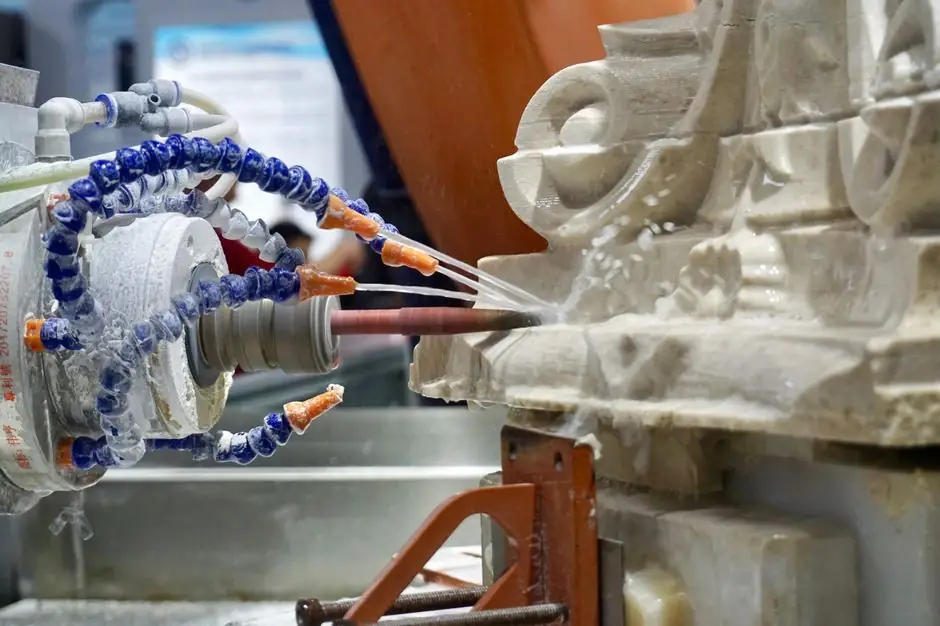
One manual fettling station costs $2,000–$15,000 [S3].
Manual deburring is best for production under 5,000 parts per year [S3].
Price gap and economic break-even
That example is useful as a boundary condition, not a universal return calculation, because cycle time, alloy, geometry, staffing, and required edge tolerance determine the actual result.
The purchase-price comparison should also include the operating envelope. Manual equipment consumes station space and an operator, while an enclosed robotic cell requires guarding, extraction, fixturing, programming, and production integration. Total ownership therefore includes labor, abrasive and spindle consumption, cell energy, extraction, maintenance, changeover, and scrap rather than acquisition cost alone.
Manual fettling grinder: appropriate scope
A manual fettling grinder is the lower-cost choice for prototypes, rework, long-tail part numbers, and production below roughly 5,000 parts per year [S3]. A pneumatic die grinder, belt sander, and suitable fixture can be installed for $2,000–$15,000 per station, with manual processing commonly delivering 5–15 parts per hour [S3].
Manual equipment is also easier to accommodate when castings exceed 100 kg or change frequently enough to prevent a stable robotic program and cell layout [S3]. Its disadvantages are equally concrete: operator-dependent results, repeatability described only as variable, and typical defect scrap of 2–5% [S3].
For a buyer comparing grinders, motor power and wheel diameter affect removal capacity, while the fettling grinder motor power and wheel diameter selection guide provides a separate engineering framework for that decision. Manual finishing remains defensible when rework freedom, low utilization, and simple access outweigh consistency benefits.
Robotic cell configuration and price drivers

Robotic deburring cells pair a 6-axis robot with force-controlled tooling, fixturing, dust management, and often vision or laser inspection. AMD specifies a typical edge tolerance of ±0.05 mm, improving to ±0.025 mm with ECM, with cycle times of approximately 30–180 seconds per part [S1].
One published commercial range lists 14 robotic fettling models across 4 series, covering iron, aluminium, steel, stainless steel, and pass-by conveyor applications [S2]. Maximum casting weight is 60, 150, 235, or 500 kg for the FDR-1 through FDR-4, 16, 60, 150, or 235 kg for the FMR-1 through FMR-4, and 500 kg for the FGR-3 [S2].
Cell price rises with several engineering variables: robot payload and reach, spindle power, number of tool stations, force sensing, fixturing, dust extraction, cooling, material handling, scanning, inspection, and MES data links. An automatic fettling cell therefore has a much wider cost envelope than a single machine purchase.
Handling and tooling architecture
A robotic fettling cell is tool-held when the robot carries a spindle or grinding head around a casting secured to a fixture or positioner [S4]. This architecture suits large castings because the robot does not have to support and rotate the workpiece, but the cell footprint expands with the working envelope and tool-access requirements.
Part-in-hand cells move small or medium castings against fixed tools, whereas tool-in-hand cells move the finishing tool around fixed workpieces [S5]. Published examples accommodate tool-in-hand parts up to 600 × 600 × 600 mm, part-in-hand envelopes from 500 × 400 × 200 mm to 500 × 700 × 200 mm, and custom machines for parts larger than 600 × 600 × 600 mm [S5].
The decision also turns on casting family. Robotic systems for aluminium die castings target flash at the die split and cores, heat-check fins, gate and runner remnants, and parting lines [S4]. For small discs and shafts, an alternating magazine can allow one side to be refilled while the robot works on the other; for large housings, clamping the casting and moving the tool is generally more practical [S4].
Throughput, tolerance, and operating limits
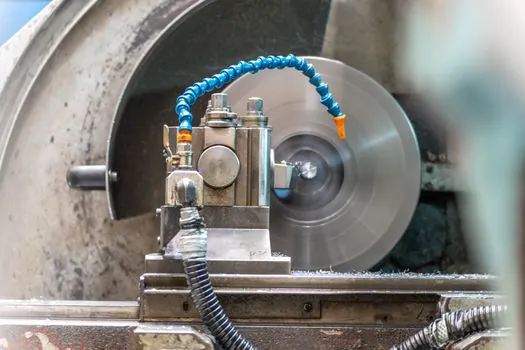
FTR pass-by lines have a typical cycle time of 20–60 seconds [S2]. This range contrasts with the broader robotic deburring estimate of 30–300+ parts per hour, illustrating how part mass, conveyor arrangement, geometry, and tool changes affect output [S3].
Consistency is the stronger argument above the break-even volume. Published robotic repeatability is ±0.1 mm, while force-controlled cells can provide typical edge tolerances of ±0.05 mm and ±0.025 mm with ECM [S1][S3]. The casting mold must still provide repeatable datums, accessible flash, and safe clamping, because robotic accuracy cannot compensate for an unstable or obstructed casting.
Robots are not suitable for every finishing task. One operator still performs load, clamp, part identification, and exception handling, while software changeover can take 5–60 minutes compared with immediate manual flexibility [S3]. Very large parts, one-off prototypes, frequent geometry changes, and low annual volume remain manual-work cases.
Process control, safety, and ownership cost
Automated cells can identify each part, scan incoming variation, finish along a stored path, inspect critical edges, sort pass, rework, or reject parts, and log serial number, force trace, spindle load, and cycle time [S1]. This traceability is more than a convenience feature: it connects abrasive wear, process drift, and rejected castings to specific production records.
Tool life affects operating cost because grinding wheels and deburring heads consume wear during every cycle. Force feedback and automatic wear compensation can reduce premature tool changes, while spindle current and contact time can trigger maintenance before quality drifts [S1][S5]. Buyers should price abrasive consumption, spindle service, extraction filters, fixturing wear, and software support as separate ownership lines.
Safety is another cost driver. A guarded robotic cell moves operators away from rotating tools, flying abrasive, and repetitive grinding work [S3]. Installation must still account for dust extraction, coolant or mist control, guarding, interlocks, and local site requirements. Additional information on fettling grinder booth airflow by dust load is relevant when comparing extraction operating loads.
Selection criteria for the lower-cost alternative

The economic selection rule is straightforward: use a manual fettling grinder when annual demand remains below about 5,000 parts, changeover is frequent, or workpieces exceed 100 kg; use a robotic cell when demand exceeds 10,000 parts per year or edge consistency has measurable production value [S3].
Between those boundaries, the decisive data are annual volume, loaded labor hours, cycle time, scrap rate, rework hours, cell footprint, and required tolerance. Manual stations offer a 5–15 part per hour baseline at $2,000–$15,000 each, whereas robotic cells provide 30–300+ parts per hour at $80,000–$250,000+ installed [S3].
A phased installation may reduce entry cost by automating the highest-volume part numbers first while retaining manual stations for the long tail. One published estimate puts phased implementation payback below 18 months at 10,000–50,000 parts per year and states that robotic-cell implementation costs have fallen roughly 30% since 2020 [S3]. The next trackable signals are measured cost per good casting, scrap percentage, changeover minutes, abrasive consumption, and operator hours per shift.