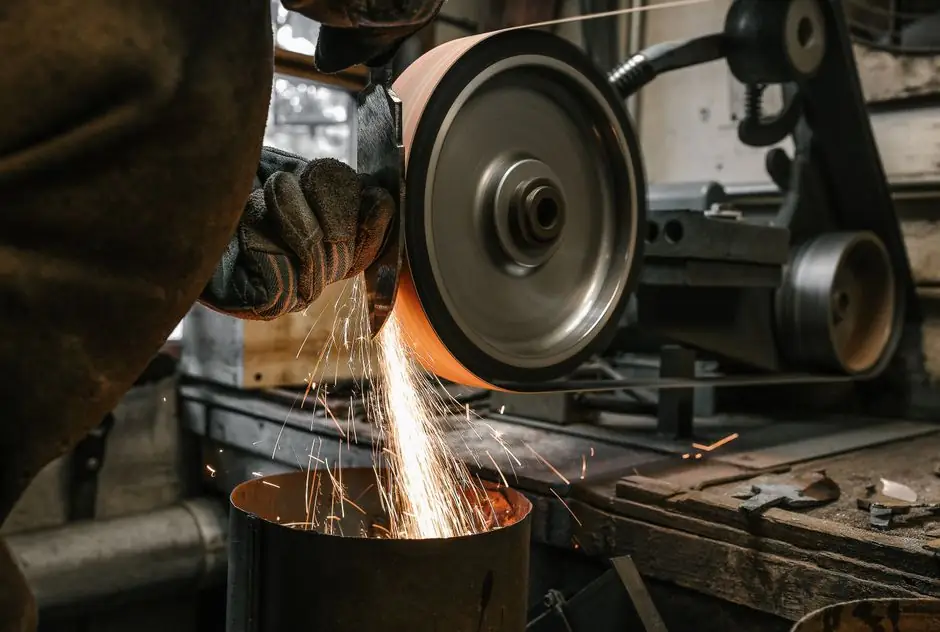
A grinding booth should combine local exhaust capture with general ventilation, with airflow selected from the grinder process, dust volume, contaminant type, and applicable exposure limits [S1][S2][S4].
The governing calculation is not a universal CFM figure: a surface-grinder installation may use a 500 CFM collector as a shop example, while industrial booth design must be verified against the actual hood and contaminant generation rate [S1][S2][S6].
Separate Capture Airflow From Room Ventilation
Local exhaust must capture the contaminant at its source, while dilution ventilation controls residual airborne particulate that escapes capture [S1][S4].
That result matters because oversized extraction can increase energy use and suspended dust rather than improve capture. A useful design record therefore separates three values: hood flow in cubic feet per minute, exhaust-system flow in CFM, and general-room supply in cubic feet per minute. For a broader view of the equipment involved, see fettling grinder.
Recirculation cannot substitute for suitable source capture or a compliant hazardous-dust evaluation.
Build the Airflow Demand from the Process
The first calculation needs the number of grinding stations, material processed, wheel or abrasive type, and expected dust volume [S2]. A production estimate should also include intermittent polishing, deburring, or cutting operations if they share the same booth. Grinding on castings, for example, is not the contaminant profile of grinding stainless steel or aluminum, even when both machines are described as fettling equipment.
These are design criteria for the cited system, not universal booth requirements. The applicable dust classification, workplace exposure limits, and combustible-dust assessment must determine whether the higher criterion applies.
The equipment layout then sets the remaining values: hood dimensions, distance from the hood to the contaminant source, duct velocity, elbow and fitting losses, filter pressure drop, and fan operating point. Fan power does not determine required airflow, but it must cover the calculated static pressure at the selected CFM.
Compare the Main Collection Architectures
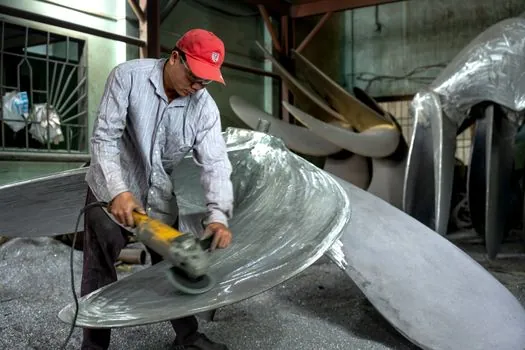
Capture hoods offer the shortest contaminant path, but they depend on correct hood geometry, source distance, and unobstructed airflow. Enclosed booths are better suited to broad-area capture and can incorporate filtered return air, while large room systems require containment and housekeeping discipline. Recirculating booths lower exhaust losses but place more importance on filter integrity, room balance, and monitoring [S4][S5].
The main decision criteria are capture effectiveness, worker exposure control, combustible-dust protection, operating cost, and maintainability. A hood can rank well on capture and footprint but perform poorly when access prevents close positioning. A booth can rank well on containment and filtration but carry higher fan and filter costs. A room exhaust system can provide broad coverage with simpler local geometry, but it usually demands more airflow to control the same contaminant [S1][S4].
Combustible material changes the comparison because a thin dust layer can present a combustion hazard, and grinding can generate hot particles [S4][S5]. Ventilation Solutions states that its metal grinding booths and industrial dust collection systems can be designed to address virtually any combustible-dust specifications or requirements and that its booths use double-wall construction [S4]. Those specifications require direct project verification, not inference from the generic term dust collector.
Size the Collector from Measured Process Data
A collector rated at 500 CFM with single-phase operation was identified as suitable for a 6 by 18 inch surface grinder in a small-shop application [S6]. This is a concrete equipment example, not a design rule for every fettling booth. A production booth with multiple grinding stations, wider workpieces, heavier stock removal, or a combustible metal dust cannot be sized from that single-machine precedent.
Industrial dust-collector selection depends on metal type, station count, dust volume, and airflow requirement [S2]. These examples show why shop scale and process intensity must remain separate from industrial equipment sizing.
For the collector, confirm filter media compatibility with the actual dust, inlet loading, hopper geometry, clean-out method, fan curve, motor rating, and final exhaust arrangement. The air-moving system should be verified at the collector inlet because filters, screens, cleanout doors, and ductwork can change system resistance after installation.
Validate Capture and Exposure after Installation
Commissioning should verify measured hood and branch airflow, fan speed or power, fan operating point, negative pressure or room balance, and filter differential pressure. The NIOSH ventilation criteria were formulated through particle-transport analysis and verified by measurements of ventilation-system performance [S1]. That makes field measurement the decisive check on a calculated installation.
Exposure monitoring should address the airborne particulate produced by the process rather than only airflow at the fan. Relevant checks include personal and area sampling, visible-air observations, dust accumulation at openings, and confirmation that filter loading or fan failure does not allow contaminant escape. For recirculating systems, monitor the condition of the filter bank and the balance between filtered return air and makeup air [S4].
Failure modes include an undersized fan, excessive duct losses, a loose filter door, plugged inlet screens, worn filter media, poor hood placement, and cross-drafts that disturb the capture path. A dust collection system and general ventilation must operate as a coordinated system; adding room air alone does not correct an ineffective hood [S4].
Match the Safeguards to the Dust Classification
The combustible-dust evaluation must be completed before selecting filters, motors, electrical equipment, or structural venting. Ventilation Solutions lists NFPA-compliant woodworking and particulate-dust collection systems, while also offering explosion-proof equipment for specified Class I locations [S4]. These are different design scopes, and a general statement that a system is dust rated is not enough for procurement.
Record the dust class, material, process, filter media, system airflow, motor and fan data, electrical classification, and inspection interval in the submittal. A 500 CFM shop collector [S6], an 80 ft/minute non-hazardous criterion [S3], and an industrial multi-station collector [S2] should never be treated as interchangeable specifications without matching the actual process.
Next, verify three trackable commissioning values: measured airflow at the hood, fan operating cfm, and measured airborne particulate exposure under production grinding. If those values match the design basis and the booth remains controlled during maintenance and filter loading, the airflow requirement has been demonstrated rather than merely calculated.