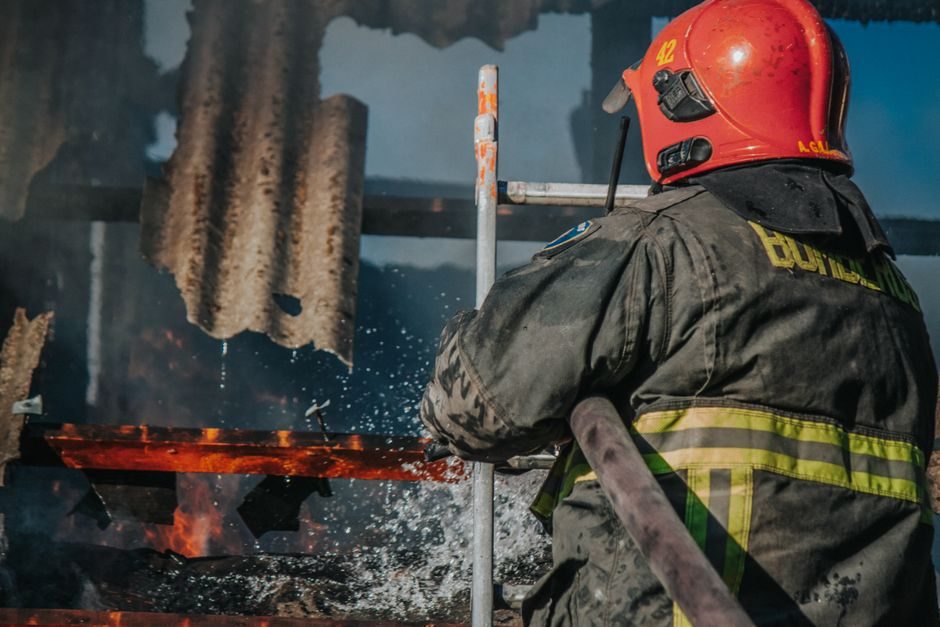
A portable fire extinguisher is a manually operated device for extinguishing small fires, with a maximum mass of 23 kg and a fire-extinguishing capability at least equivalent to that of a 9 L fluid extinguisher [S2]. The same source confirms a cylindrical pressure-vessel geometry: 1-8 kg dry-powder bodies and 1, 2, 3, 5, and 7 kg CO2 bodies are the standard fill weights used in service equipment sizing [S2].
Specifying an extinguisher is a chemistry-versus-fuel decision, not a generic "buy one for the office" choice. The four industrial workhorses — water/foam, dry powder, CO2, and clean-agent — each defeat fire through a different physical mechanism, and each one comes with a class rating, a use-case sweet spot, and a hard failure mode that gets people killed when it is misapplied [S1][S2].
Extinguisher Classes, Fuels, and Operating Envelope
Class A extinguishers target ordinary combustibles (wood, paper, cloth, rubber) and rely on the cooling-and-soaking action of water or foam; Class B handles flammable liquids and gases where a film or powder must interrupt the vapor phase; Class C denotes an electrically non-conductive agent suitable for live equipment; Class D covers combustible metals such as magnesium, sodium, and lithium alloys; Class K is the wet-chemistry kitchen-oil rating [S2]. A dry-powder unit is the most flexible single agent because it scores on Class A, B, and C simultaneously, which is why you see ABC-rated 1-8 kg dry-powder cylinders on almost every industrial wall bracket [S2].
Selection starts with the fuel and ends with the environment. A typical 4 kg ABC dry-powcher extinguisher discharges in roughly 9-14 seconds; a 5 kg CO2 unit runs out in 9-12 seconds with a discharge horn that can reach -78 °C at the nozzle and cause cold burns if gripped [S2]. That is the trade-off: CO2 leaves zero residue and spares electronics, but it offers no post-discharge cooling and provides no knock-down of deep-seated Class A embers.
Advantages Across the Four Common Chemistries
Water and foam units are the cheapest extinguisher per kilogram of agent delivered, are refillable from any municipal supply, and provide the only meaningful cooling of a deep Class A fire seat; on the downside, water conducts electricity, freezes below 0 °C unless a glycol additive is loaded, and produces contaminated runoff that will enter floor drains [S2]. Dry-powder ABC units interrupt the chain reaction in the flame zone, work on three classes at once, tolerate a -20 °C to +60 °C storage window with the right propellant, and weigh 1-8 kg in the standard portable range, so one technician can carry two [S2]. CO2 units are clean, leave no residue, and are the only practical choice for a server room, a switchgear cell, or a paint-shop robot; they are also inert and displace oxygen, which is both the suppression mechanism and the personnel hazard in a confined space [S2].
Clean-agent extinguishers — typically fluoroketone or HFC-based — add a fourth option for occupied spaces where CO2 concentration would be unsafe, but the agents have a Global Warming Potential that is now driving restrictions in several jurisdictions and is the single biggest reason dry-powder ABC remains the industrial default [S2]. The selection logic collapses to three questions: what fuel, what residual can be tolerated, and what is the minimum operator-training level in the building.
Disadvantages, Failure Modes, and Misuse Costs
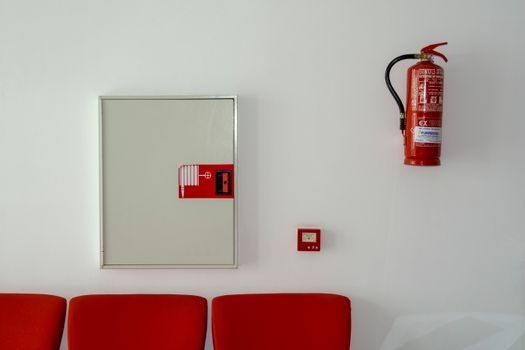
The first hard limitation is operator reach. A portable extinguisher is rated for incipient-stage fires only; once a room flashes over, the 9-14 second discharge of a 4 kg unit cannot overcome the thermal momentum of a fully developed fire, and the operator must evacuate rather than fight [S2]. The second limitation is recharge discipline. A dry-powder cylinder that sits on a wall bracket for 5 years without a pressure-gauge check, a shake to settle the agent, and a hydrostatic re-test on a 12-year cycle is a painted paperweight; the gauge needle, the safety pin, and the tamper seal are the only on-site indicators of readiness [S3].
The third cost is misapplication. A water extinguisher on a live 480 V panel can kill the operator; a CO2 extinguisher on a deep pan of cooking oil in a commercial kitchen will blast the oil out of the pan and create a flaming aerosol; a dry-powder extinguisher in a data center will save the hardware but contaminate every PCB with a corrosive sodium / monoammonium phosphate dust that is harder to remediate than the original fire. A 23 kg wheeled dry-powder unit overcomes the 9-second runtime problem on Class B spills, but it requires a 1.5 m clearance to maneuver and a trained two-person team, which most offices do not have [S2].
Comparison Matrix: Water vs Dry Powder vs CO2 vs Clean Agent
Set against four decision criteria — multi-class rating, residue, electrical safety, and refill cost — the four chemistries separate cleanly. Water scores low on multi-class (A only), zero on electrical safety, low on residue damage, and lowest on refill cost. Dry powder ABC scores high on multi-class (A, B, C), high on residue damage to electronics, high on electrical safety when the agent is non-conductive, and medium on refill cost. CO2 scores low on multi-class (B, C only — useless on deep Class A), zero on residue, high on electrical safety, and high on refill cost because the cylinder is a pressure vessel requiring hydrostatic re-test every 10 years. Clean agent scores high on multi-class (A, B, C), zero on residue, high on electrical safety, and highest on refill cost, with the additional regulatory exposure tied to agent GWP [S2]. For a typical industrial plant, the practical answer is dry-powder ABC on the wall at 1-8 kg fill weight, CO2 wheeled or hand-held at 2-7 kg fill weight next to every electrical panel, and a Class K wet-chemical unit in any food-service area [S2].
Maintenance, Inspection, and Compliance Anchors
Annual, semiannual, and monthly service intervals are the three cadence points used by US fire-protection service companies to keep portable equipment code-compliant, with state-licensed technicians performing the inspection, recharge, and repair [S3]. The same service model covers fire-suppression systems for restaurants and industrial hoods, exit and emergency lighting under OSHA rules, and the hydrostatic re-test cycle on stored-pressure cylinders, which is the one maintenance line item that gets skipped most often and turns a wall-mounted unit into a liability [S3].
Compliance is not a single rule but a stack: NFPA 10 governs selection, distribution, and inspection; OSHA 29 CFR 1910.157 covers workplace placement and training; the hydrostatic re-test on CO2 and dry-powder cylinders follows the intervals defined in the relevant DOT/transport-pressure-vessel codes. A facility that wants to stay off the audit list pairs its extinguisher inventory with the broader passive-protection stack — fire doors and fire-rated doors on egress paths, fire hydrant coverage for the fire-department connection, and a gas fire suppression system in the server room — rather than treating the extinguisher as a standalone purchase. Related reading on industrial equipment trade-offs: Tank Cleaning Machines: Operating Envelope, Advantages, and Selection Limits and Rock Wool Advantages and Disadvantages: Spec, Use-Case, and Selection Map follow the same chemistry-versus-application logic this article applies to extinguishers.
Selection Rule of Thumb for a Spec-Writer
Specify by fuel, not by brand. Step 1: list every ignition fuel in the protected area. Step 2: match each fuel to its extinguisher class (A, B, C, D, K). Step 3: enforce a maximum walking distance of 15-23 m from any point to the nearest unit, per the model code in force. Step 4: anchor the fill weight to the 1-8 kg portable range, with a 23 kg wheeled unit wheeled in for any Class B spill larger than 1 m² [S2]. Step 5: pair every electrical risk with a CO2 or clean-agent unit; pair every commercial kitchen with a Class K wet-chemical unit; pair every combustible-metal workstation with a Class D unit specific to the metal on the bench. Step 6: log the inspection cadence — annual visual, semiannual maintenance, 12-year hydrostatic — on the same schedule as the electrical fire monitor and the wider suppression system [S3].
Until then, the 23 kg / 9 L equivalent portable envelope and the 1-8 kg dry-powder / 1-7 kg CO2 fill-weight convention remain the hard numeric anchors for any new purchase order [S2].