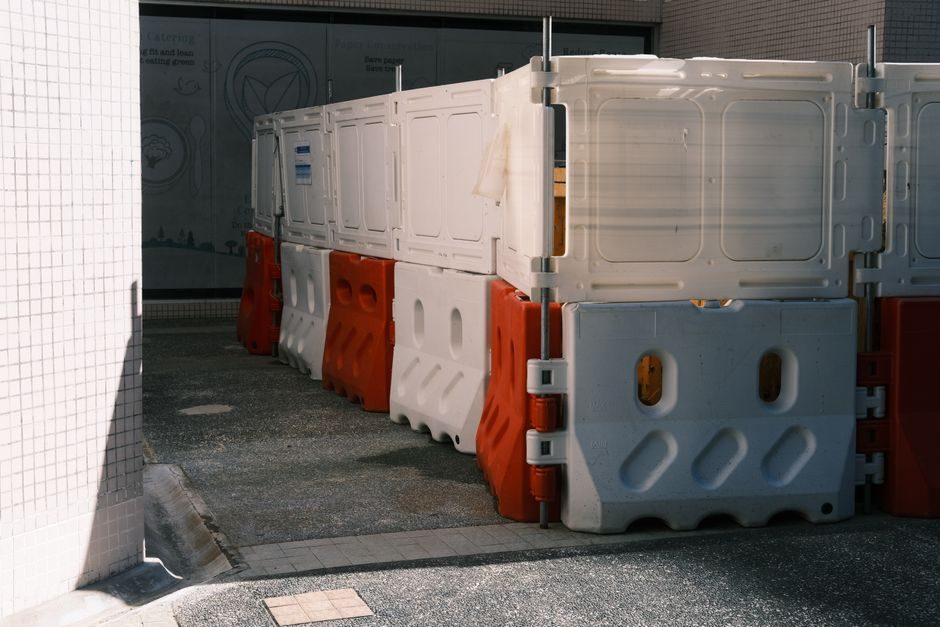
Safety fence installation on industrial and commercial sites follows a fixed sequence — layout survey, post-hole drilling, concrete footing pour, panel hang, and gate commissioning — with post embedment depth typically set at 600-900 mm for 1.8-2.4 m perimeter safety fence heights, depending on soil class and wind exposure [S1].
Three US installer reference points frame the work: RamCor Fence covers fence-condition assessment and repair planning for residential, farm, and light-commercial property [S1]; Savannah Gate and Fence scopes automatic gates, keypads, and access-control integration alongside fence runs [S2]; Brennan's Fence Installations reports 45 years of work in North Carolina clay soils across Johnston and Wake Counties [S3]. Engineering standard BS 7669-3:1994 — "Vehicle restraint systems — Guide to the installation, inspection and repair of safety fences" — remains the cited reference for vehicle-barrier installations [S4].
Pre-Install Site Survey and Post Embedment Depth
Pre-install surveys must record ground slope, soil class, existing services, and finish grade before any hole is drilled, because post depth is the single variable that drives long-term plumb retention [S1][S2]. For perimeter safety fence runs on cohesive clay or loam, post holes are commonly 600-900 mm deep with a 250-300 mm diameter bell; granular or fill soils push depth toward the upper end or require a concrete collar [S1].
Acceptance test: a plumb bob on two adjacent faces of every post should read ≤5 mm deviation from vertical over the 1.8-2.4 m exposed height, and a hand-pull test on the post head should show no detectable movement before the concrete has cured. When a safety barrier is replacing an aged timber line, the survey must also flag residual post stubs, root balls, and buried utilities before drilling — failures here are the most common source of post drift in year one [S1][S3].
Concrete Footing Mix, Cure Time, and Loading
Post footings for industrial safety barrier lines are typically poured with a 20-25 MPa ready-mix using a 50-75 mm slump, and the post must be braced within 15 minutes of pour to hold plumb during the 24-48 h initial cure [S1][S2]. Full design strength is reached at 28 days, but light panel hang can proceed after 24 h if the bracket is not torque-loaded.
For a 1.8 m fence with 100 km/h design wind, the concrete collar is commonly 250 mm diameter × 900 mm deep; the same post in a high-traffic vehicle zone should be upgraded to a 300 mm × 1 000 mm footing to satisfy BS 7669-3 vehicle-restraint load assumptions [S4]. Acceptance: concrete must show no surface cracking at the post-base interface at 7-day inspection, and the gap between post and soil should be backfilled with compacted native material, not loose fill. Field crews should reject the pour if ambient temperature drops below 5 °C during the first 24 h cure window unless a cold-weather accelerator is dosed to supplier specification [S2].
Panel, Rail, and Fastener Torque Specification

Panel-to-post connection torque is the most under-specified number in residential fence contracts — a 30-40 N·m range on M8 or M10 stainless or zinc-plated bolts is the practical working value for steel post brackets, and under-torqued fasteners account for the majority of "loose panel" callbacks within 12 months [S1][S2].
Material-by-material comparison: wood privacy panels (pine, cedar, pressure-treated) take a #8 × 40 mm exterior screw at 2.5-3.0 N·m driver setting; vinyl/PVC panels need supplier-specific brackets with torque typically ≤25 N·m to avoid cracking the rail; aluminum ornamental panels use 1/4-20 stainless hardware at 18-22 N·m; chain-link fabric tension is set to a 30-40 kg pull on the tension bar, not a torque. Safety gloves rated EN 388 cut level 3 or higher are appropriate for handling tensioned wire and cut metal mesh. Acceptance: a rail-height check across the run should not exceed ±10 mm from specified height, and a sight-line check should show no daylight gap greater than 25 mm between panel and post on privacy applications.
Gate, Hardware, and Access-Control Integration
Gate posts carry 1.5-2× the load of line posts because they absorb the dynamic swing force of the leaf and any operator reaction load, so a 100 mm square gate post on a 2.4 m swing gate is a common minimum, set in a 400 mm × 1 200 mm concrete footing [S2]. Savannah Gate and Fence specifies that driveway and automatic gate work must be planned in the same scope as the fence run — gate, grade, hardware, and finish reviewed together before the quote is issued [S2].
Comparison of three common gate types against four decision criteria: (1) swing gates up to 4 m on residential or light-commercial sites are the lowest cost and simplest to install but need 90-180° of clear arc; (2) sliding (cantilever or roller) gates suit narrow frontages or sites with grade change, at 1.5-2× the hardware cost; (3) automatic operator retrofits add 24 V DC or 120 V AC power, a low-voltage control loop, and an entrapment sensor per UL 325 / equivalent, which is the most-skipped spec in residential bids. Acceptance test: a manual swing gate should self-close from any open position between 15° and 90° within 5-7 seconds, and an automatic gate should reverse within 2 seconds on sensing a 40 mm rod obstruction at the closing edge.
Repair, Inspection Cycle, and When to Replace Rather Than Fix
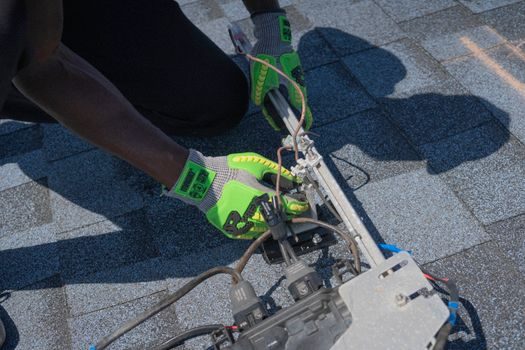
Inspection cycles on safety barrier lines follow a 6-month walk-around for commercial sites and 12-month for residential, checking post plumb, fastener torque, panel integrity, and gate operation — the same checklist used for new-install handover [S1][S3]. Common failure modes: leaning post (root cause: undersized footing or backfill not compacted), loose panel (root cause: fastener under-torque or stripped wood), gate sag (root cause: gate-post footing undersized for leaf weight).
Replace rather than repair when more than 25% of posts in a run show plumb deviation >15 mm/m, when a vehicle impact has bent the rail or post (BS 7669-3 calls for full-section replacement on deformed vehicle-restraint members) [S4], or when chain-link fabric shows >30% surface rust through. Safety glasses rated to EN 166 or ANSI Z87.1 are appropriate for cutting wire and drilling metal posts. Escalation criteria: any post that has moved more than 25 mm at the ground line since the last inspection, or any gate that fails the 40 mm obstruction reverse test twice in a 30-day window, should be taken out of service until repaired. Brennan's Fence Installations notes that the same North Carolina clay soils that cause post heave in winter also cause summer shrinkage, so seasonal inspection beats a fixed annual one for that region [S3].
Trackable next nodes for buyers and specifiers: (1) request a written post-depth and footing-diameter table from any contractor before signing, with values keyed to local soil class; (2) require the panel-fastener torque value to be printed on the as-built handover, not just "fastened per spec"; (3) for any site with vehicle traffic, confirm the contractor is working to BS 7669-3:1994 [S4] or a current local equivalent rather than a generic "code-compliant" statement.
For related coverage, see Vision Controller Buying Guide: Specs, Variants, and Selection Logic.