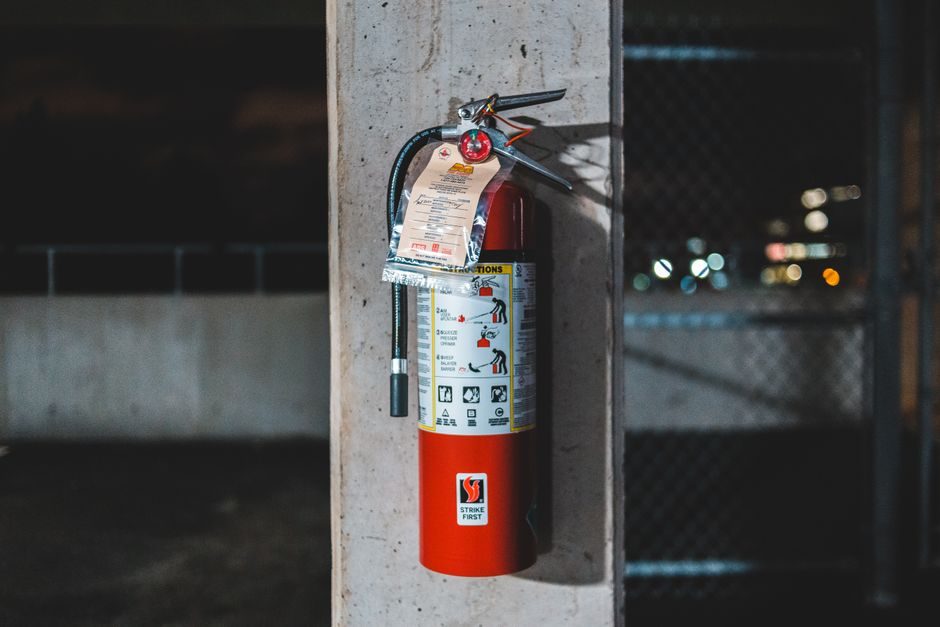
Fire extinguishers are first separated by the fire class they are designed to suppress — Class A (ordinary combustibles like wood, cloth, paper, and some plastics), Class B (flammable liquids such as gasoline, oil, alcohol, and grease), Class C (energized electrical equipment), Class D (combustible metals such as sodium, potassium, and magnesium), and Class K (cooking oils and fats in commercial kitchens) [S7].
UL ratings printed on the nameplate quantify capacity: a 1-A:10-B:C home unit, for example, carries one Class A equivalent and is rated to cover 10 square feet of Class B liquid fire, while commercial offerings climb through 2-A:10-B:C, 3-A:40-B:C, 4-A:60-B:C, 4-A:80-B:C, and 10-A:120-B:C as the agent charge rises from 2.5 lb to 20 lb and beyond [S3][S2].
Class A, B, C, D, K: What Each Rating Actually Covers
Class A fires involve ordinary solid combustibles — paper, wood, cloth, and some plastics — and are best attacked by water or by dry chemical agents that both coat and cool the fuel [S7]. Class B covers flammable liquids (gasoline, oil, alcohol, ether, grease) and is smothered rather than doused; water is a poor choice because it can spread the burning liquid [S7].
Class C designates fires in energized electrical equipment, where the extinguishing agent must be non-conductive so the operator is not exposed to shock hazard; CO2, dry chemical, and Halotron are the standard picks, while water is explicitly contraindicated [S7]. Class D covers flammable metallic substances such as sodium and potassium, requiring specialized dry powder agents that smother the metal without reacting violently with it [S7]. The OSHA/NFPA-aligned classification rounds out with Class K for commercial kitchen cooking-media fires, a category carved out because deep-fat fryers defeat ordinary Class B agents [S1].
Extinguishing Agent Types and Their Operating Limits
ABC dry chemical extinguishers use monoammonium phosphate as the suppressant and are nitrogen-propelled at roughly 195 psi stored pressure, with the powder working mainly by smothering the fire and interrupting the chemical chain reaction rather than by significant cooling [S1]. CO2 units are filled to about 2,000 psi with no gauge, work as BC-rated clean agents for laboratories and electrical hazards, and leave no residue [S1].
Halon and Halotron serve electronic and aviation applications where residue is unacceptable, with Halotron BrX positioned specifically for the aviation segment [S3]. Purple K (potassium bicarbonate) is the higher-performance dry chemical option for higher-hazard Class B and C risks, while Novec 1230 and Z-series high-performance wheeled units cover data-room and industrial fixed-system-adjacent needs [S3]. For Class D metal fires, dedicated dry powders are matched to the specific metal family (sodium, magnesium, lithium, etc.) and must never be substituted with ABC powder, which can react violently with burning metal. The reference architecture for portable extinguishers and their mounting hardware is covered in the fire extinguisher encyclopedia entry.
Reading the UL Rating: A and B Numbers Are Not the Same Units
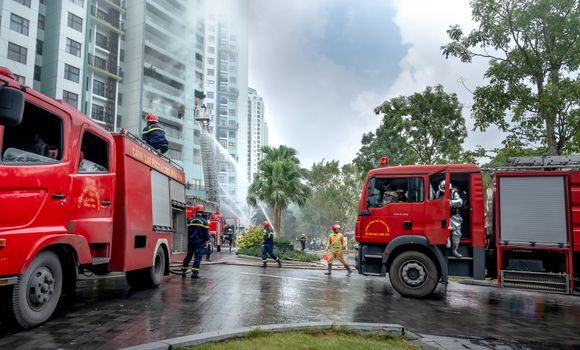
The A-prefix on a UL rating is a relative equivalency: each "A" unit corresponds to the extinguishing capability of 1.25 gallons of water against a Class A wood crib, so a 2-A rated extinguisher is roughly equivalent to 2.5 gallons of water for ordinary combustibles [S3]. The B-prefix, by contrast, is an absolute area: a 10-B rating means the extinguisher has been fire-tested to suppress approximately 10 square feet of a heptane pan fire, so a 40-B unit covers roughly 40 sq ft of flammable-liquid fire [S3].
The C suffix carries no numeric capacity — it only certifies that the agent is non-conductive and safe to use on energized electrical equipment, so a 1-A:10-B:C home unit and a 10-A:120-B:C industrial wheeled unit are both electrically safe but differ by a factor of ten in liquid-fuel coverage [S3]. Published catalog ratings at retail (e.g., First Alert's UL Rated 1-A:10-B:C home extinguisher) typically pair an A rating of 1 or 2 with a B rating between 5 and 10, while commercial catalogs span the full ladder from 1-B:C up to 120-B:C and from 2-A through 10-A [S2][S3].
Choosing the Right Extinguisher by Application
For a residence, an ABC dry chemical unit in the 2.5 lb to 5 lb size range with a 1-A:10-B:C or 2-A:10-B:C rating is the most common specification, paired with a kitchen-specific Class K or wet-chemical extinguisher for cooking-oil events [S2]. Vehicle and garage applications move up to 3 lb to 5 lb ABC units rated 1-A:10-B:C, while offices typically carry 5 lb to 10 lb 2-A:10-B:C or 3-A:40-B:C units matched to floor-area coverage rules [S3].
Commercial kitchens require Class K wet-chemical agents designed to supplement fixed kitchen suppression systems, not ABC dry chemical, which is the most common specification error in retrofit projects [S1]. Data rooms, server closets, and telecom facilities call for clean agents — CO2, Halotron, or Novec 1230 — because the residue from monoammonium phosphate will corrode electronics; clean agents also avoid the post-discharge cleanup that halts operations. Construction sites, marine vessels, and aircraft each have dedicated listings in the catalog taxonomy (Marine B-I and B-II, aviation Halotron BrX, construction site units), and these carry USCG, FAA, or job-site-specific listings on top of the UL rating [S3]. For broader selection logic and cabinet mounting, see the fire-rated door encyclopedia entry and the fire hydrant encyclopedia entry for fixed-system boundary comparisons.
Inspection, Recharge, and Service Intervals
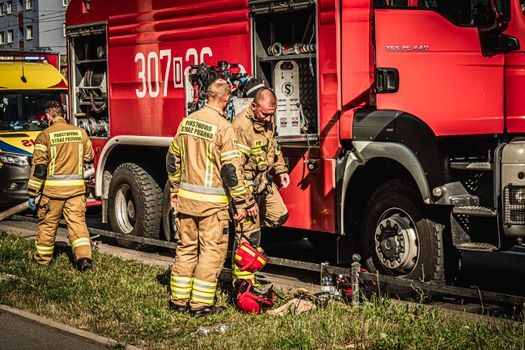
Portable extinguishers require monthly visual checks (pressure gauge in the green band, intact pin and tamper seal, no visible damage or corrosion) and annual maintenance by a licensed fire-extinguisher service company, with hydrostatic testing of the cylinder on a schedule set by the standard under which it was manufactured [S4]. A licensed State Fire Marshal contractor is the legal authority in most U.S. jurisdictions for the annual service tag and any 6-year internal examination or 12-year hydrostatic retest that the unit's stamped manufacture date triggers [S8].
Recharge intervals are not arbitrary: even without discharge, dry chemical agents compact and can fail to flow, and CO2 units slowly lose pressure through seal permeation, so an extinguisher that sits unused for a decade is typically not serviceable without a full recharge and valve rebuild [S5]. Service providers operating under a separate brand from their parent security or safety company is a common structural pattern in the U.S. market, allowing a focused fire-protection division to handle commercial inspection, recharge, and 6-year / 12-year overhauls under dedicated State Fire Marshal licensing [S6]. A practical procurement comparison from a different spec domain is laid out in the laser screed types and classifications reference, which uses the same equipment-class taxonomy approach for heavy equipment selection.
Limitations, Misuse, and Cross-Class Hazards
Using water on a Class B flammable-liquid fire is the single most common misapplication: the water can flash to steam, throw the burning liquid outward, and spread the fire across the room, which is why Class B calls for smothering agents such as CO2, dry chemical, or foam [S7]. On Class C energized electrical fires, water is again contraindicated because of shock hazard, and only non-conductive agents (CO2, dry chemical, Halotron, Novec 1230) are listed as safe by UL [S7].
ABC dry chemical is not a universal answer: it is explicitly not rated for deep-fat fryers (Class K) — where wet-chemical agents are required to prevent re-flash — and is not rated for combustible metals (Class D), where applying monoammonium phosphate to burning magnesium or sodium can intensify the reaction [S1]. Carbon dioxide extinguishers are listed as primarily for laboratories, not for homes or general businesses, because of the asphyxiation risk in enclosed spaces and the lack of cooling effect on deep-seated Class A fuel [S1]. Halon, while an extremely effective clean agent for electronics and aviation, has been phased down under the Montreal Protocol on Substances that Deplete the Ozone Layer for general-purpose use, and Halotron or Novec 1230 are the modern replacements in most new specifications. For the broader fixed-system side of the picture — clean-agent flooding for data rooms and gas suppression for industrial enclosures — the gas fire suppression encyclopedia entry covers the engineered alternatives.
Specifying a Class K wet-chemical extinguisher sized only for a residential kitchen hood is a common false economy in small commercial operations: NFPA 10 requires Class K coverage to match the cooking-media hazard, and a 6-liter commercial wet-chemical unit is the minimum typically applied to a two- or four-burner range. Selection should always cross-check the UL rating, the agent compatibility, the mounting hardware (USCG brackets for marine, vehicle brackets for fleet, recessed cabinets for finished commercial interiors), and the jurisdiction's adopted fire code edition before purchase.