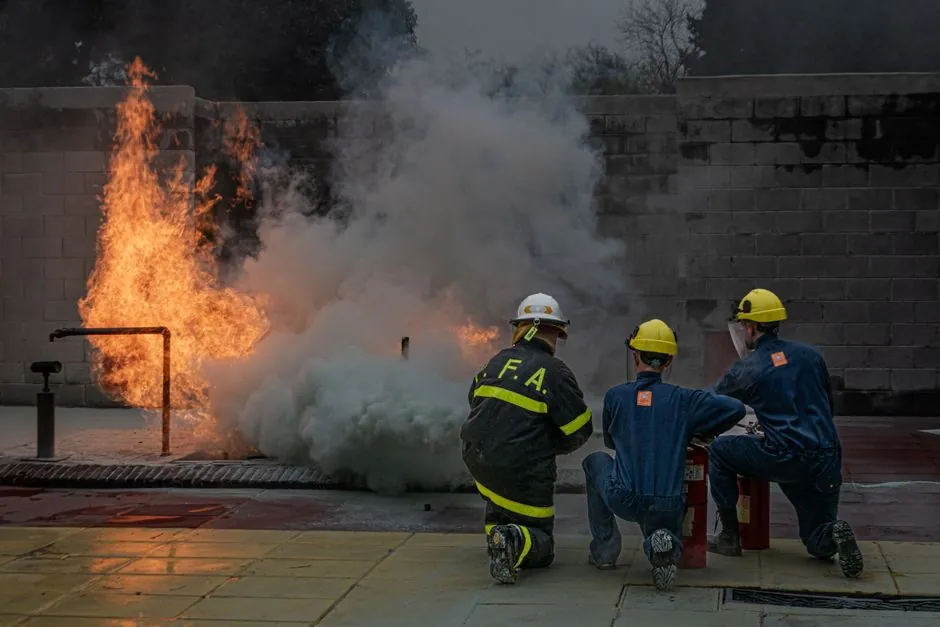
A cabinet encloses an extinguisher behind a door, while a rack holds multiple extinguishers on an open freestanding frame [S2].
The decision depends on hazard exposure, unit capacity, access time, wall construction, and local fire-code requirements, not merely on the price of the mounting hardware [S2][S3][S4].
Bracket versus cabinet: the operating difference
A wall bracket is the simplest storage method: it secures one extinguisher directly to a wall and leaves the cylinder fully visible from all angles [S2]. It therefore supports rapid access and straightforward monthly inspection, but it provides no enclosure against impact, weather, theft, or tampering [S2][S7].
A cabinet encloses the extinguisher behind a door and is better suited to public areas, industrial environments, and locations where the cylinder needs physical protection [S2][S7]. It can use glass or a solid door and may incorporate a lock, but the door introduces one operating action before access [S2].
The comparison is straightforward: brackets optimize visibility, cost, and immediate access; cabinets optimize protection, appearance, and security. Both can comply when mounted correctly, so neither method is inherently noncompliant [S2].
Compare cost, protection, access, and capacity
The bracket is the economic choice for one unit, while the cabinet carries a higher material cost in exchange for enclosure and optional tamper deterrence [S2].
A rack can hold multiple extinguishers in one location [S2]. For a single point of coverage, a bracket offers the lowest installed complexity; for a multi-unit location, a cabinet remains practical only when its internal capacity matches the planned loadout [S2][S6].
Access follows the same trade-off. Brackets permit immediate “grab and go” removal, racks keep multiple cylinders visible, and cabinets require the door to be opened [S2]. A solid door reduces visibility, whereas a glass door retains partial visual identification [S2][S4].
Where each mounting method performs best
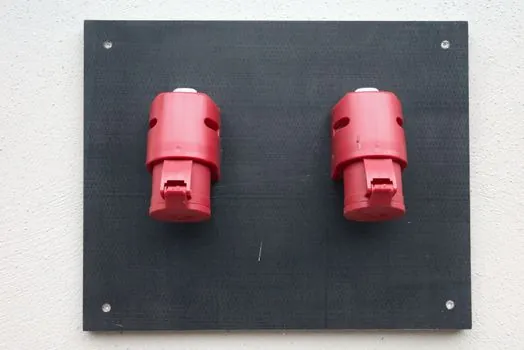
Use a bracket where the extinguisher is not exposed to impact, weather, theft, or tampering, and where rapid access and low cost dominate the decision [S2][S7]. This makes it practical for ordinary corridors, controlled rooms, and areas where visibility is valued.
Use a cabinet in public-facing spaces, industrial settings, loading areas, and other positions where the cylinder may be struck, handled, exposed to harsh conditions, or concealed from casual misuse [S2][S4][S7]. An outdoor enclosure should have a gasketed door and corrosion-resistant hardware; surface-mounted weatherproof cabinets without those features can deteriorate quickly [S5].
A cabinet is not a reason to defer or obstruct access. OSHA 29 CFR 1910.157 requires extinguishers to be conspicuously located and immediately accessible, while cabinets must not cause emergency access delays [S2][S4]. Where an enclosure obscures the extinguisher, clear marking is needed [S4].
Surface-mounted, recessed, and semi-recessed cabinets
A surface-mounted cabinet attaches to the wall face and projects into the room, avoiding stud cutting, wall cavities, and potentially concealed plumbing or wiring [S3][S5]. It is often the practical choice for concrete-block or thin masonry walls that cannot accept a recessed box [S5].
A recessed cabinet sits within the wall cavity, leaving the frame and door visible while reducing corridor projection and accidental-impact risk [S3]. It suits new framed construction and finished commercial interiors where a flush appearance and unobstructed circulation justify greater installation coordination [S3].
A semi-recessed cabinet combines partial wall insertion with reduced outward projection, which can help where some stud depth exists but the full cabinet will not fit inside the wall [S5]. In every configuration, confirm cabinet dimensions, extinguisher size, door swing, projection, and required egress clearance before ordering [S5].
Mounting limits and travel-distance checks
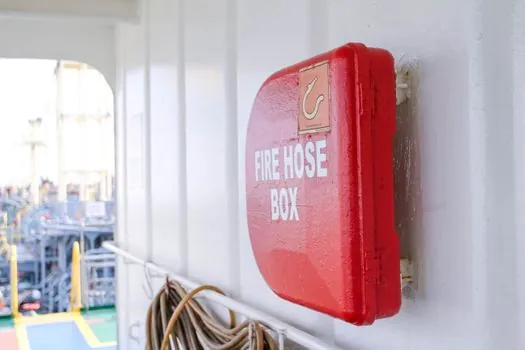
For portable extinguishers weighing 40 lb or less, the top must be no more than 5 ft above the floor; for units heavier than 40 lb, the top must be no more than 3.5 ft above the floor, and the bottom must remain at least 4 in above the floor [S2]. These are placement checks for either a bracket or cabinet, not reasons to select one storage format over the other [S2].
For Class A hazards, an extinguisher should be within 75 feet [S5]. Position the enclosure against the hazard layout rather than wall convenience, and verify that the extinguisher is not obstructed or obscured from view [S2].
Surface-mounted hardware should be anchored into studs, block, or an equivalent structural substrate rather than relying only on drywall anchors, because a cabinet holding a 10 lb extinguisher transfers shear load into the fastening system [S5]. Cabinet position must also avoid reducing exit-path width or creating a door-swing conflict [S5].
Material, access, and inspection trade-offs
A white plastic wall-mount cabinet is available for 10-pound fire extinguishers [S1]. These dimensions illustrate the difference between a small plastic enclosure and a larger steel cabinet, but they are not universal sizing rules.
Do not assume the extinguisher must be secured to an internal wall bracket inside the cabinet. The cabinet-selection guide states that mounting inside the cabinet is not generally required, except for bubble cabinets [S6]. The practical requirement is that the selected enclosure properly supports and retains the intended cylinder without defeating rapid removal [S6].
For maintenance, a bracket leaves the extinguisher visible and easy to inspect, while a cabinet requires opening each door and confirming that the enclosure does not obscure identification or delay access [S2][S4]. In occupied public buildings, evaluate locked or alarmed cabinets as added deterrence, but do not introduce a closure mechanism that users cannot operate immediately during an emergency [S4].
Application-based selection and sourcing checks
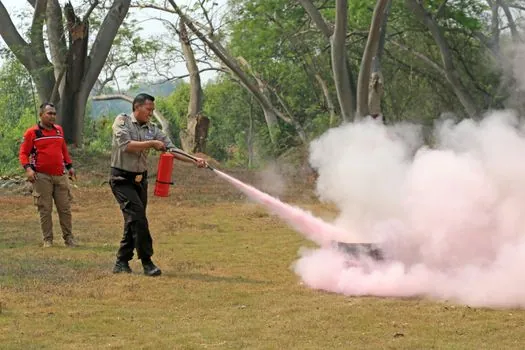
Specify a bracket for one extinguisher where the surrounding environment is controlled, exposure risk is low, and immediate visibility matters. Specify a cabinet where impact, weather, tampering, theft, or appearance is a defined problem; select surface mount when wall depth is constrained, recessed construction when the cavity is available, and semi-recessed construction as the compromise [S2][S3][S5].
Check the extinguisher rating, cylinder dimensions, cabinet capacity, mounting height, travel distance, signage, door operation, and local approval before purchasing. For multiple extinguishers or high-risk batteries, the lithium battery fire extinguisher versus ABC selection guide provides a separate technical comparison for the extinguishing agent rather than the storage enclosure.
Use the fire extinguisher component reference for the complete equipment family, then document the selected bracket or cabinet, extinguisher rating and size, installation substrate, mounting height, and hazard-based travel distance as one traceable installation record.
