
A fire hydrant rated for 150 psi working pressure must not be treated as a 250 psi hydrant, even though both ratings may appear on compliant equipment.
The controlling pressures are the maximum working pressure at the hydrant, the pressure rating of connected piping and valves, and the operating limits of the fire department’s apparatus.
Working pressure is not residual fire-flow pressure
Working pressure describes the pressure the hydrant assembly and its connected piping must tolerate during service. It is not the same as the residual pressure used to measure available fire flow. [S2]
NFPA 1, 2021 edition, and NFPA 291, 2022 edition, define fire flow as the flow rate available at 20 psi residual pressure. Fire flow is a building-specific value calculated from factors such as the building's area and construction type [S3]. A hydrant can therefore have a 150 psi working-pressure rating while remaining useful to firefighting if it can deliver the required flow at the applicable residual pressure.
For comparison, field discussions describe ordinary hydrant pressures around 80–100 psi, some systems with hydrants marked 150 psi, and a diesel pump that starts below 125 psi in one installation [S4]. These observations are not universal design values, but they show why static pressure alone should not determine the specified rating.
150 psi versus 250 psi: decision criteria
The 150 psi option is appropriate for a network whose documented maximum working pressure at every hydrant is no greater than 150 psi, provided the local code, utility, and fire authority accept that rating. Las Vegas and Henderson Fire Code 2021, Section C104.4, requires underground piping to have a minimum working pressure of 150 psi (Class 235) and underground piping connected to a fire pump or Fire Department Connection (FDC) to have a minimum working pressure of 200 psi (Class 305) [S2].
The 250 psi option becomes necessary when the design includes higher static or working pressure, elevated tank or transmission-main conditions, fire-pump service, or an FDC connection that exceeds the lower rating. A 250 psi-rated hydrant should not be selected solely because 250 psi appears in a specification or discussion; the design engineer must verify that pressure can occur at the assembly.
Selection criteria are straightforward:
One code example requires hydrants to be designed for 200 psi working pressure and 350 psi hydrostatic pressure, while specifying a 4.5-inch pumper nozzle, two 2.5-inch hose nozzles, a 5.25-inch main valve, and a 6-inch mechanical-joint connection [S5]. That 200 psi requirement demonstrates why a 150 psi hydrant is not automatically acceptable on a pumped or higher-pressure installation.
When 150 psi is the better selection
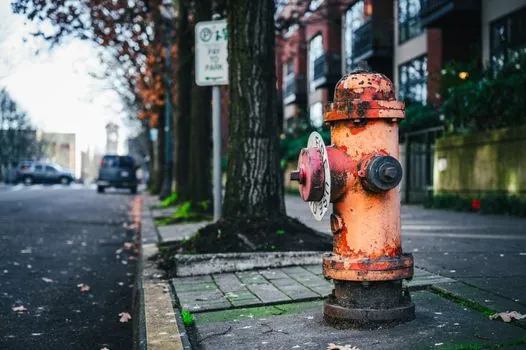
Select 150 psi when the maximum working pressure at the hydrant is demonstrably 150 psi or less, the water utility accepts the rating, and the fire department’s hose and intake equipment can handle the expected pressure. This is the lower-cost and simpler route only when it is supported by the actual hydraulic profile. [S1]
The pressure classification must cover more than the nominal main rating. Pipe, valves, fittings, hydrant barrel, operating nut, caps, gaskets, restraints, and the branch connection all remain part of the pressure boundary. A practical municipal specification may require 150 psi working-pressure underground piping and 200 psi piping connected to a fire pump or FDC [S2].
A 150 psi hydrant is not the right choice for a site where the designer expects 210–250 psi at the tap. That operating condition exceeds the lower rating even if a particular manufacturer offers a 150 psi hydrant that is nominally compliant with its governing standard. The review point is maximum working pressure, not merely the number stamped on the body.
When 250 psi is justified
Select a 250 psi-rated hydrant when the hydraulic design or fire authority establishes that pressures above 150 psi can occur during the required operating conditions. The discussion of a proposed installation with 210–250 psi at the hydrant identified the real engineering issue: every component and the responding apparatus must remain within its operating range [S1].
The 250 psi rating provides more capability than a 150 psi assembly, but it does not eliminate overpressure risk. The maximum anticipated pressure must remain below 250 psi, and the piping system must be rated for the same service. A 250 psi hydrant connected to 150 psi piping or a 150 psi auxiliary valve creates an uncontrolled mismatch.
High static pressure also affects operational practice. Where pressure must be maintained for sprinkler performance, the design may require pressure zones, a pressure-reducing assembly, or separation of the yard hydrant network from the high-pressure system.
Apparatus capability and flow performance

A hydrant rating protects the assembly, while apparatus capability determines whether firefighters can use the delivered pressure and flow. Fire-engine performance data cited in a fire-hydrant FAQ lists rated-capacity operation at 100% at 150 psi, 70% at 200 psi, and 50% at 250 psi, while noting no universal 150 psi upper limit [S6]. These figures describe the cited engine capacity under those conditions, not a fleet-wide rule.
That distinction matters because a 250 psi hydrant does not guarantee 250 psi delivery during a fire. Flow testing and marking under NFPA 291, 2022 edition, remain the practical basis for determining available output [S3]. For equipment configuration, the related guide to configuring two 2.5-inch and one 4.5-inch hydrant outlets covers outlet sizing, but it does not replace pressure-rating verification.
Coordinate the hydraulic design with the fire department before approving 250 psi service. Confirm the rated working pressure of the hydrant, main, valves, hose connections, and fire-engine intake. If a pressure-reducing valve is used, verify its set pressure, full-portability at the required flow, drainability, and failure position rather than treating it as an automatic solution.
Specification and acceptance checklist
Specify 150 psi working pressure for a low-pressure installation only after confirming the maximum service pressure. Specify 250 psi working pressure for a higher-pressure installation only after confirming that all connected piping and apparatus are rated for the applicable condition. Fire-flow acceptance should be based on flow at 20 psi residual pressure, with required flow determined for the building [S3].
Before submittal approval, check seven items:
The 150 psi versus 250 psi decision is not a choice based on the largest number. It is a system decision: 150 psi is appropriate below the lower rating, while 250 psi is justified where higher service pressure is documented and compatible throughout the assembly.