
Fire flow is the water-supply flow available at 20 psi residual pressure, a reference condition used to compare hydrant performance and assess fire-protection capacity [S1][S2].
Hydrant flow tests measure static pressure, residual pressure, and pitot pressure, then project the available flow at 20 psi using measured discharge and system head loss [S3][S4].
What the 20 psi residual rating means
The 20 psi value is a pressure condition, not the total volume of water stored or the maximum unrestricted discharge from a hydrant. NFPA defines fire flow as the flow rate available for firefighting when measured at 20 psi residual pressure [S1][S2].
A hydrant rated at 1,000 gpm at 20 psi residual can deliver 1,000 gpm while leaving 20 psi in the water main under the projected test condition. That figure is not interchangeable with outlet flow at zero residual pressure, nor does it guarantee 1,000 gpm through every individual outlet arrangement [S3][S4].
For context, a fire hydrant flow test normally separates three readings: static pressure with no flow, residual pressure while water is discharging, and pitot pressure at the flowing outlet [S4]. The test record should also identify the outlet diameter, outlet shape or discharge coefficient, and the number of outlets flowing [S3][S4].
Compare the four NFPA 291 rating classes
These colors describe tested water-supply capability, not mechanical certification of the hydrant body. A hydrant can retain its listed pressure class, valve size, or material specification while its flow rating falls as mains age, sediment accumulates, or the network becomes encrusted [S1].
Calculate available flow from a field test

The available flow at 20 psi is projected with Q<sub>R</sub> = Q<sub>F</sub> × (h<sub>r</sub> / h<sub>f</sub>)<sup>0.54</sup>, where Q<sub>F</sub> is measured flow, h<sub>r</sub> equals static pressure minus the 20 psi target, and h<sub>f</sub> equals static pressure minus observed residual pressure [S3][S5].
For a static pressure of 70 psi, a residual pressure of 50 psi, and measured flow of 1,000 gpm, h<sub>r</sub> is 50 psi and h<sub>f</sub> is 20 psi. The projection is approximately 1,640 gpm at 20 psi residual, placing the result in Class AA [S5].
When pitot pressure is used instead of metered flow, the outlet equation is Q = 29.83 × c × d<sup>2</sup> × √P, with c as the coefficient of discharge, d in inches, and pitot pressure P in psi [S4][S5].
Those are outlet calculations, not automatically the hydrant's available-flow rating at 20 psi residual.
Choose the right test arrangement
A two-hydrant or multi-hydrant test gives a more representative result than a single-hydrant test because the flow hydrant and static/residual hydrant should be selected within the same vicinity and evaluated as a network [S3][S4].
Recognize the limits of a flow rating
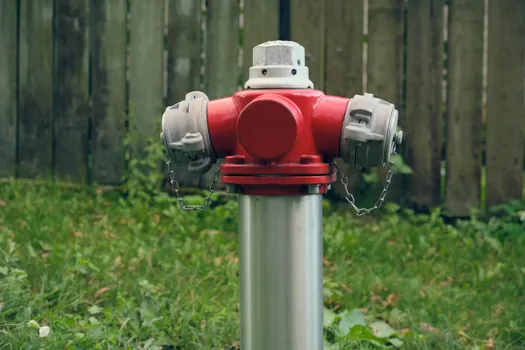
The 20 psi rating is a standardized projection from a specific test condition, not a guarantee of performance for every fire-flow demand. The residual pressure depends on network capacity, friction losses, demand from flowing hydrants, and the condition of the mains [S1][S3][S4].
Sedimentation and encrustation can reduce available pressure and flow, which is why historical test data should be tracked [S1]. A 1,640 gpm result from 70 psi static and 50 psi residual does not mean that 1,640 gpm remains available if additional hydrants are opened, a large fire-flow demand is imposed, or the system condition changes [S5].
NFPA 291 reporting guidance requires rounding the available-flow result to the nearest 100 gpm. One documented compliance example reports 1,900 gpm available at 20 psi residual at a test location [S8]. Always apply the edition and reporting procedure required by the authority having jurisdiction.
The selected target residual must remain credible. The supplied NFPA 291-based calculator guidance states that a residual pressure at least 10% below static is desirable and that a smaller pressure drop makes the projection to 20 psi unreliable, requiring a second outlet [S5].
Apply ratings in design and emergency decisions
Available fire flow supports community planning, tactical firefighting, sprinkler design, and property-development decisions. ISO uses this information when evaluating water-supply credit, while fire departments use it to assess whether the system can support a particular firefighting demand [S4].
The rating belongs to the tested location and water-supply condition, not merely to the hydrant casting, barrel, valve, or outlet size. Comparing barrel construction without accounting for flow performance would answer the wrong procurement question; the related analysis of ductile iron and cast iron fire hydrant selection covers material choices, while the 20 psi rating must still be established from a supply test [S1][S4].
Local requirements control. The cited fire-code material states that the code does not establish a universal flow volume, pressure, or duration unless the referenced appendices are adopted, and many jurisdictions establish their own fire-flow and hydrant standards [S1]. Required fire flow therefore cannot be selected solely by choosing a color class from the four-category table.
Convert field readings into an auditable rating

A defensible rating record needs the test date, hydrant locations, time of day, static pressure, residual pressure, pitot pressure, outlet size, discharge coefficient, number of flowing outlets, measured flow, calculated flow at 20 psi, and the resulting color classification [S3][S5].
The arithmetic must distinguish measured flow from projected available flow. If the test produces 2,432 gpm at the selected 20 psi condition, the rating is 2,432 gpm and falls in Class AA because it exceeds 1,500 gpm [S5][S6]. If another test yields 1,900 gpm at 20 psi residual, that value also falls in Class AA and is reported as 1,900 gpm under the cited nearest-100-gpm guidance [S8].
The next traceable action is to verify the hydrant's operating condition, repeat the test with the same outlet configuration, and compare the projected result with the 500, 1,000, and 1,500 gpm class boundaries [S3][S5]. Any replacement or upgrade should be judged against the required fire flow and the measured supply performance, rather than the hydrant's nominal size alone [S1][S4].