
Fire hydrants and smoke detectors sit on opposite ends of a building's fire-protection chain — the fire hydrant is a fixed water-delivery terminal for firefighters, while the smoke detector is an automatic aerosol sensor that triggers alarm and downstream response in seconds. They are routinely confused in procurement because both are called "fire equipment," but their duty cycles, standards basis and supply chains do not overlap.
This comparison covers spec bands, detection physics, the standards that govern each, and the practical sourcing reality for industrial and commercial buyers. A separate comparison of fire-rated door cost levers is detailed in the linked reference, since compartmentation sits between detection and suppression.
Functional Scope: Manual Suppression Asset vs Automatic Sensor
A fire hydrant is fundamentally a piping terminal: a ductile-iron or bronze body connected to a pressurized municipal or private water main, with a rated outlet (typically 2.5-inch hose nozzle plus a 4.5-inch pumper connection) sized for fire-flow delivery measured in hundreds of gallons per minute [S1]. Its job is passive: it waits for a fire crew, then delivers bulk water through attack hoses.
A smoke detector is an active electro-optical or ionization sensor: it samples the protected space continuously, and on threshold obscuration (typically on the order of a few percent per foot of light obscuration for photoelectric units) it switches a relay, sounds a horn, and signals a fire-alarm control panel. The two devices are designed around different physics — a hydrant is rated on static pressure (commonly 150 psi / 250 psi hydrostatic test) and flow rate, a detector is rated on sensitivity (% obscuration/ft) and response time in seconds.
Detection Technology Bands for Smoke Detectors
Three principal sensing technologies cover virtually all of the installed base. Ionization chambers use a small radioactive source to ionize air and measure a baseline current; smoke entering the chamber disturbs the current and triggers alarm — they are most responsive to fast-flaming fires with small particles [S8]. Photoelectric (optical) units use a light-emitting diode and a photodiode at an angle; smoke scatters light into the sensor, and they are most responsive to smoldering, large-particle fires [S7][S8].
Laser-photoelectric and multicriteria detectors add forward-scatter optics and combined smoke/heat/CO algorithms. Fire-test work published in Fire Technology shows laser-photoelectric and multicriteria detectors achieve response times close to standard photoelectric units when sensitivity is matched [S6]. A typical siting rule (governed by regional codes such as NFPA 72 in the US) requires detectors on ceilings, with spacing generally on the order of 30 ft (9.1 m) for smooth ceilings, and reduced spacing under beams, joists or ducts.
Selection criteria, in order of decision weight, are: fire type expected (smoldering vs flaming), ambient environment (steam, dust, cooking aerosols drive false-alarm risk), and listing/approval. Photoelectric is the common default for residential and office occupancies; ionization is now restricted in several jurisdictions; multicriteria and aspirating systems are specified in data halls and clean rooms [S7][S8].
Hydrant Spec Bands: Body, Pressure Class, Outlet Geometry
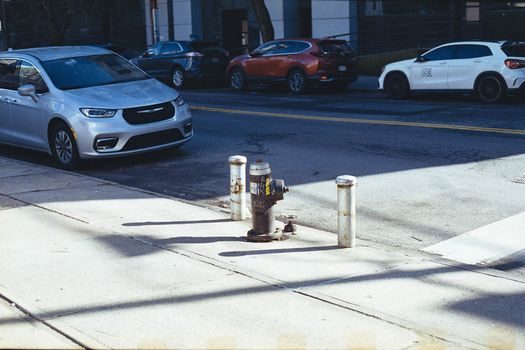
Hydrant bodies are typically ASTM A536 ductile iron, with bronze/brass trim for the valve seat, drain ring and hose/pumper caps. Working pressure is usually 150 psi (Class 150), with a 250 psi hydrostatic test rating per AWWA C502 / C503 in North America; the European EN 14384 standard covers the EU equivalent. The two-outlet geometry — 2 × 2.5" (DN65) hose nozzles plus one 4.5" (DN100) pumper nozzle — is near-universal for municipal hydrants in many regions, though local codes vary. [S1]
Selection criteria, in order: required fire flow (NFPA 1 / NFPA 1142 calculators give a starting point in gpm or L/min), water-supply pressure at the hydrant location, traffic load (breakaway vs non-breakaway barrels for vehicle-hit zones), and climate (dry-barrel for freeze risk, wet-barrel for warm climates). Lead-time for a Class 150 ductile-iron pillar hydrant from a major China OEM typically runs 30–45 days at MOQ 10 units [S1]. For context on cost levers across a different but adjacent fire-protection asset, see the fire-rated door pricing guide.
Decision Matrix: When to Spec a Hydrant vs a Detector
These two devices are not substitutes; the matrix below clarifies which one answers a given engineering question. Choose a hydrant when the answer is "we need to deliver water at flow rate X to a fire area"; choose a detector when the answer is "we need an automatic alarm in under Y seconds when smoke is present." A third option — a fire extinguisher — sits between the two for small, incipient fires. [S2]
Decision criteria: (1) Trigger source — manual / fire crew vs automatic / self-actuating; (2) Output — water flow at 100+ gpm vs relay closure / sounder at <1 A; (3) Failure mode — main shut off / main break (rare) vs sensor contamination, low battery, or chamber insect ingress (common); (4) Standards basis — AWWA C502/C503, EN 14384, IS 908, GB 4452 vs UL 268, EN 14604, ISO 7240-7, GB 4715. They share no design standard.
For occupied buildings, both are normally specified together: detectors trigger evacuation and an alarm-transmission path, and the hydrant network provides the water source for the responding fire service. The two systems are independent; a detector failure does not impair hydrant function, and a hydrant main break does not silence an alarm.
Limitations and Failure Modes

Hydrant limitations are largely mechanical: internal corrosion can seize the operating nut, drain valves can clog with debris, and traffic-impact damage is a recurring cause of in-service failure. Bolted-cassette hydrant designs (per AWWA C502) address the traffic-breakaway failure mode by shearing cleanly above the grade line. Winter freeze-ups in dry-barrel hydrants are prevented only by a working drain valve — a clogged drain converts a dry barrel to a wet one and risks barrel rupture. [S3]
Smoke detector limitations are environmental and design-driven. Photoelectric units can be blinded by steam or cooking aerosols; ionization units are increasingly restricted because of the radioactive source and their false-alarm behavior near kitchens. Battery-backed wireless units lose sensitivity if the battery is allowed to discharge below about 2.7 V on a 3 V lithium cell, and the average detector service life is 10 years before the sensor chamber must be replaced [S7]. Multicriteria and aspirating systems reduce false alarms but add cost on the order of 3–5× a standard photoelectric unit.
Sourcing Reality and Lead-Time Notes
Hydrant sourcing is dominated by a handful of foundries with ductile-iron casting capacity. A 2025-vintage OEM profile lists conventional sprinkler, UL-listed sprinkler, fire extinguisher, fire valve and smoke-detector lines under a single fire-protection umbrella, with ISO 9001:2015 certification and a production scale in the thousands of units per month [S1]. This vertical mix is typical: many Chinese fire-protection OEMs now bundle hydrant, sprinkler, extinguisher and detector categories so a single PO can cover an entire wet-side and detection-side package.
Detector sourcing is more fragmented, and open-source projects on GitHub show the rapid prototyping path: a 2026 repository demonstrates image-based fire and smoke detection on commodity cameras, with milestone tracking through Q2 2026 [S3][S4]. This is a parallel development track to the certified hardware market, and specifiers should not confuse a research-grade CV model with a UL 268 / EN 14604 listed detector — the listing path remains mandatory for life-safety credit under model building codes.
The next buying decision is rarely "hydrant or detector" — it is "which listing, which body, and which delivery slot."