
Smoke detectors and fire extinguishers are not competing products — they address the detection phase and the suppression phase of a fire event, and specifying one in place of the other is the single most common spec error on small commercial fit-outs [S1][S2]. A photoelectric or ionization smoke detector senses combustion aerosols in the air and raises an alarm within seconds; a portable fire extinguisher holds 0.5-6 kg of agent (ABC dry powder, CO2, foam, water) and is discharged manually onto a small incipient fire. NFPA and equivalent codes treat these as complementary layers of the same fire-safety system, not alternatives.
Supply-side data from 2026 confirms both categories remain active China OEM segments. Shenzhen Convoys Fire Technology Co. has positioned itself as a combined conventional smoke detector, fire alarm control panel and fire extinguish system manufacturer for more than twenty years [S2]. Shenzhen PGST Co., Ltd. lists smoke detectors, fire alarm panels and fire extinguisher balls on the same product page, with FOB unit pricing on basic standalone photoelectric units in the 4.00-5.00 USD/piece band and a stated monthly supply ability of 10,000 pieces [S4]. The grouping of detection and suppression SKUs under one supplier is a useful sourcing signal: it indicates shared component supply chains, shared UL/CCC/CE testing pipelines, and consolidated logistics for fit-out contractors who would otherwise juggle three or four vendors.
Detection vs Suppression: Where the Two Devices Sit in the Fire Timeline
UL 217 and EN 14604-listed residential smoke detectors are designed to sound within minutes of a smouldering ignition, well before flashover; interconnected 120 V AC units with battery backup remain the dominant North American spec, while 9 V battery-only standalone units dominate retrofit residential stock [S3]. Commercial addressable systems use 24 V DC detectors on a loop, with a fire alarm control panel (FACP) polling each detector every 5-10 seconds and isolating any unit that fails the periodic self-test, as sold in the Convoys catalogue [S2]. The detection chain ends at an audible/visual notification appliance (horn-strobe, 75-110 dB at 3 m) and a signal to the FACP, which can in turn release suppression agents, close fire doors or call the monitoring centre.
Portable fire extinguishers are passive until actuated. Pressurized dry chemical units (ABC powder, monoammonium phosphate) typically operate at 12-14 bar at 21 °C, with a 1.5-6 s discharge time and a 3-5 m effective throw range. CO2 units run at roughly 55-60 bar at 21 °C with a discharge horn and a 1-1.5 m range because the gas disperses rapidly. Neither will do anything useful unless a person is already holding it, the fire is still at the incipient stage, and the correct class is selected (Class A: ordinary combustibles; Class B: flammable liquids; Class C: energized electrical; Class D: combustible metals; Class K: cooking media). The two devices are time-shifted by minutes in the fire timeline, which is why building codes mandate both, and the engineering logic for pairing them is layered defence rather than redundancy.
Selection Criteria: Photoelectric, Ionization, Aspirating, Multi-Criteria
Photoelectric (optical) smoke detectors respond faster to smouldering, smoky fires (Class A polyurethane foam, electrical insulation) and are less prone to nuisance trips from cooking aerosols; ionization detectors respond faster to fast-flaming fires with smaller smoke particles. Multi-criteria / multi-sensor units combine a photoelectric chamber with a heat sensor (typically fixed 57 °C or rate-of-rise 8.3 °C/min) and sometimes a CO sensor; these are the fastest-growing commercial category, because they cut nuisance-alarm rates that have historically driven end-user bypass of single-sensor units. Aspirating smoke detection (ASD / HSSD) draws air through a pipe network to a central laser detector, with sensitivity 100-1000× higher than spot detectors, and is specified for clean rooms, data centres and cold-storage facilities where very early warning is required. [S1]
Selection should be driven by four criteria, in order: (1) fire signature expected (smouldering vs flaming, fuel type, ventilation rate), (2) ambient environment (humidity, dust, cooking aerosols, RF exposure), (3) listing/standard (UL 217 8th edition for US residential, EN 14604 for EU residential, UL 268 7th edition for US commercial, EN 54-7 for EU commercial), and (4) integration with the FACP loop voltage and protocol. End-of-life for sealed-battery 10-year photoelectric units means roughly 10% of detector stock is replaced every year, so specifiers should treat detectors as a recurring maintenance line item rather than a one-time capex purchase.
Extinguisher Classes, Agent Mass and Placement Logic
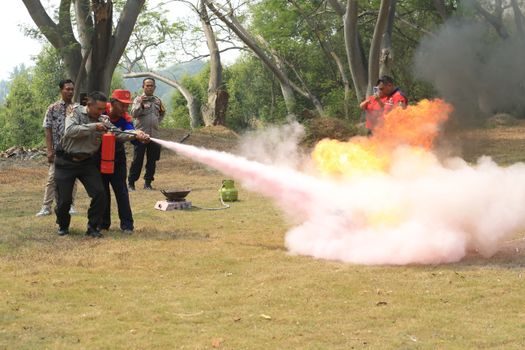
For extinguisher selection, NFPA 10 groups portable units by hazard: Class A size 2-A (minimum 2.5 gal water or 4 lb ABC powder) for light office, size 4-A for general office, size 10-A or larger for Class A extra hazards; Class B units sized by square-foot coverage of spill fire (e.g. 5-B for ~1 m2 of spill); Class C is a marking rather than a size, indicating the agent is non-conductive for use on energized electrical; Class K wet-chemical units sized by cooking-media fryer volume. Travel distance to a Class A or Class D extinguisher should be ≤23 m, to Class B ≤15 m, and to Class K ≤9 m per NFPA 10. Discharge time of a 4-5 kg ABC dry powder unit is 9-15 s; CO2 (typically 2.3-6.8 kg) is 9-18 s; water-mist is longer. Specifying an extinguisher that is too small for the hazard (e.g. 1 kg ABC powder on a server rack room) is a common mistake that fails the post-incident review. [S2]
Placement density drives agent reserve. A 1000 m² light-hazard office with 20 ABC 4-kg units on the wall costs roughly 1500-3000 USD in hardware plus 100-200 USD annual inspection per unit; an equivalent server room with clean-agent total-flooding (FM-200 / Novec 1230) systems is a different engineering layer entirely. For retail fit-outs, sourcing basic ABC dry powder and CO2 units in mixed order quantities from a China OEM like PGST (with mini order 10 pieces) [S4] and combining with CE/RoHS-marked photoelectric detectors (FOB 4.00-5.00 USD/piece) [S4] is a workable low-end spec — but the listing marks and the AHJ approval still rest with the importer, so OEM brochures should be read for spec rather than approval.
Use Cases: Where Each Device Earns Its Place
Smoke detectors belong in every occupied space — sleeping rooms, corridors, server closets, lift machine rooms, transformer rooms, kitchens (with heat augmentation) — and they are mandatory under the IBC, NFPA 101 and most international equivalents. Combination smoke/CO units are now standard in code-compliant US multi-family construction because CO cannot be sensed by a smoke detector alone. Aspirating systems are the right call in data centres (where standard spot detectors can take 30-60 s longer to react than an HSSD sampling the airflow) and in refrigerated warehouses (where standard ionization chambers lose sensitivity below 0 °C). Where the user question is "do I need a smoke detector in a small unoccupied utility room," the answer is still yes per most code books, with the caveat that the detector can be a lower-sensitivity rate-of-rise heat detector in some occupancies instead. [S3]
Fire extinguishers belong in occupied spaces, near exit doors, and along egress paths, but they are not required in every room — only within the NFPA 10 travel-distance envelope of each hazard. Kitchens, mechanical rooms, transformer vaults, and refuelling bays each have specific class and size requirements. Specialty hazards (Class D combustible metals such as magnesium, titanium, sodium) require dedicated dry powder agents (NaCl, Cu, graphite) and are not interchangeable with ABC powder. Sourcing a single ABC 4-kg unit to cover a magnesium machining line is a wrong spec that no discount justifies. The decision rule is simple: a detector is specified to be everywhere humans sleep or work, an extinguisher is specified to be within arm's reach of every fire hazard.
Limitations, Failure Modes and Cross-References
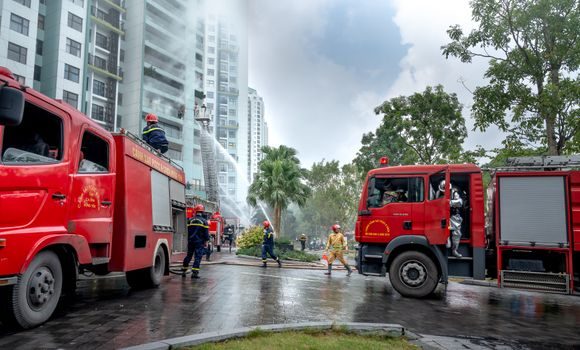
Smoke detectors fail in three dominant modes: nuisance alarms from cooking steam or dust (drives end-user bypass), dead backup battery at 5-7 years (false sense of security), and sensor chamber contamination in dusty industrial environments. Mitigation is selection (photoelectric in corridors, ionization avoided in kitchens, multi-criteria in apartments) and maintenance (annual functional test, 10-year replacement). A fire hydrant is the next escalation layer for fires that have grown past first-stage suppression, and it sits in a totally different supply chain from extinguishers — cast-iron ductile pipe, FM/UL 246 listed hydrant bodies, AWWA C502/C503 — and should never be conflated with portable extinguishers. Similarly, a fire-rated door and an electrical fire monitor are passive or fixed-system devices that complement but do not replace either of the two portable categories in this comparison. [S4]
Common spec mis-steps: (a) omitting detectors because extinguishers are present (wrong — extinguishers require a human to act, detectors are automatic and early), (b) omitting extinguishers because the building has sprinklers (wrong — first-aid extinguishers are still required for incipient-stage response before sprinkler activation), (c) specifying ionization detectors in residential corridors next to kitchens (high nuisance-alarm rate → tenant tampering), and (d) under-sizing CO2 units for electrical cabinets (1 kg CO2 will not displace enough oxygen to suppress a sustained arc). Pairing detection and suppression correctly is layered defence, not redundancy.
2026 Sourcing Reality: China OEM Supply Bands
Current supply data from 2026 shows the smoke detector and portable fire extinguisher categories both remain active in the Shenzhen-Guangdong OEM cluster, with vendors such as Convoys [S2] and PGST [S4] offering both SKUs on overlapping product lines. PGST's published FOB price of 4.00-5.00 USD/piece for a CE/RoHS-marked standalone photoelectric smoke detector, paired with a stated monthly supply ability of 10,000 pieces, gives a useful price band for a low-end commercial unit [S4]. Convoys advertises twenty-plus years in conventional smoke detectors, FACPs and fire extinguish systems, with explicit CE/UL/CCC-marketed SKUs [S2]. Sourcing decisions should still be filtered by the local authority having jurisdiction (AHJ) and the required listing mark (UL 217 8th edition for US residential, EN 14604 for EU, AS 3786 for AU) — Chinese OEM price is irrelevant if the listing is not transferred through the importer.
For a single-trackable signal: watch UL 268 7th edition and EN 54-7 compliance documentation when sampling from any new China supplier, and confirm 24 V DC loop current draw (typically 0.3-1.5 mA per detector at 24 V) matches the FACP loop budget. For extinguishers, confirm the hydrostatic test date stamp (typically every 5 years for stored-pressure dry chemical, every 12 years for CO2), the EN 3-7 or UL 154 marking, and the manufacturer date on the cylinder neck — a cylinder over 12 years old on the shelf is a rejected unit in most jurisdictions.
For related coverage, see Planetary Reducer Suppliers 2026: China OEM Clusters, Ratio Bands and Sourcing Reality.