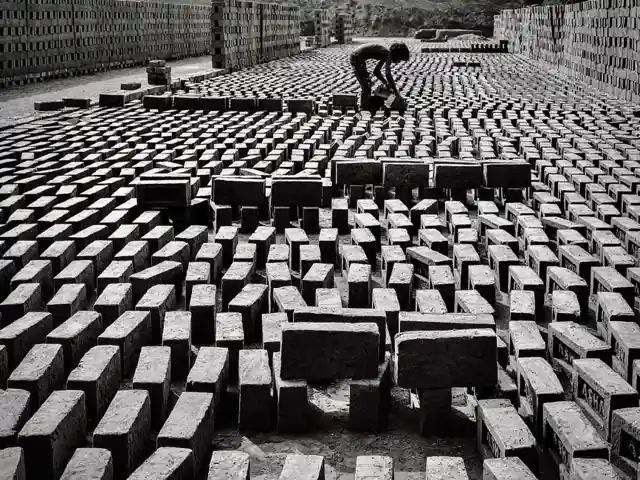
For a single-family home in 2026, first-class burnt clay brick priced from roughly $0.25 to $4 per unit in U.S. retail, sized near 8 in × 4 in in modular thicknesses, is the default masonry veneer specified over wood- or steel-framed backup walls [S1][S3].
Selection is driven by four decisions: brick class (first through fourth), firing type (kiln-burnt vs. sun-dried), wall function (load-bearing solid vs. anchored veneer), and the local freeze-thaw exposure that governs porosity and sealant choice [S2][S3].
Burnt Clay Brick: The Residential Default
Burnt clay brick is the unit most people picture when they hear "brick house": wet clay pressed into molds, dried, and fired in a kiln until the clay vitrifies into a hard, dimensionally stable ceramic, typically red or brown with a slightly rough face [S1][S2]. It is the most common brick used in house construction and the dominant material in older Detroit-area homes and most U.S. housing stock from the 1920s through today [S2].
Burnt clay bricks are sold in four classes. First-class units are the finest, with no noticeable flaws, the best strength, and the highest cost; second-, third-, and fourth-class units step down in surface quality, dimensional tolerance, and structural capacity [S1]. For a residential veneer where appearance and weather resistance matter, first- or second-class is the practical floor; third- and fourth-class are reserved for temporary or hidden work.
The standard residential format is a modular brick roughly 8 in long × 4 in high, with thicknesses of about 2.25 in, 3 in, or 3.625 in controlling wall thickness and the count per square foot of face [S1]. Compared to sand-lime and concrete alternatives, burnt clay tolerates freeze-thaw cycling far better when specified at the right density, which is why it remains the default where winters are real [S2].
Engineering Brick vs. Common Burnt Clay: When to Spend More
Engineering bricks are a denser, higher-fired subset of clay brick, manufactured at very high kiln temperatures to drive porosity to a minimum and compressive strength up [S1]. They are specified where strength and water or frost resistance are non-negotiable: sewers, retaining walls, manholes, foundation work, and below-grade tunnels, not typically the full exterior of a single-family home.
For a house, the trade-off reads cleanly across four decision criteria:
1) Compressive strength and density: engineering brick is the strongest, common burnt clay sits in the middle, and sun-dried mud brick is the weakest by a wide margin [S1][S2].<br>2) Water and frost resistance: engineering brick has the lowest porosity and the best freeze-thaw performance; common burnt clay is adequate when paired with a breathable sealant and sound mortar joints; sun-dried mud brick is the least durable of the three [S1][S2].<br>3) Cost per square foot of face: common burnt clay is the cheapest path to a code-compliant residential veneer, while engineering brick can run several times the price and is rarely needed above grade [S1].<br>4) Use case fit: common burnt clay for above-grade residential veneer, engineering brick for foundations, sills, and any course within the splash zone, sun-dried mud brick for low-rise, dry-climate vernacular construction only [S1][S3].
A common spec mistake is substituting concrete or sand-lime units for the first few courses of a clay veneer at the foundation line. The chemistry is different: sand-lime brick is an autoclave-cured calcium silicate with a smoother face and tighter tolerances, but it is more sensitive to efflorescence and aggressive cleaners than fired clay [S2]. Keep the brick type consistent within a single wythe, or detail a clear expansion break between clay and non-clay courses.
Wall System: Veneer, Not Solid Brick
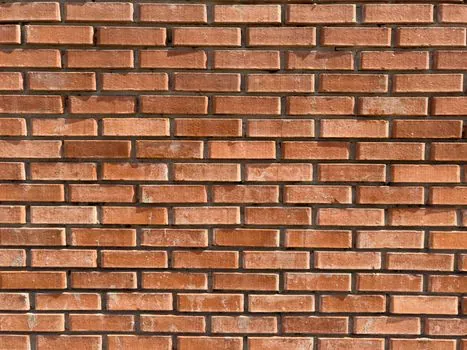
Most modern U.S. houses described as "brick" are framed structures with an anchored brick veneer on the outside, not a load-bearing solid brick wall [S3]. The roof and floors ride on a wood- or steel-framed backup wall; the brick is a separate outer wythe tied back with metal wall ties, sitting on its own brick ledge or continuous footing, and separated from the sheathing by a drainage cavity and water-resistive barrier.
This changes the spec list. The brick still has to be first- or second-class for appearance and durability, but the wall as a system also needs: a footing or brick ledge sized for the veneer weight, through-wall flashing at lintels and sills, weepheds at the base, movement joints at roughly 20-25 ft on center (a common engineering rule of thumb that must be confirmed against the local code and the project-specific engineer's calc), and a breathable, film-forming-free sealant on the exposed face where freeze-thaw exposure is high [S2][S3].
For a related decision on wall systems in renovation and high-rise work, the lightweight partition panel selection for high-rise buildings spec map walks through the alternative where brick veneer is not viable. For renovation contexts where existing masonry has to be matched, lightweight partition panel selection for renovation projects covers the panel-side trade-offs.
Fire Rating: What a Clay Brick Wall Actually Buys You
Clay brick's fire rating is the time, expressed in minutes or hours, that a brick wall or lining holds integrity under a standard fire exposure without letting fire pass through or losing load capacity [S4]. Residential clay-brick veneer assemblies are commonly rated between 1 and 4 hours depending on wall thickness, density, and the specific listing used, with dense engineering brick pushing the upper end of that range.
Three standardized test methods govern the rating itself: ASTM E119 in the United States for walls, floors, and structural elements; EN 13501-2 in Europe for fire classification including resistance duration; and ISO 834 internationally for the standard time-temperature curve applied during the test [S4]. A specifier should pin the rating to one of these methods rather than to a generic "fire-resistant" claim.
Material composition drives the upper temperature limit. Higher alumina (Al₂O₃) content gives better refractoriness, with refractory clay bricks rated up to roughly 1450°C, well above anything a house fire will reach, which is why the same family of material shows up in furnace linings and fireplace surrounds [S4]. For ordinary residential walls, the operative question is wall thickness and listing, not raw material refractoriness.
Moisture, Mortar, and the 100-Year Question

A brick house can stand for a century; the worker who knows how to keep it standing cannot be learned in a weekend [S3]. The most common failure mode is not the brick itself but the moisture it absorbs. In a freeze-thaw climate, water absorbed into a porous clay face and frozen in winter exerts expansion pressure that spalls the face and opens cracks; the mortar joints around the brick fail by the same mechanism, and once joints go, the moisture path accelerates [S2].
Two maintenance rules follow directly. First, use a breathable penetrating sealant on the brick face, never a film-forming sealer, because trapping vapor inside the wall makes freeze-thaw damage worse instead of better [S2]. Second, plan on repointing mortar joints at a maintenance interval measured in decades, not years, and inspect annually for hairline cracks and joint loss so the repointing happens before the brick starts moving.
For ongoing maintenance, avoid acid washes and aggressive commercial cleaners on any brick face; a mild detergent and a soft brush is the routine that protects both the fired clay surface and the mortar joint [S2]. On the construction side, the industrial ceramic selection for mold and die tooling spec map is a useful cross-reference on how kiln-fired ceramic material behavior, including porosity-vs-strength trade-offs, plays out in a completely different industry but on the same material physics.
Selection Checklist and Sourcing Standards
For a 2026 single-family residential project, the minimum decision set is: first- or second-class burnt clay brick, modular size to match the wall layout, matching mortar type (typically N or S for above-grade veneer in freeze-thaw climates), breathable penetrating sealant at the exposed face, engineering-brick or dense brick for the first two or three courses at the foundation line, and a wall listing under ASTM E119 or EN 13501-2 that documents the fire rating required by the local code [S1][S2][S4].
Sourcing standards to pin on the spec sheet include: ASTM C216 for facing brick (the U.S. standard for solid clay facing brick, graded into FBS, FBX, and FBA for appearance and tolerance), ASTM C62 for building brick, and the matching mortar standard ASTM C270 with Type N or Type S as appropriate; in Europe, EN 771-1 governs clay masonry units and EN 1996-1-1 (Eurocode 6) covers masonry design. Always check the listing applies to the exact wall assembly, stud spacing, tie type, and cavity width you are building, not just to the brick alone [S3][S4].
Trackable signals for the next 6-12 months: any revision activity around ASTM C216 severity grades (FBX remains the tightest tolerance grade and the most expensive), evolving EN 1996-1-1 national annexes for cavity-wall tie spacing in high-wind zones, and the gradual migration of U.S. residential veneer detailing toward larger-format thin brick on panelized systems, which is shifting some of the load away from traditional modular fired-clay units but is not replacing them in the mainstream single-family market [S1][S3].
For component-level specifications, see fired brick, and construction tools.