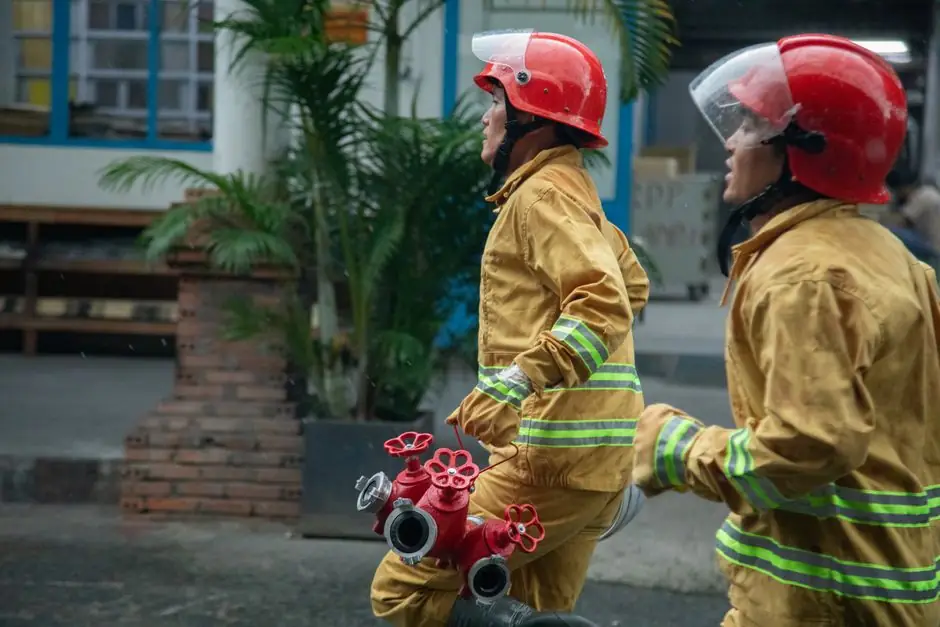
Selecting the correct warning sign for firefighting applications depends on a five-category taxonomy and a fixed colour-and-shape code set out under ISO 7010: prohibition (red circle with diagonal bar), warning (yellow triangle, black pictogram), mandatory (blue circle, white pictogram), rescue/safe condition (green square, white pictogram), and fire protection/equipment (red square, white pictogram) [S1][S2].
For firefighting use the dominant categories are fire protection signs (red, identifying extinguishers, alarms, hose reels, blankets) and warning signs (yellow triangle, identifying flammable materials and similar fire-load hazards); the other three categories appear as supporting signage on the same facility plan [S1][S2][S3].
Colour-and-shape code as the decision gate
The ISO 7010 colour-and-shape code is the first decision gate, because each combination has a fixed meaning: green = safe condition (escape route, assembly point, first aid); red square = fire protection equipment; red circle with diagonal bar = prohibition (e.g. "No smoking", "Do not extinguish with water"); blue circle = mandatory action (e.g. "Fire door keep shut"); yellow triangle = hazard warning (e.g. flammable material) [S1][S2].
Because the code is symbol-based rather than text-based, the same pictogram set is legible to a non-reader, a visitor, and a shift-change operator; the standard approach is white pictograms on the relevant coloured background for maximum contrast in low-light evacuation conditions [S1]. In the UK workplace this system is not optional and is enforced as a legal requirement under the Regulatory Reform (Fire Safety) Order, which mandates display of the right signs at the right location [S1].
Fire-equipment signs (red squares): extinguisher-class pairing
Red fire-equipment signs identify the location and class of firefighting tools, and the most heavily specified sub-type is the extinguisher sign, which must display the extinguisher class letter so operators match the agent to the fuel [S1]. The five practical classes used on signs are A (wood, paper, textiles), B (flammable liquids), C (flammable gases), D (metals), and F (cooking oils) [S1].
Mounting rules are concrete: extinguisher signs sit directly above or adjacent to the extinguisher and must remain visible from at least 2 metres in normal lighting; fire-alarm call-point signs use a white bell pictogram or "Break Glass" wording mounted immediately above the device; fire-blanket signs concentrate in kitchens, while fire-hose-reel signs are placed along corridors and stairwells [S1]. For a deeper view of how hazard pictograms integrate with the broader hazard-class colour code on industrial sites, see the warehouse warning sign selection map.
Warning signs (yellow triangle): hazard-class identification
Yellow triangular warning signs do not instruct an action; they identify a fire-load hazard that may need firefighting response, and the canonical example is a triangular yellow sign with a black flame icon marking flammable materials [S3]. The shape (equilateral triangle, black border) and the colour (yellow background) are non-negotiable under ISO 7010 so a worker can read the hazard in under a second.
Typical deployments on a firefighting-relevant site include flammable-material stores, paint and solvent cabinets, lithium-battery charging areas, gas-cylinder racks, and hot-work zones. Where a hazard sign sits next to the fire-equipment sign for the same fuel, the pairing lets an operator see both the fuel class and the correct extinguisher class letter without instruction [S1][S3].
Mandatory and prohibition signs on the firefighting escape route
Mandatory (blue circle) and prohibition (red circle with diagonal bar) signs are not firefighting tools but they gate the escape route the firefighting crew is trying to keep clear. The two most common in fire plans are "Fire door: keep shut" and "Fire door: keep clear", both mandatory blue circles that protect the compartmentation firefighters rely on to stage a fire attack [S1][S2].
Prohibition signs cover "No smoking" and "Do not use water to extinguish" (a critical prohibition for Class D metal fires and for live electrical enclosures), and these are typically the red-circle-with-diagonal-bar pictogram on a white background. Both categories are part of the same ISO 7010 family and follow the same contrast rule (white pictogram, coloured field) [S1][S2].
Rescue and safe-condition signs (green squares): egress marking
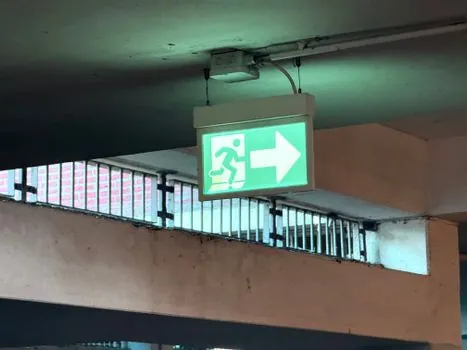
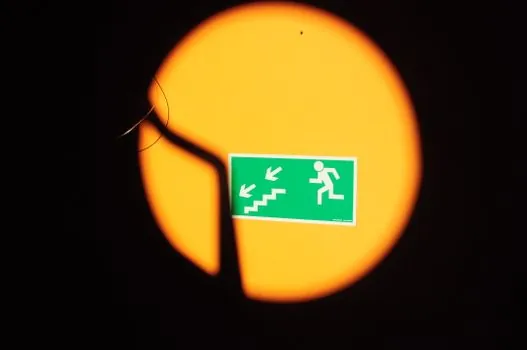
Green square signs mark the conditions firefighters need protected during an incident: the running-man "fire exit" pictogram with directional arrow above doors and along escape routes, assembly-point signs at the muster area, first-aid stations, emergency telephones, and safe-refuge points [S1][S2].
The shared green-and-white scheme keeps these signs recognisable under smoke and low light, which is why ISO 7010 places them in a single category rather than mixing colours. For facilities designers, the green egress series is also where photoluminescent or internally illuminated variants are most often specified, because the escape route is the one path that must remain legible after a power loss.
Selection criteria comparison: which sign for which job
A specifier choosing warning signs for a firefighting-relevant site can line the four practical categories against four decision criteria: shape, primary colour, ISO 7010 reference category, and typical firefighting use [S1][S2][S3].
The four main sign types are: (1) Fire equipment sign, red square, category E, identifying extinguisher, alarm call point, hose reel, blanket; (2) Hazard warning sign, yellow triangle, category W, marking flammable materials, oxidisers, hot-work areas; (3) Mandatory sign, blue circle, category M, holding fire doors shut/clear and PPE rules; (4) Prohibition sign, red circle with diagonal bar, category P, blocking "No smoking" or "No water on metal fires" actions [S1][S2][S3]. The two non-applicable categories (green rescue/safe condition and any non-ISO custom sign) do not replace these four on a firefighting-relevant site, but the green egress series is always required alongside them.
Limitations, failure modes, and sourcing standards
The most common failure mode is a sign with the right text and the wrong category: a flammable-liquid cabinet marked with a red "no smoking" prohibition rather than a yellow-triangle flammable-material warning, or a Class D metal-fire area with a generic extinguisher sign instead of a "do not use water" prohibition [S1][S3]. A second failure mode is an extinguisher sign without the class letter, which removes the fuel-to-agent pairing and forces a decision under stress.
Sourcing should be against ISO 7010 graphical symbols, the equivalent European standard EN ISO 7010, and the local fire-safety regulation (in the UK, the Regulatory Reform (Fire Safety) Order 2005); UK workplace display is a legal requirement, not a recommendation, and pictograms must be used rather than text-only signs wherever the workforce includes non-readers or visitors [S1][S2]. For a complementary view of how hazard pictograms are paired with substrate and material spec gates in industrial environments, the industrial gas cylinder sign and lab gas safety map covers adjacent hazard-class territory.
Two trackable signals: confirm the extinguisher sign at every extinguisher carries the class letter matching the fuel hazard (Class A/B/C/D/F), and verify the yellow-triangle flammable-material pictogram sits next to every red fire-equipment sign covering that fuel so a single glance gives both hazard and response.
Spec-level background on the components involved: warning sign, warning tape, and pressure transmitter.