
Industrial buyers in 2026 lock the first aid kit specification on three inputs: the ANSI/ISEA Z308.1-2021 kit class (A or B), the OSHA 29 CFR 1910.151 "adequate" test, and the response-time window the facility can actually meet [S3][S6].
The decision is not the bag — the bag is a deliverable vehicle. The decision is whether the kit's contents meet the worst credible injury at that workstation, in the time the nearest medical professional can be reached, and the kit's packaging meets the labelling and minimum-fill requirements an OSHA inspector or ANSI auditor will look for [S3].
What ANSI/ISEA Z308.1-2021 Actually Specifies
ANSI/ISEA Z308.1-2021 is the US national standard for minimum contents and performance of Class A and Class B first aid kits and their supplementary supplies, with a 2021 update that added a 5-year expiry-dating requirement for solutions and a bleeded-control kit option; the standard also mandates a label that conforms to ANSI Z535.1 for hazard and use information [S3]. Class A kits are sized for the most common workplace injuries — minor burns, abrasions, sprains, minor eye injuries — and are intended for use in lower-hazard, lower-headcount environments; Class B kits are designed for higher-hazard or larger-population sites and add a bleeding-control kit (tourniquet, hemostatic gauze, pressure bandage, chest seal) plus a broader size assortment of dressings and burn dressings [S3].
OSHA 29 CFR 1910.151 ties the kit back to the facility: in the absence of an infirmary in near proximity, a person adequately trained to render first aid must be available at the worksite, and "adequate" first aid supplies must be readily available — a test OSHA interprets through Z308.1 conformance plus the hazard survey [S3]. The kit itself is a deliverable, but the procurement spec must include the expiry-dating field, the label conformance statement, and the lot-traceability document, or the kit is not compliant on paper.
Class A vs Class B: Decision Criteria Compared
Class A vs Class B is a four-criterion call: hazard level, head-count, response time, and inspector visibility. Hazard level drives the bleeding-control requirement — any task with rotational equipment, sharp tooling, hydraulic lines, or vehicular movement inside the facility moves the site into Class B territory and forces a bleeding-control sub-kit [S3]. Head-count: ANSI/ISEA Z308.1-2021 sizes minimum-fill quantities per kit (e.g. a Class B 50-person kit has a defined minimum of 4× 4" gauze, 2× 8"×10" dressings, 1× burn dressing 4"×4", and the bleeding-control add-on), and the calculation is not one-kit-per-employee but one-kit-per-risk-cluster matched to headcount in that cluster [S3].
Response time: if a medical professional is more than a few minutes away, Class B's bleeding-control components are the differentiator, because direct pressure plus a tourniquet within the first 3-5 minutes is the window that decides survival on a severe arterial bleed [S6]. Inspector visibility: a kit in a soft pouch with no Z535.1 label and no visible expiry date will be flagged; purpose-built metal and polypropylene cabinets (such as the FIRSTAR Deluxe Tin First Aid Box for Travel Home at $3.60-$5.00) or wall-mountable plastic cases with printed ANSI label areas are the safer specification [S2][S3].
Kit Class, Mount Style, and Container Material

Container choice and the first aid kit form factor are downstream of the class, not independent. Soft-pouch kits (polyester 600D, ~20×15×8 cm) are typical for mobile crews and vehicles, but the pouch itself does not satisfy Z308.1 minimum-fill visibility — the kit is a package, and the contents list with expiry dates must be affixed or insertable [S3][S2]. Wall-mountable polypropylene or metal cabinets with a piano hinge and a breakable seal are the default for indoor fixed installations; the FIRSTAR Deluxe Tin First Aid Box range (0.4-0.5 mm tinplate, baked-enamel finish, with internal tray and cross-divider) is typical of the consumer/home-grade container class, with 282 SKUs and 85 accessory SKUs in the supporting catalogue [S2][S5].
Mounting location also drives the spec: kitchens and food-processing sites need a dust-sealed gasketed case (typically polypropylene with a silicone gasket, IP54-class) because of the wash-down environment; construction and oilfield sites need a high-visibility yellow or red case with tamper-evident seal and reflective ANSI Z535.1 label; vehicle kits need a vibration-tested hard case with a foam-lined tray so contents do not migrate [S1][S3]. PCNA's promotional-channel kit range (4 brands, 10 colour codes, 4 decoration methods) shows the same logic — colour-coded cases (blue, black, clear, gray, white) are not aesthetic, they are a Z535.1-style way to drive recognition across multi-site operations [S4].
Supplementary Supplies and the Bleeding-Control Sub-Kit
Class B kits and many high-hazard Class A kits now ship with a standalone bleeding-control kit (BKC / IFAK) as a labelled inner pouch; the 2021 Z308.1 revision made this an option that is effectively mandatory for any Class B site with a hazard survey pointing to crush, laceration, or amputation risk [S3]. The BKC typically contains a CAT or SOF-T wide tourniquet, compressed gauze, hemostatic gauze (kaolin or chitosan-impregnated, with FDA 510(k) clearance), a 6" emergency pressure bandage, and a chest seal (vented, 14G needle decompression optional) [S3].
Beyond the BKC, supplementary supplies are where procurement leaks money: antihistamine and burn-gel single-dose packets (typically 0.9 g sachets with 3-5 year shelf life), cold packs (ammonium nitrate squeeze, instant-activation, 5"×9" standard, 24-month shelf), eye-wash bottles (sterile saline 16 oz or 32 oz, FDA OTC monograph compliance), and CPR barrier masks with one-way valve [S1][S3]. When the site has an eye wash station plumbed in, the kit's eye-wash supply is a buffer for the 10-15 second walk between incident and station; the kit is a bridge, not a replacement for plumbed ANSI Z358.1 emergency eyewash.
Expiry Management and Lot Traceability

The 2021 Z308.1 update formalised what good sites already did: every solution, gel, and sterile dressing carries an expiry date that must be visible on the kit, and the inspector reads it. A typical expiry matrix: sterile gauze/dressings 5 years from manufacture, saline eye-wash 2-3 years (sterility), ammonium nitrate cold packs 24 months (slow nitrogen loss), medications (antihistamine, glucose, analgesic) 1-3 years depending on formulation, hemostatic gauze 3-5 years, tourniquets 5+ years (mechanical, but the windlass strap has a UV-degradation limit) [S3][S6].
Lot traceability is the other half: every kit needs a manufacturer's lot number, a manufactured-on date, an expiry date, and a contents list tied to that lot, so a recall on a specific component (e.g. a hemostatic gauze recall) traces to every shipped kit, not to a guess [S3]. This is also where a pressure transmitter or flow meter procurement spec is a useful analogy: the spec sheet carries the model code, the serial range, the material certificate, and the calibration record — a first aid kit procurement spec carries the same four fields, just with different units.
Where the Selection Fails in Practice
Three failure modes dominate. First, a Class A kit is installed in a Class B hazard environment: no tourniquet, no hemostatic gauze, no chest seal, and the first 5 minutes of a severe bleed are wasted. Second, expiry management is calendar-based, not kit-based: a site rotates supplies into a central bin and back, and a pouch that expired 18 months ago keeps appearing in the wall mount because nobody logged the kit serial. Third, the kit is placed where the incident cannot reach it — inside a locked office, behind a door that requires a badge, in a cabinet above a chemical storage line [S3][S6].
The fix is procedural and is owned by EHS, not by procurement. The kit is a once-a-quarter inspection item: contents vs Z308.1 minimum-fill, expiry dates, seal integrity, mounting location, and a documented refill log. Cross-reference this with the fire door and fire-extinguisher inspection cadence — the fire door selection audit logic (rating, hardware, signage) and the fire-door inspection cadence map cleanly onto a first aid kit audit, and the same inspector can cover both with a shared checklist.
Sourcing, Standards, and Trackable Signals
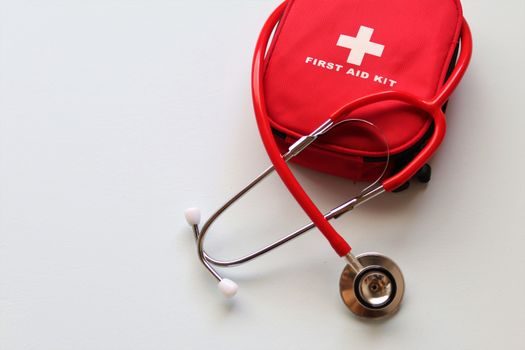
The procurement trail: a Class A or Class B kit is sourced from an ANSI/ISEA Z308.1-2021-conformant manufacturer (FIRSTAR, Acme United, Cintas, Honeywell, Medline are common US/EU channels), the spec sheet carries the class designation, the minimum-fill table reference, the lot number, and the expiry matrix, and the PO line carries the unit count plus the supplementary SKUs (BKC, eye-wash, cold pack, burn gel) as separate lines so the audit trail does not collapse into one undifferentiated bag [S2][S3][S4]. EU buyers should also reference DIN 13157 / DIN 13169 for the equivalent German workplace standard, and EN 13164 for vehicle kits, as the ANSI standard is a US benchmark, not a global one.
Trackable next signals: the 2026 Z308.1 maintenance cycle (5-year revision) is the next governance event to watch, the rise of BKC-only public-access kits in schools and transit hubs is the most visible market-direction signal, and the integration of kit telemetry (NFC tag on the pouch opening that logs inspection) is the procurement differentiator that will separate commodity pouches from specification-grade kits over the next 18-24 months [S1][S3].