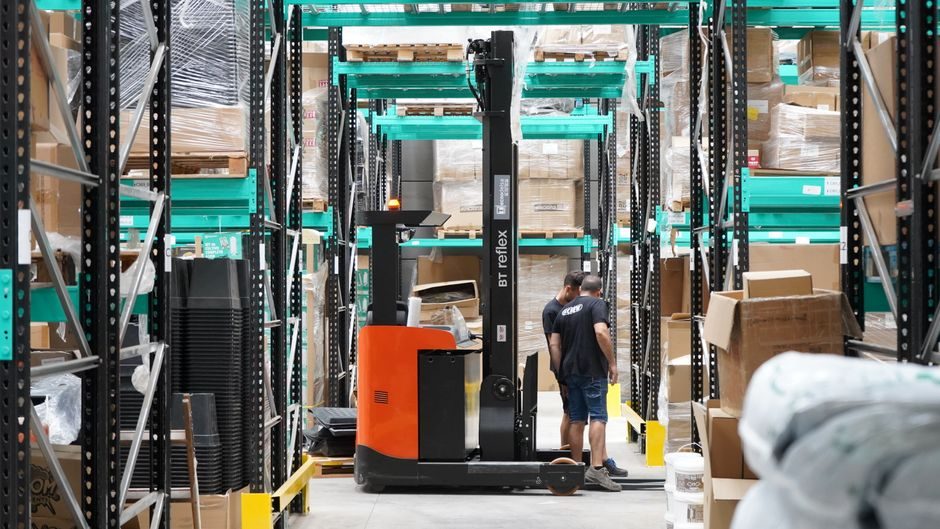
Fixed gas detection in a warehouse is a coverage problem, not a gadget problem: sensor count, sensor technology, and mounting geometry drive whether you catch a forklift-propane leak or a refrigeration ammonia release before the vapour cloud reaches an ignition source [S1][S3].
Across industrial catalogues the same five families recur: single-channel toxic detectors (e.g. NH3 at 0-50/100/200 ppm [S2]), combustible-gas detectors, multi-gas detectors, refrigerant-leak detectors, and oxygen-deficiency monitors [S1]. A warehouse typically needs a mix, not a single SKU, and the trade-off between electrochemical, catalytic-bead, infrared, and semiconductor sensing drives the bill of materials.
What a warehouse fixed detector must actually do
Three failure modes dominate warehouse gas incidents: a refrigerated cold store releasing ammonia after a compressor seal failure, a battery-charging room accumulating hydrogen above 4% by volume, and a propane/LPG forklift bay pooling heavier-than-air vapour near the floor [S3]. Each one demands a different sensor family, a different mounting height, and a different alarm threshold ladder.
Detectors in this class are designed as permanently installed 4-20 mA or relay-output transmitters, paired with a control panel that handles alarms, voting logic, and shutdown contacts [S1][S3]. Point Safety's fixed-gas catalogue (Crowcon, Honeywell, Analox product lines) groups these as "Fixed Systems," with sub-lines for control panels, explosion-proof sensors, infrared point detectors, and open-path detectors [S1]. Dräger positions the same architecture as a "fixed fire and gas detection system" with engineering support, not an off-the-shelf box [S3].
Sensor technology selection by warehouse hazard
Electrochemical cells are the workhorse for toxic gases such as NH3, CO, H2S, Cl2, and NO2; the ATO GD300-NH3, for example, ships in three calibrated ranges — 0-50, 0-100, 0-200 ppm — priced at $754.13 per unit, suited to refrigeration plant rooms rather than occupied storage aisles [S2]. The lower the range, the faster the cell responds to TLV-level excursions, but the shorter its service life in humid environments.
Catalytic-bead (pellistor) sensors remain the default for combustible hydrocarbons at or below the lower explosive limit (LEL), and infrared point detectors are the upgrade path when silicone vapours, hydrogen, or background oxygen shifts would poison a pellistor [S1][S3]. For battery rooms, hydrogen-specific electrochemical or palladium-NMOS sensors are specified, because H2 has a wide flammability range (around 4-75% vol) and a very high diffusion coefficient — it leaks out of any enclosure faster than methane.
Warehouse engineers routinely pair these into a multi-gas detector head at the panel side, while the field devices remain single-channel fixed gas detectors on a star topology [S1]. This keeps spare-parts inventory low: one type of pellistor, one type of EC cell, one type of IR source.
Coverage geometry: how many detectors, where

Detection coverage is governed by the physical property of the gas. Ammonia (molar mass 17 g/mol) is lighter than air and stratifies near ceiling level; propane (44 g/mol) pools at floor level; refrigerant blends such as R-449A sit somewhere between [S1]. Mounting height is not optional — a combustible-gas gas detector installed at 2.4 m in a propane-forklift aisle will miss every credible leak.
Rule-of-thumb sensor spacing in unblocked warehouses is 7-12 m for LEL combustible detectors at floor level, and 5-8 m for ceiling-mounted toxic detectors, narrowed where racking creates dead-air pockets. Dräger's published engineering practice explicitly calls for "gas mapping" at the design stage, using 3D modelling to place detectors in stagnation zones [S3]. Gas Monitor Point's fixed-systems product tree mirrors this: detectors, open-path beams, control panels, and calibration gas are sold as a designed package, not individual items [S1].
Area classification, outputs, and integration
Where forklift battery chargers, propane storage cages, or ammonia plant rooms sit inside the same building, the detector head is typically explosion-proof (Ex d) or intrinsically safe (Ex i) depending on zoning [S1]. Honeywell's fixed catalogue alone lists explosion-proof sensors, intrinsically safe transmitters, and infrared detectors as distinct sub-families — the zoning dictates which sub-family the spec can call out [S1].
Output protocols are largely 4-20 mA analog with optional HART, relay, or Modbus RTU; the control panel collects contacts and drives beacons, sounders, and shutdown of fuel valves or refrigeration compressors. For ammonia-refrigeration warehouses, a toxic gas detector is usually hardwired to both the fire panel and the BMS, so the same alarm triggers ventilation ramp-up and refrigerant shutoff. Cross-zoning with voting logic (e.g. 1-out-of-2 or 2-out-of-3) is a common way to suppress nuisance trips from a single failing sensor.
Calibration, service, and total cost of ownership
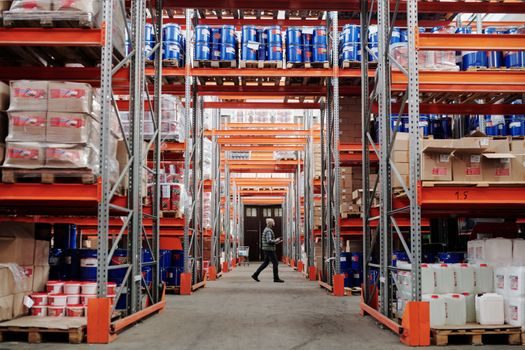
Every detector family has a different service interval. Electrochemical toxic-gas cells are typically 12-24 months, catalytic-bead sensors 6-12 months, and IR sources 12-24 months, with bump-test gas applied every 30-90 days depending on the safety-integrity target [S1]. Point Safety's service menu explicitly splits calibration into "Fixed System Service" and "Self Calibration Equipment," reflecting that most sites send detectors back to a lab rather than gassing on-site [S1].
For combustible gas detector selection in a warehouse, the dominant cost driver after purchase is calibration gas and replacement sensors over a 10-year horizon; an ATO-class NH3 detector at $754 per point [S2] amortises differently than a $1,500-class IR hydrocarbon head with a 5-year cell warranty. When covering forklift bays plus battery charging plus a cold store annex, a portable gas detector is normally added for supervisor bump-testing and confined-space entry, sitting alongside the fixed array rather than replacing it.
Selection criteria and who this spec is for
Use a fixed detector array when the warehouse has any of: ammonia refrigeration, propane/LPG forklift charging or storage, battery-charging rooms above a few dozen kW, solvent storage, or a hot-work maintenance programme. Do not rely on fixed detection alone in open-sided warehouses with strong crosswinds, where dispersion outruns sensor response; in that case, add open-path IR beams across door lines [S1][S3].
A practical spec filter, in priority order, is: target gas and required range (e.g. NH3 0-50 ppm vs 0-200 ppm [S2]); sensor technology matched to the gas (EC, pellistor, IR, semiconductor); mounting height and zone classification; output protocol compatibility with the existing panel; calibration interval and gas availability. Procurement teams should treat the engineering hours for gas mapping and zoning as non-optional, since Dräger's own positioning is that the system is "only as effective as the planning which goes into it" [S3]. For an electrical-room or switchgear-room cousin to this spec, the Fixed Gas Detector Selection for Electrical Work: Spec Map article covers the sensor mix for that adjacent use case.
Track the next node by validating the gas list against the warehouse's hazardous-area classification drawing, confirming detector-to-panel cable distances against the 4-20 mA loop budget, and booking the first bump-test-gas delivery against the planned commissioning date [S1][S2].