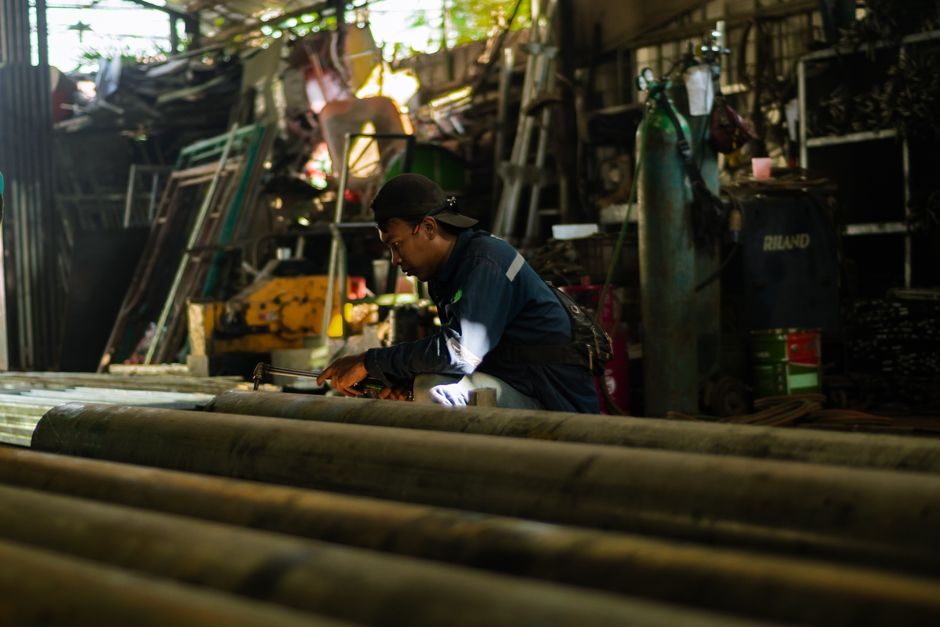
Welding bays generate a four-hazard gas envelope — oxygen depletion from inert shielding gas, combustible fuel-gas leaks (acetylene, propane, natural gas), toxic CO/NOx from the arc, and VOC/particulate fume — and a correctly specified fixed gas detector stack must address all four with a sensor per hazard [S4].
ATO lists its GD300-series fixed detectors with selectable measuring ranges of 0-50/100/200 ppm for NH3 and 0-100% Vol for N2, with 4-20 mA and RS485 output options at USD 742-754 list price [S1][S4]. MSA Safety's fixed-portfolio flagship ULTIMA X5000 gas monitor, FL5000 MSIR flame detector, and Chillgard 5000 ammonia monitor are positioned as the integrated detection layer for oil and gas, utilities, and general industry [S3].
Hazard Map: What Welding Actually Puts Into the Air
Shielding-gas leaks (argon, CO2, helium) act as simple asphyxiants, so an O2 sensor set to alarm at 19.5% Vol (deficiency) and 23.5% Vol (enrichment) is the baseline for any enclosed welding station [S4]. Combustible fuel-gas accumulation is monitored with a pellistor or infra-red LEL sensor; ATO's fixed LEL detectors are commonly paired with the GD300-NH3 unit when welding-grade ammonia is present in nearby refrigeration or process lines [S4]. Arc by-products — ozone, NO, NO2, CO — require dedicated electrochemical cells, and fixed CO detectors in the 0-500 ppm range are typical for fabrication shops welding carbon steel with CO2-rich shield gas [S3][S4].
Stainless and high-alloy welding additionally produces hexavalent chromium fume and Mn fume; a toxic gas detector with the correct electrochemical or PID cell must be specified separately from the combustible/O2 loop because no single sensor covers both families. Sensidyne's SensAlarm Flex all-in-1 platform and Plus-Series sensors explicitly market continuous monitoring of combustible, toxic, and O2 channels from a single head, which is a common configuration on shop-floor arrays [S2].
Sensor Technology Comparison for the Welding Hazard Set
Three sensing principles dominate welding-bay fixed detection, and selection is driven by the target gas, not by vendor preference. Infra-red (NDIR) sensors are the default for combustible hydrocarbons and CO2 because they are poison-resistant — important in welding environments where silicone fume from anti-spatter sprays can kill pellistor LEL beads. Electrochemical cells cover O2, CO, NO, NO2, H2S, and NH3 at ppm resolution and low power draw, which suits 4-20 mA loop-powered heads like the ATO GD300 series [S1][S4]. PID (photo-ionisation) sensors address VOC fume from solvent-cleaned joints and from coatings; GDS Instruments markets the PIDScan 800 as a fixed PID detector using a ceramic-glass PID lamp for extended maintenance intervals [S5].
The decisive spec axes are: target gas and range (e.g. NH3 at 0-50/100/200 ppm vs N2 at 0-100% Vol), output protocol (4-20 mA analog for legacy DCS, RS485 Modbus for modern PLCs, HART for hybrid), enclosure rating (ATEX/IECEx Zone 1 for flammable solvent co-presence, IP65 minimum for shop-floor wash-down), and response time T90 (typically <30 s for electrochemical toxic, <10 s for IR LEL) [S1][S2][S4]. A side-by-side read on three representative fixed heads — ATO GD300-NH3, MSA ULTIMA X5000, and GDS PIDScan 800 — illustrates the option spread rather than a recommendation, because the right pick is hazard-driven.
Selection Criteria Engineers Actually Use
Four decision gates govern a welding-bay fixed detector bill of material, in this order: hazard identification per the site's arc/process map, sensor-to-gas matching, certification/classification match to the zone, and integration with the existing fire-and-gas controller or PLC [S2][S3]. MSA Safety's fixed portfolio explicitly bundles gas and flame detection (FL5000 MSIR, FL500 UV/IR) under one safety layer, which is the architecture most EPCs now write into welding-bay FGS cause-and-effect matrices [S3]. Sensidyne ships SensConnect monitoring as the controller layer that aggregates SensAlert ASI, Plus-Series sensors, and SensCast wireless into one map, reducing the head-count on a welding line [S2].
For greenfield welding shops, the typical bill of material is one O2 head at 0-25% Vol, one LEL infra-red head at 0-100% LEL, one CO head at 0-500 ppm, plus optional NO2 and PID heads; each head is wired 4-20 mA to a multi-channel controller with relay outputs to the shop's ventilation interlock. Gastech's published guidance for fixed gas detection on offshore FPSOs — enclosed welding habitats on rigs share the same logic — is to layer point detectors at breathing-zone height plus open-path IR over long welding bays, with detection triggering mechanical ventilation, gas shutoff, and evacuation alarm in that priority [S6]. For a deeper read on how this architecture scales to first-responder PPE, the Portable Gas Detector Selection for Firefighting: 2026 Spec Map walks the same sensor stack from the personal-monitor side.
Output, Wiring, and Controller Integration
Welding-shop retrofits still lean heavily on 4-20 mA because that signal rides on legacy fire-and-gas loops and trips relay-based ventilation contactors without protocol conversion [S1][S4]. New builds are moving to RS485 Modbus RTU for multi-drop wiring (one cable, up to 32 heads), with HART retained where the existing DCS already speaks it; ATO ships both 4-20 mA and RS485 as selectable options on the GD300 series [S1][S4]. For very large fabrication halls, Sensidyne's SensCast wireless layer is the option when running cable is impractical — e.g. across crane bays — and the controller side collapses to a single SensConnect gateway [S2].
Controllers must have a SIL-rated logic solver for the welding-bay safety function, because the FGS typically drives gas shutoff, ventilation start, and evacuation; Sensidyne positions its "Gas Detection Controllers" line as the aggregating layer, while MSA bundles the logic into the broader Connected Safety stack [S2][S3]. Multi-gas detector heads that combine O2 + LEL + CO + H2S in one housing reduce conduit runs but force a single point of failure on the bay, so most welding-shop specs still split the hazards across dedicated heads for fault tolerance.
Certification, Zone Classification, and What to Verify on the Datasheet
Any fixed detector within a welding bay is normally in a hazardous-area classification — Zone 1 if the bay handles solvent cleaning or co-located flammable gas, Zone 2 for general fabrication — and the head must carry ATEX 2014/34/EU or IECEx certification matched to the zone, plus the gas group (IIA propane, IIB ethylene, IIC acetylene/hydrogen). Ingress protection IP65 is the shop-floor minimum to survive wash-down and grinding dust. Engineers should confirm the published measuring range covers both the alarm threshold and the full-scale excursion: ATO's GD300-NH3 lists selectable 0-50, 0-100, and 0-200 ppm ranges, which is a workable spread for an ammonia refrigeration plant adjacent to a welding bay [S4]. For an O2 displacement hazard, the head must reach 0-30% Vol to bracket both the 19.5% deficiency and 23.5% enrichment alarms [S1][S4].
Calibration interval is the other spec that quietly dominates lifecycle cost: electrochemical CO/O2 cells typically drift and need a 90-day bump-gas check, while NDIR LEL and ceramic-glass PID lamps run 6-12 months between services. GDS positions the PIDScan 800's ceramic-glass PID lamp as a long-interval service item, which matters when the detector is mounted 6 m above a welding cell on a remote crane column [S5]. Sensidyne's Certified Factory Service program is the safety-officer's fallback when in-house bump testing is not staffed, and that program explicitly supports fixed gas detection alongside air sampling and detector tubes [S2].
Common Failure Modes and Sourcing Reality
Three failure modes show up repeatedly on welding-bay detectors: pellistor LEL poisoning by silicone from anti-spatter spray, which mandates switching to NDIR; electrochemical CO cross-sensitivity to hydrogen generated by water-shielded MIG, which is mitigated by a hydrogen-scrubber filter on the cell; and PID lamp fouling by oil mist, which forces routine window cleaning in heavy fabrication [S2][S5]. Sourcing reality as of mid-2026: Sensidyne designs and manufactures in St. Petersburg, FL; MSA's July 2026 quarterly results were released 30 July 2026 and the company completed its acquisition of Autronica Fire and Security on 9 July 2026, which broadens the fire-and-gas bundle available to welding-shop EPCs [S3]. GDS is Singapore-based and serves the PID niche globally; ATO is a Chinese direct-to-OEM source with the lowest published unit price among the four [S1][S4][S5].
Trackable signals to watch over the next quarter: whether MSA integrates Autronica flame detection into the ULTIMA X5000 controller line, whether Sensidyne expands the Plus-Series sensor menu to include NO2 cells for stainless welding, and whether ATO publishes an ATEX/IECEx variant of the GD300 series for European fab shops. Engineers specifying a new welding-bay FGS in 2026 should treat the O2/LEL/CO triad as non-negotiable, add NO2 only for stainless work, and reserve PID for solvent-laden processes; for a broader view of the gas-detection taxonomy, the combustible gas detector and gas detector reference pages lay out the underlying sensor principles.