
Laboratory fixed gas detection differs from a refinery or offshore deck spec chiefly in sensor density, gas target list, and zoning: room-scale coverage, low-ppm toxic thresholds, and bench-to-fume-hood siting rule the day, not flame or LEL perimeter arcs [S1][S6].
Honeywell, Dräger, Gastech, and the Chinese OEMs (K800 series, ATO GD300, GEWEE) all publish 4-20 mA + RS485 Modbus transmitters in 2/3/4-wire formats, with ATEX/IECEx certification as the common baseline for lab build-outs under European and most APAC electrical codes [S1][S4][S6].
Sensing Technology Matched to Lab Gas Targets
Electrochemical cells are the dominant pick for Cl2, NH3, H2S, NO2, and CO at low ppm because the working curve stays linear into the sub-10 ppm region where lab TLVs live; ATO's GD300-NH3 ships in selectable 0-50, 0-100, and 0-200 ppm NH3 ranges to match the bench-scale use case [S3]. NDIR (non-dispersive infrared) is the established choice for CO2 and most refrigerants because it is non-consumptive and unaffected by lab humidity swings.
Output Protocol and Wiring Topology
Modern lab transmitters all converge on two physical layers: an analog 4-20 mA loop (HART-ready on higher-end units) and a digital RS485 Modbus RTU channel for multi-drop daisy-chaining back to a BMS, LIMS, or a Dräger/Vesda-style controller [S1][S4][S6]. 2-wire loop-powered units cut conduit count in retrofit labs; 3-wire and 4-wire units add a dedicated power pair and an isolated relay output for solenoid shutoff on the fume hood, which is usually mandatory once gas cabinets or H2 cylinders enter the room. The K800-series spec sheet confirms the 2/3/4-wire menu, RS485 Modbus, and explosion-proof housing built for ATEX zones where a lab gas cabinet is co-located with electrical gear [S4].
Certification, Zoning, and Cross-Border Compliance
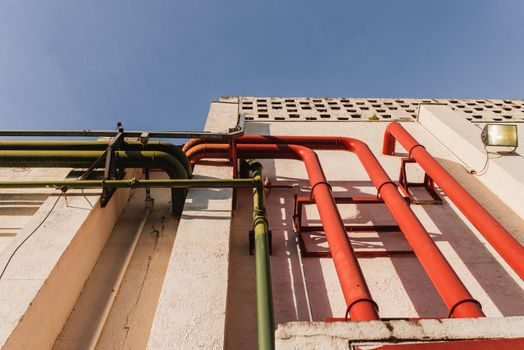
ATEX (EU) and IECEx (international) are the two certifications that show up on essentially every lab-grade fixed detector in 2026 OEM catalogs; UL/CSA appear on North-American builds, and China-Ex / CCC sit on domestic Chinese supply [S2][S4][S6]. GEWEE explicitly lists ATEX, IECEx, SIL, FM, CSA, and CE on its industrial portfolio, and Dräger's fixed-gas line carries the same multi-jurisdiction stack built around IEC 60079-family explosion-protection rules [S2][S6]. For a university or pharma lab the practical decision is whether the room is classified Zone 1 / Zone 2 (IEC 60079-10-1) — typically yes if you store >5 L of flammable solvent — which forces Ex d or Ex e enclosure marking on the sensor head [S2][S4].
Selection Criteria Comparison Across Lab Detector Families
On the four criteria that drive a lab spec — gas target match, output protocol, certification breadth, and form factor — the main fixed-detector families line up as follows. Honeywell and Dräger dominate the high-end with full IEC 60079 + SIL2/SIL3 stacks, 4-20 mA HART plus Modbus, and a serviceable sensor head [S1][S6]. Gastech's portfolio spans offshore-FPSO to pharma-room builds with comparable certification breadth [S7]. The Chinese K800-series delivers ATEX + UL on a 2/3/4-wire platform with 4-20 mA and RS485 Modbus, aimed at cost-sensitive Asian and Middle-East lab builds [S4]. ATO's GD300 series targets single-gas toxic monitoring (NH3, CO, etc.) with selectable ppm ranges, calibrated for fixed-point bench installation rather than wide-area coverage [S3].
Use Cases Across Lab Types
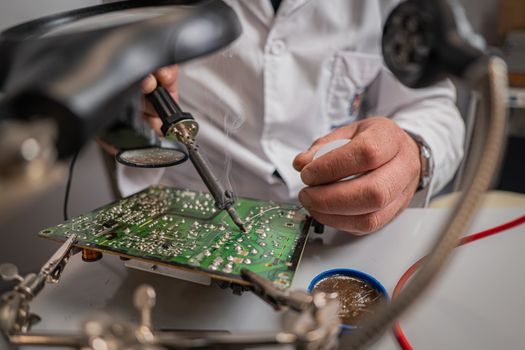
Analytical chemistry and pharma QC labs typically deploy NH3, HCl, H2S, and solvent-vapour detectors at the fume-hood exhaust manifold and at the bench gas-cabinet, with one sensor per gas in the 0-50/0-100 ppm range. Biotech and cell-culture labs add CO2 NDIR monitoring inside incubators (5% vol range) and O2 deficiency sensors (0-25% vol) in cryogenic LN2 storage rooms, where asphyxiation risk drives the spec more than toxicity. University teaching labs running methane, hydrogen, or natural-gas demonstrations need catalytic-bead or NDIR methane plus a H2 electrochemical cell, mounted 30 cm below ceiling for the lighter gases and 30 cm above floor for CO2 / solvent vapour denser than air. For a wider fixed-install context, see the spec map on construction-site deployments Fixed Gas Detector Selection for Construction Sites and the welding-shop sensor/output walkthrough Fixed Gas Detector Selection for Welding Operations: Sensor, Output, and Spec Map. [S2]
Failure Modes, Calibration Cadence, and Cross-Sensitivity
Electrochemical cells drift 2-5% per month in clean lab air and lose sensitivity at end-of-life (typically 24-36 months), so a fixed lab install must budget 6-month bump-test and 12-month full-calibration cycles against a certified span gas [S6]. Cross-sensitivity is the silent killer: an NH3 cell will react to Cl2 at a fraction of its NH3 signal, and an H2S cell will spike on NO2, which is why multi-gas detectors in mixed-chemistry labs should not share a single sensor head. Humidity above 90% RH and temperature below -10 °C degrade both electrochemical and catalytic-bead readings; lab HVAC should hold the sensor environment at 15-30 °C and 20-80% RH to keep the published accuracy spec. For a complementary safety layer on technicians entering confined lab spaces, a portable multi-gas monitor carrying its own sensor stack Portable Gas Detector Selection for Work at Height: Sensor Stack, Certification, and provides the personal-exposure backstop a fixed array cannot.
Sourcing Notes and 2026 Market Signals

Dräger's 2026 product page continues to anchor its fixed-gas line on 70+ years of in-house sensor development, marketing the proven DrägerSensor family against third-party replacement heads [S6]. Honeywell's 2026 industrial-fixed catalog groups gas-and-flame detection under its SPS (Safety and Productivity Solutions) umbrella and exposes a Product Finder keyed by category, part number, and gas target [S1]. Gastech, a multi-brand distributor published 2026-01-23, runs a fixed-gas-detection article series on offshore FPSO and riser protection that doubles as a free reference on zoning and detector placement [S7]. Trackable signals to watch: (a) Honeywell / Dräger / MSA SIL3 firmware updates and SIL re-certification announcements, (b) ATEX 2014/34/EU Notified-Body audit cycles that drop non-conforming Chinese Ex d housings, (c) any IEC 60079-0 / IEC 60079-29 revision affecting combustible-gas and toxic-gas performance verification. For an introduction to how a fixed gas detector is defined versus portable or multi-gas variants, the encyclopedia entry covers the core term set used throughout this spec map.
The underlying component specifications are covered under gas detector, and combustible gas detector.