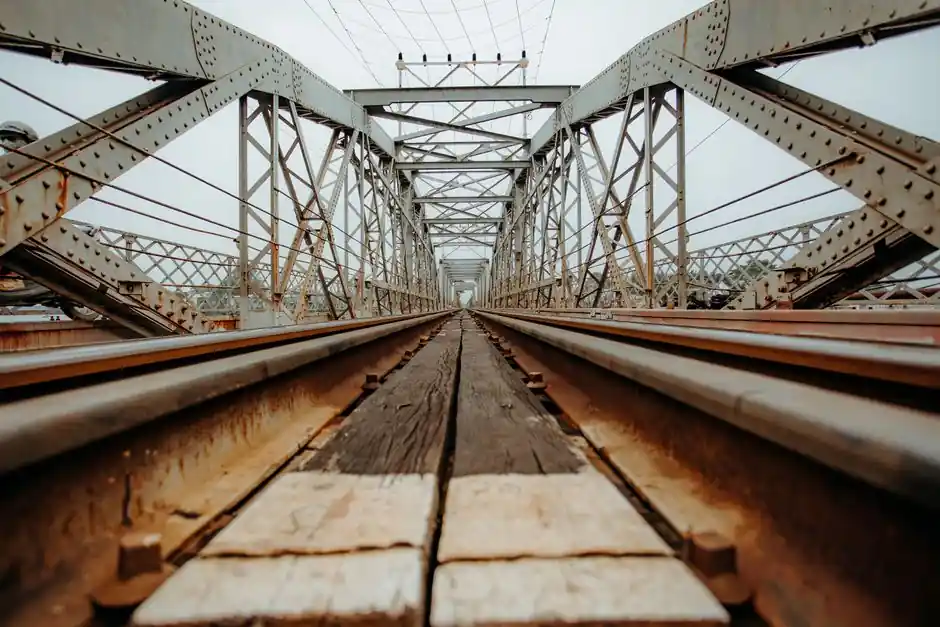
Floor-mounted chain conveyor systems provide direct product access and straightforward installation, while overhead systems use suspended tracks to move carriers above workstations, traffic lanes, and process equipment [S1][S2].
The decision depends on payload, routing, accumulation, building geometry, maintenance access, and safety requirements; overhead configurations are not simply floor conveyors with a higher installation [S3][S4].
What the two configurations solve differently
A floor-mounted chain conveyor places the drive, chain, carriers, and product path in the working area, making loading, unloading, inspection, and maintenance comparatively direct. It is generally suitable when a defined ground-level route is available and the conveyor must support moving loads without suspending them from an overhead carrier [S1][S4].
An overhead conveyor uses a powered chain or trolley arrangement above the floor to carry parts through stations such as paint booths, ovens, curing zones, assembly areas, or storage [S2][S3][S4]. Suspended carriers move through a defined path while the area below remains available for operators, forklifts, AGVs, fixtures, and support equipment [S3].
The practical distinction is space and routing. Floor-mounted equipment occupies or crosses the operating area, while overhead equipment uses vertical space and can incorporate elevation changes, curves, or switches [S2]. Overhead systems therefore fit plants where floor congestion or collision risk is a material constraint, not merely plants that want a “cleaner” layout.
Decision criteria: cost, access, routing, and load
Compare the options on four criteria: installation, product access, routing flexibility, and carrier load.
Overhead monorail systems reduce ground-level interference and support a fixed route through multiple process stages, while power-and-free overhead systems add individual stopping, accumulation, and selective routing at the cost of greater mechanical complexity and installed cost [S2][S3][S5].
These are vendor-published reference values, so the final selection must use project-specific load, temperature, duty-cycle, and safety data rather than substituting them for a design calculation.
Where floor-mounted chain conveyors fit

Specify a floor-mounted chain conveyor when operators must repeatedly load, unload, inspect, or manually intervene at product level, and when the route can remain clear of pedestrian and vehicle traffic. The roller conveyor alternative is often preferable for stable, level products, while a chain conveyor remains appropriate when a positive chain drive, controlled movement, or a defined powered sequence is required. [S2]
Typical floor-side applications include inbound and outbound movement between storage and assembly, transfer between machines, and line-side delivery where the conveyor is the intended operator interface. Product geometry must permit stable engagement with the chain or slat, and the layout must leave room for guarding, cleaning, take-up access, and safe removal of the carried item.
The route must be checked against pedestrian paths, forklift routes, workbenches, utilities, and emergency exits. If these conflicts cannot be resolved without rerouting the entire line, overhead transport should be evaluated rather than adding guards or local transfers to a poor floor layout.
Where overhead track systems fit
Choose an overhead configuration when product must cross a busy work zone while leaving the floor below available, when the process sequence includes elevated equipment, or when a suspended carrier provides the required product orientation. Overhead chain conveyors are used in finishing lines, surface treatment, painting, curing, and high-volume internal transport [S3][S4].
The three principal overhead arrangements differ by function. Enclosed track protects the chain and trolley wheels inside a formed-steel rail, reducing exposed chain debris and supporting clean environments. I-beam monorail uses an exposed running rail and can move parts through workstations, paint booths, ovens, or storage areas [S2]. Power-and-free uses a powered chain plus a separate carrier rail so trolleys can stop, accumulate, enter sidings, or transfer to another route [S2][S3][S5].
For specification discipline, overhead chain suppliers state that their systems range from loads of a few grams to 10,000 kg, but this broad capability range does not replace a carrier-specific rating [S3]. Load variation, chain pitch, curve radius, support spacing, drive tension, thermal exposure, and attachment geometry must be selected together. Structural support must also be checked because overhead systems transfer operating and defect loads into roof trusses, building columns, or purpose-built support steel [S5].
Routing, accumulation, and process timing
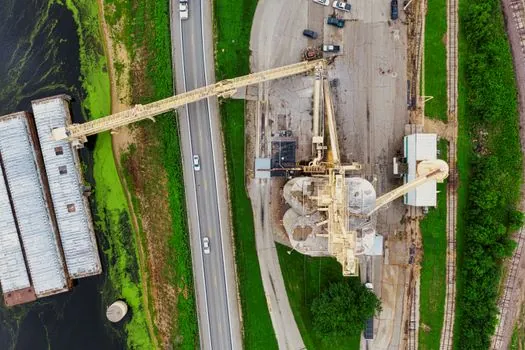
Single-line monorail systems are appropriate for standardized products, predictable cycle times, and continuous or indexed movement through a fixed sequence. Power-and-free systems are stronger when work must accumulate between stations, individual carriers must stop, or routes must diverge, because the powered chain continues while carrier movement is controlled by engagement devices [S3][S5].
Enclosed-track systems are suited to light assembly, garment and electronics finishing, and clean areas, but their enclosed geometry constrains direct observation of internal chain movement. I-beam monorail systems provide visible access to the running rail and suit continuous paint and foundry flows, while power-and-free systems provide the greatest routing flexibility [S5].
The comparison can be reduced to four questions. Does the process need individual stopping? If yes, power-and-free is normally the stronger overhead choice. Is maximum carrier load below 400 lb and cleanliness critical? Enclosed track may be suitable. Are heavy carriers or temperatures approaching 220 °C involved? I-beam monorail warrants evaluation using project-specific data [S5]. If operators require continuous floor-level access to every transfer point, a floor-mounted conveyor may remain more practical than an overhead system.
Failure modes and maintenance constraints
Both configurations can become production bottlenecks when transport behavior is not matched to the process. For overhead lines, conveyor speed and carrier spacing can determine throughput, accumulation, product spacing, and line stability; a transport mismatch can therefore create a bottleneck outside the paint booth, oven, tank, or curing zone [S3].
Overhead chain lengthens through service because of wear, requiring inspection, repair, replacement, or compensation through a take-up arrangement [S1]. Chain and trolley replacement are normal lifecycle work, and a supplier describes a typical engineered overhead-chain service life of 25–35 years with periodic component replacement; this is a reference expectation, not a warranty [S5].
Floor-mounted systems avoid difficult overhead access but put drives, chains, slats, and transfer points within the operating zone, where they remain exposed to impact, contamination, and housekeeping problems. Maintenance planning must cover tension adjustment, sprocket and chain inspection, guard removal, lubrication where applicable, and access around the product path. The practical advantage of a floor layout is that these tasks are easier to reach, while its disadvantage is that the service footprint competes with production space.
Sourcing and safety information for the comparison
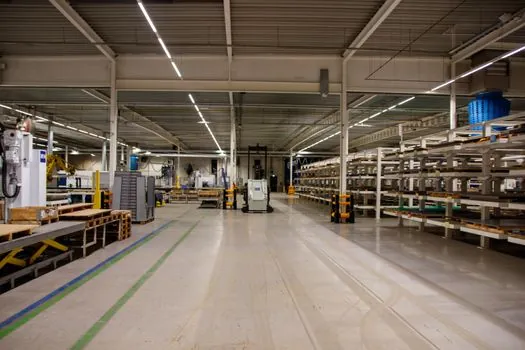
Request a project-specific load envelope rather than one “maximum capacity” value. The data package should define individual carrier load, maximum and minimum product dimensions, expected load variation, carrier pitch, line speed, cycle rate, accumulation requirement, curve radius, elevation change, temperature exposure, atmosphere, cleaning method, and maintenance access [S3][S4].
For an overhead project, also request support-steel loads, attachment details, drive arrangement, control philosophy, emergency-stop coverage, and guarded-access requirements. One referenced decision guide for overhead conveyor clearance addresses an 8 ft pedestrian clearance and a 10 ft forklift rule, but site geometry, powered industrial truck equipment, and the applicable risk assessment determine the actual installation [S6][S7].
Use recognized manufacturer documents and applicable national or local machinery-safety rules for guarding, emergency stops, maintenance access, and overhead support design. No single general reference establishes a universal floor or overhead conveyor rule for every plant. Procurement should compare vendor ratings, drawings, controls narrative, spare-parts strategy, and commissioning tests against the same application data.
A defensible selection record should state the decisive constraint: floor access, available support structure, process accumulation, carrier load, thermal exposure, route conflicts, or installed-cost target. Review that record after the first 2 or 3 process stations are laid out, because a conveyor that works in an isolated layout can become uneconomic once transfers, guard access, and floor traffic are included.