Wet, food-grade conveyor lubrication provides a continuous lubricating film for chain and slider contact, while dry products depend on a carrier and dry friction modifiers [S1][S2][S3].
The decision is application-specific: wet lubrication fits conveyor surfaces and package formats requiring repeatable film performance, whereas dry lubrication reduces oil attraction to airborne dirt but has lower efficiency, wear resistance, and single-application longevity [S1][S2][S3].
Decision Criteria for Food-Grade Conveyor Lubrication
Lubricant selection should be based on four measurable conditions: contact mode, contamination exposure, cleanability, and relubrication frequency. A wet lubricant forms a film between metal surfaces, and film strength generally governs how well the two surfaces are separated [S3].
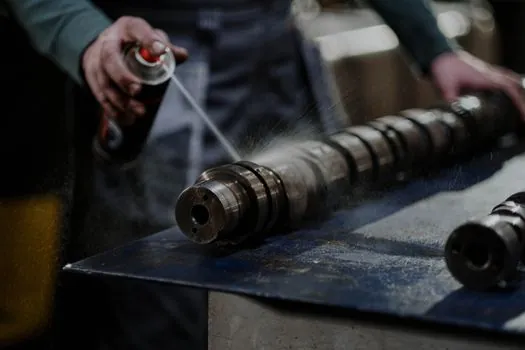
In the bicycle-chain discussion, dry lubricant is described as a carrier base with dry friction modifiers added, using PTFE powder as an example [S3]. The carrier transports particles to the contact zone, but this does not create the same continuous oil film as wet lubrication [S3].
For conventional food handling, wet lubrication is the defensible default when the conveyor can be kept clean. Dry lubrication becomes more credible where the design prohibits liquid lubricant collection, or where a narrowly controlled application requires a non-wet residue. Neither category should be selected by cost alone.
Wet Lubrication Performance in Food Handling
Wet lubrication uses a base oil with friction modifiers, and the oil penetrates chain links and forms a separating film between contacting surfaces [S3]. Lubodrive Pro is identified as an all-purpose, food-grade wet lubricant for multiple conveyor surface types and package formats [S1].
This makes wet lubrication suitable for conveyor lines handling packaged food where a repeatable lubricating film matters. Oil-based lubricant attracts dirt, whereas dry lubricant has no oil to attract dirt [S3].
That limitation is controllable, but not optional. The conveyor requires a defined cleaning and lubrication schedule, with inspection of chain links, slider contact, product-contact surfaces, and drainage paths.
Dry Lubrication Benefits and Technical Limits
Dry lubricants attract less dirt than oil-based wet lubricants and are often lower-cost because their constituent materials can be inexpensive [S3]. These are secondary benefits, not proof of superior conveyor performance. In the available comparison, dry lube ranks lowest for efficiency, wear, and single-application longevity [S3].
Each chemistry must be reviewed separately for food-contact exposure, residue behavior, equipment compatibility, and cleaning validation; the broad label “dry” does not establish suitability.
The carrier in dry lubricant helps transport friction-modifying particles to the area between the chain's inner and outer links [S3]. Food-grade marketing language alone is not enough for acceptance.
Comparison of the Main Lubrication Options
In the bicycle-chain comparison, wet lube has higher film strength, while dry lube attracts less dirt [S3].
Dry lubes are typically very cheap to buy because their materials can be inexpensive [S3]. That comparison does not include labor, lubricant consumption, chain replacement, or sanitation work.
Semi-dry lubrication occupies the middle operational position because it behaves like wet lubrication while using a more concentrated formulation [S2]. It may reduce free oil while retaining a lubricating phase, but the supplied material provides no quantitative residue threshold, washability result, or wear data. Use it only after a product-specific validation and compatibility review.
Application Recommendations by Operating Environment
Use wet, food-grade lubrication for ordinary packaged-food conveyor service when the line can be cleaned and the application point can be controlled [S1]. This is the preferred route where continuous metal-to-metal or chain-to-slider contact occurs and reliable chain life is required.
Use dry lubrication only where wet lube is operationally excluded, such as locations without liquid collection, drainage, or controlled cleaning [S2][S3]. Do not infer that a dry product can replace routine chain inspection. That figure is not a conveyor rating, but it demonstrates that wear monitoring remains necessary.
For installations combining both approaches, segment the conveyor by load and exposure rather than forcing one specification across the line. The chain conveyor design should identify lubrication zones, product-contact boundaries, cleaning access, and the component supplier’s lubrication limits before the lubricant chemistry is fixed.
Food-Grade Validation, Sourcing, and Failure Controls
A lubricant trial should record application method, quantity per unit time, belt or slider surface, chain type, package format, washdown temperature, washdown chemistry, and observation interval [S1]. Record repeatability rather than relying on one successful operating shift. Food-grade claims must be supported for the exact formulation and intended application, not for a broad lubricant family.
Several failure modes require separate controls. Wet-lube failure is usually contamination accumulation, excessive application, poor drainage, or inadequate cleaning. Dry-lube failure can arise from rapid carrier evaporation, inadequate residual coverage, unsuitable modifier chemistry, poor transfer to the contact zone, or residue that interferes with cleaning [S2][S3].
For chain selection, verify the manufacturer’s lubrication recommendation and operating limits for the actual conveyor chain, attachment style, pitch, and load. If the conveyor uses a moving belt rather than a chain, the belt conveyor surface and product-contact constraints take precedence. The material must also be checked against any chain pull calculation, as described in Calculate Conveyor Chain Pull with Friction Factors.
Final acceptance should include three measurable records: product-contact approval for the exact lubricant, a written cleanability result after the plant’s worst-case wash, and a wear or line-performance comparison against the incumbent method. If wet lube meets those criteria, specify it. Move to dry or semi-dry only where wet collection creates an unresolved food-safety, drainage, or equipment-compatibility problem.