
A sanitary sump application differs from product pumping: the duty may include washwater, CIP chemicals, fruit pulp, peel, leaves or other debris, so the wetted materials, motor protection, discharge route and cleaning regime must be specified together [S1][S2][S4].
Define the sump duty before choosing a pump
Start with measured flow, not a pump catalog horsepower. Specify normal and peak inlet flow, discharge head or pressure, suction condition, fluid density and viscosity in cP, operating temperature in °F or °C, and the size and concentration of solids [S2][S4].
Food and beverage plants should avoid oversizing because an oversized pump raises purchase cost and operating cost and can operate outside its efficient operating range [S3]. As a general selection rule, pumps should operate at 30% to 60% of the rated capacity, with the final operating point checked against the manufacturer curve at the plant frequency, 50 or 60 Hz [S3][S4].
Distinguish four services before comparing equipment: clear plant water, washdown, CIP chemical service and solids-bearing waste. For deeper pump-type selection, see Centrifugal Pump Selection for Food and Beverage.
Compare the principal pump architectures
Submersible solids-handling pumps are suited to wastewater pits containing peel, pulp, leaves and other debris, provided the impeller or grinder can pass the stated solids [S1].
Solids handling should be evaluated for clogging, and a solids-handling pump architecture should be selected when required. Pump selection should match the actual service, including considerations such as shear sensitivity and solids handling.
Set temperature, motor and corrosion limits
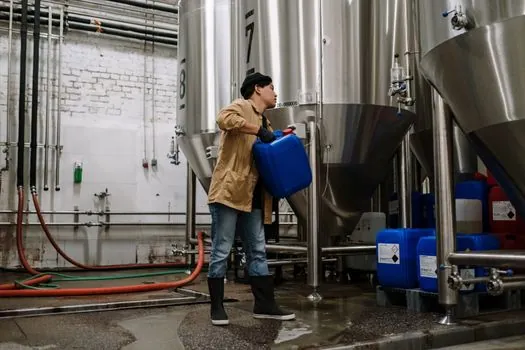
Evaluate both the waste temperature and heat generated by the motor. Both the temperature of the waste and the heat generated by the pump's internal motor contribute to the overall pump temperature requirements, and oil-filled motors and high-temperature stator windings are features to consider.
This example is a model-specific reference point, not a universal rating for all food and beverage sump pumps.
Stainless construction helps against acidic juice and CIP chemicals, but the material of construction must be reviewed for the housing, internals, shaft, fasteners and elastomers rather than for the casing alone [S1][S6]. Food-processing selection guidance identifies housing and internal materials as a primary decision point, since corrosion or contamination can damage product integrity and shorten service life [S6].
Specify a defensible sealing arrangement
Better sump pumps may use an outer seal and a chamber filled with oil, while an oil-filled motor is a feature to consider when evaluating pump temperature requirements.
Specify a seal-failure probe where the consequence of leakage is material. For shutdown logic, define alarm delay, pump-stop contact, power isolation and the manual reset sequence rather than relying on the probe alone.
A budget sump pump may be listed as "no oil" and "fish safe," while better sump pumps have an outer seal and a chamber filled with oil. Food and beverage selection should therefore use the manufacturer’s seal construction, fluid list, temperature rating and failure mode, not the informal label “food grade.”
Match hygiene criteria to the actual exposure

A 3-A Symbol authorization or EHEDG certificate addresses equipment design and cleanability, not the plant’s CIP recipe, final-product safety or every component in a product series. A 3-A Symbol authorization or EHEDG class is a hygiene criterion, while marketing language is not a certificate.
FDA food-contact listings apply to specified materials such as elastomers and polymers; they do not certify pump geometry or hygienic design [S4]. Require the authorization number, listed model, elastomer grade, wetted-material declarations and current certificates. A plant-specific 3-A, EHEDG, FDA-contact or internal SOP requirement governs procurement even when a pump is otherwise suitable.
Plan solids, discharge and operating limits
Define the maximum solid size, shape, concentration and expected debris type before choosing a clear, open impeller, recessed impeller, chopper or grinder [S1][S2]. Record whether discharge piping is 2, 3 or 4 inches, and verify that solids will not accumulate at elbows, check valves, baskets or the discharge point.
A sanitary sump pump must also tolerate the liquid level that can occur during startup, high flow, blocked discharge or failed downstream equipment. Require the manufacturer’s maximum submergence, minimum liquid level, minimum suction submergence, maximum starts per hour and maximum run time. The research provides no universal values for those limits, so they must come from the selected model and application rather than an assumed rule [S4].
For remote or unattended pits, define motor overload, thermal cutout, high-level and low-level interlocks, seal-probe alarm and manual reset. Keep the sump pump data sheet, electrical schedule, materials list and duty calculation in the same approval package.
Use a shortlist logic that prevents an audit failure

Shortlist a submersible solids or shredder pump when the pit contains visible debris, the waste reaches about 170 °F or above, or corrosion and seal reliability dominate. Shortlist a sanitary centrifugal pump for low-viscosity washwater or clean liquids with little entrained air. Shortlist positive displacement only when viscosity, shear sensitivity, metering or product recovery outweigh its solids sensitivity [S1][S2][S4].
For every candidate, require seven documents: the duty curve at 50 or 60 Hz, maximum flow and head, temperature rating, solids limit, wetted-material list, seal arrangement and certificate or authorization details. A quote without those items is not a comparable selection, and a broad 3-A claim is not a substitute for a model-specific authorization [S4].
The first trackable signal is the completed application packet: viscosity in cP, temperature in °C, solids description, flow, head, power frequency, voltage, phase and CIP/SIP exposure. The second is a witnessed test against the selected curve, including any declared solids size and the highest expected fluid temperature.