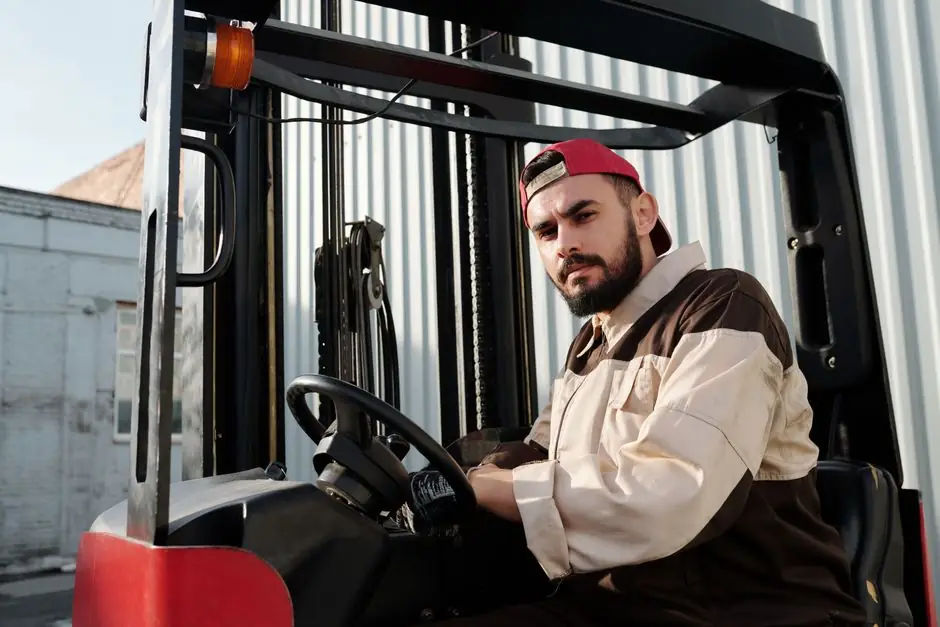
Forklift AGVs, tugger/tow AGVs, and unit load AGVs are the three AGV categories that handle roughly 80% of the pallet and trolley traffic in modern distribution and manufacturing facilities, and they are not interchangeable [S1][S2]. Each is built around a different load-transfer mechanism (lifting forks, towing hitches, or top-mounted decks/conveyors), which sets the hard limits on payload mass, aisle width, and transfer-station design.
The cleanest way to pick between them is to start from three numbers: the maximum single-load mass, the longest round-trip distance, and the required lift height. Those three values eliminate most of the candidate fleet before any vendor negotiation begins, and they line up directly with the AGV taxonomy used by integrators such as Linde MH (MATIC series) and by AGV-reference publishers [S1][S4].
What Each AGV Class Actually Is
AGV (automated guided vehicle) is the umbrella term for driverless industrial trucks that follow fixed guide paths (magnetic tape, laser contour, or natural-feature map) and stop-and-wait on collision, defined under ANSI/RIA R15.08-1-2020 as distinct from free-path AMRs [S5]. Within that envelope, forklift AGVs carry forks and lift; tugger/tow tractor AGVs hitch to and pull trains of carts; unit load AGVs ride under, carry on deck, or roll onto a transfer conveyor [S1][S3][S5].
Concretely, a tugger AGV such as the Linde P-MATIC is an autonomous electric tow tractor rated for towing loads up to 5,000 kg and is used for line-side parts delivery, waste removal, and inter-hall hauling [S4]. A unit load AGV is a deck- or conveyor-equipped carrier that often drives underneath its load and lifts it via a lift table, with typical use cases spanning pallet transport and dolly movement in distribution centers [S2][S6]. A forklift AGV is the automated version of a counterbalanced, reach, or very-narrow-aisle truck, with mast lift and forks capable of placing loads onto selective or drive-in racking [S4][S7].
Decision Matrix: Forklift vs Tugger vs Unit Load
The table below is the spec-by-spec comparison most procurement engineers want first. Numbers come from the manufacturer and integrator references cited; where a value is platform-dependent, the qualifier is called out.
On payload mass, forklift AGVs and heavy unit load AGVs cover the widest range; tuggers cap out lower per cart but move many carts in one train. A Linde P-MATIC tow tractor is rated for 5,000 kg of towed load [S4]; large unit load AGVs from builders such as DTA are specified to carry 25-ton steel coils, with custom deck configurations above that [S5]. Standard counterbalanced forklift AGVs (Linde L-MATIC class) typically handle 1.0–3.5 t lift capacities with mast lift heights of 3–8 m depending on configuration [S4].
On lift height, forklift AGVs win: only they can place loads onto selective, drive-in, or push-back racking, and they are the only class that scales to very-narrow-aisle (VNA) operation with mast heights beyond 8 m [S4]. Unit load AGVs and tuggers both stay at floor level, with the lift performed by an external station, conveyor, or roller bed [S2][S3][S6].
On aisle width and maneuverability, the unit load underride variants (also called AGCs, mouse AGVs, or self-driving carts) have the tightest turning footprint and the lowest unit cost, and they scale to large fleets in automotive and tier-1 supplier lines [S5]. Tugger AGVs need a tow-pin or hitch envelope at the back and trailing clearance for the cart train, which sets a minimum aisle width that grows with cart count [S1][S4]. Forklift AGVs need counterbalanced swing clearance or a reach-truck mast profile, typically demanding 2.8–3.6 m minimum aisle depending on pallet size.
On throughput per vehicle, tugger AGVs lead because they can pull trains of 3–6 carts in a single move, while a forklift or unit load AGV moves one load at a time [S1][S5]. On integration cost, underride unit load AGVs are the cheapest per unit and the simplest to commission, while forklift AGVs are the most expensive because of the safety-rated mast, the lift-height sensors, and the racking interface requirements [S5].
Selection Criteria: Which Class Fits Which Use Case
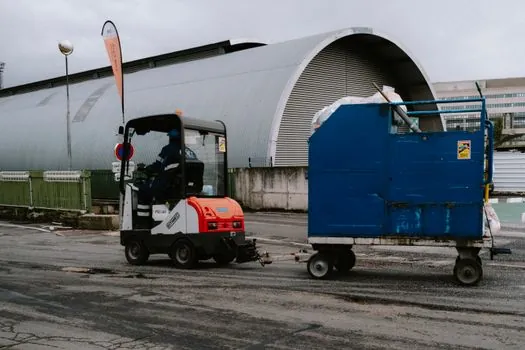
For long-distance, line-side, low-lift delivery (parts to an assembly line, empty totes back, waste removal), the tugger AGV is the right spec because the value is in moving many small loads over a long loop without manual drivers, and the 5-tonne-class tow tractor is the workhorse [S1][S4]. For pallet-in / pallet-out flows where the load arrives on a conveyor or pallet and must be moved between two floor-level stations, the unit load AGV is the lower-cost, higher-density option and is the dominant fleet type in automotive and FMCG distribution [S2][S3][S5][S6].
For any flow that ends in racking, especially selective racking above 1.5 m or any VNA, the forklift AGV is the only correct answer, because unit load and tugger classes cannot place a load at lift height [S4][S7]. The use-case map lines up with the broader AGV types by load handling method reference, which groups these classes by transfer mechanism rather than by marketing label.
For mixed-pallet warehouses where inbound is floor-level conveyor and outbound goes to rack, the common spec is a hybrid: unit load AGVs for dock-to-stage moves and forklift AGVs (reach or counterbalanced) for stage-to-rack moves, with tuggers removed entirely or limited to returns and empty-tote loops [S1][S4].
Navigation and Safety: What the Specs Do Not Tell You
AGV navigation falls into two families: track-guided (magnetic tape, magnetic spots, wire, or painted/contour line) and natural-feature navigation (laser scanner building a map of walls, racks, and fixed objects during commissioning) [S4]. Track-guided systems are cheaper and more deterministic but require physical infrastructure changes when routes are modified, while natural-feature systems allow route updates via software with no floor work [S4].
Safety follows ANSI/RIA R15.08-1-2020, which separates AGVs (fixed guide path, stop-and-wait on obstacle) from AMRs (free path, dynamic obstacle avoidance) [S5]. In practice this means every AGV in these three classes needs a rated safety scanner (typically SICK microScan3 or equivalent, PL d / SIL 2 under ISO 13849-1 / IEC 62061), defined safety fields around the load and forks, and a defined traffic-management scheme with the WMS or fleet manager. The integrator datasheet, not the brochure, is what to verify on these points.
Constraints, Failure Modes, and Common Spec Errors
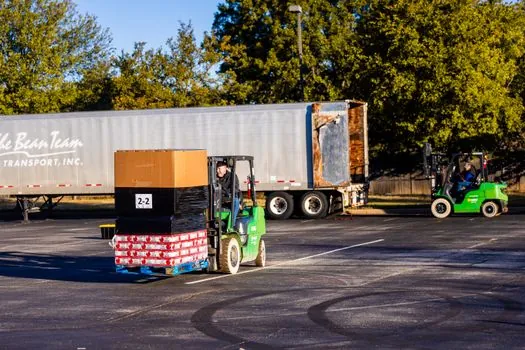
The most common spec error is choosing a forklift AGV for a long, high-throughput line-side loop where a tugger would carry the same load with a smaller fleet and lower unit cost, or choosing a tugger for a flow that actually requires placing a pallet onto racking [S1][S4]. A second common error is undersizing aisle width: tugger cart trains need trailing clearance that is rarely modeled in the early simulation, and forklift AGVs need mast-tilt and load-swing envelopes that are not captured in static AGV footprint drawings [S5].
Floor condition is a hard constraint for unit load underride AGVs: cracks, expansion joints, metal mesh, and floor flatness deviations of more than a few millimeters per meter will desync a fleet of mouse-style AGVs, and that constraint is rarely stated in marketing copy [S5]. For outdoor or rough-surface movement between buildings, a different class entirely (rough-terrain forklift, mobile robot on outdoor-rated wheels) is the correct spec, not an indoor AGV with a higher IP rating [S1].
Sourcing, Standards, and a Trackable Next Step
Spec sheets to verify at RFQ stage: rated towed or lifted load (with safety factor stated), lift height, minimum turning radius with rated load, navigation method (track-guided vs natural-feature), safety scanner PL/SIL rating, fleet manager API, WMS/WCS integration protocol, and battery chemistry with opportunity-charge behavior [S1][S4][S5]. The reference taxonomy across the three classes is consistent across manufacturer and integrator sources and tracks with ANSI/RIA R15.08-1-2020 for the AGV/AMR boundary [S5].
For deeper class-by-class detail on lift trucks versus tow tractors versus deck carriers, the AGV robot and forklift encyclopedia pages lay out the same taxonomy from the equipment side. Where the application is outdoor yards or loading docks rather than a finished-floor warehouse, a rough-terrain forklift is a different category entirely and should not be specified as an AGV substitute.
Next signal worth tracking: AGV market projections cited in 2024 industry coverage point to a $3.3 billion global AGV market by 2028, up from $2.4 billion in 2023, and unit load / underride AGV sales are the largest single segment in that data, with tugger AGVs growing fastest in line-side automotive deployments [S3]. Any RFQ written in Q4 2026 should require vendors to quote against the revised R15.08 series and to disclose natural-feature mapping versus track-guided cost separately, because that single line item is where most of the lifecycle cost now lives [S4][S5].