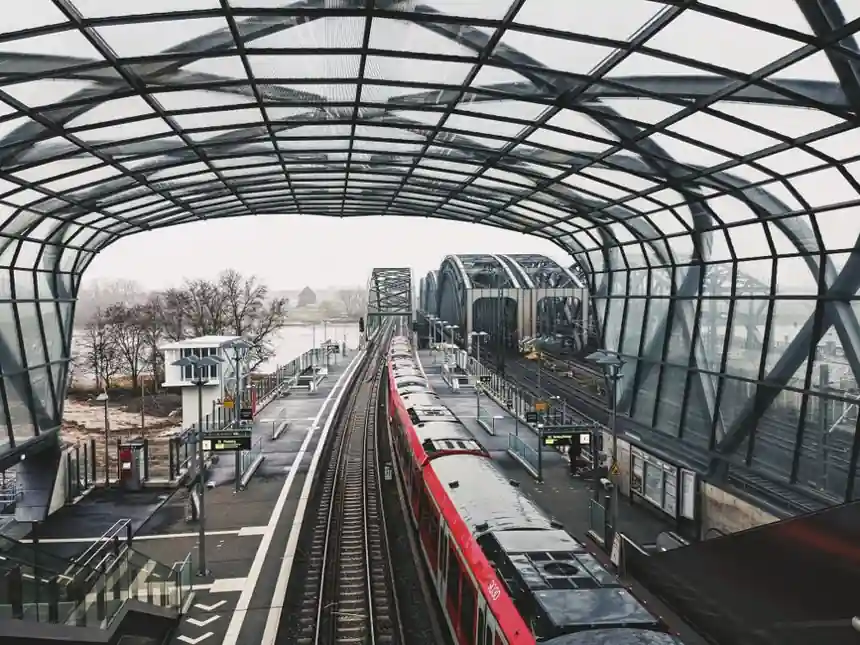
FRP use in rail now spans at least four product families: pultruded structural profiles (handrails, bridge decks, cable ducts), SMC molded rail fasteners, FRP interior panels, and mass-transit platform slab panels, with each family governed by a different fire-smoke-toxicity (FST) and qualification regime [S1][S2][S4][S7].
Pultruded glass FRP delivers axial tensile strength of roughly 240 to 690 MPa at a tensile modulus of about 17 to 30 GPa, near one tenth of structural steel (200 GPa), so FRP design in rail is governed by stiffness and deflection rather than raw strength, per the FRP composite encyclopedia entry [S6].
Four rail FRP families and what each is actually for
Pultruded structural profiles from suppliers such as the krafton/Fiberline group hold EBA approval 21.51-21izbia/030-2101#008-(011/18-ZUL) and are specified for handrails, safety rails, level crossings, bridge decks, cable ducts, work platforms and cleaning platforms alongside tracks, with exports into NS, SNCB/NMBS, DB, SNCF, RATP, CFF and FS networks [S1]. Pultruded FRP flat bars are commonly produced in 12×3 mm to 305×25 mm sizes with unidirectional glass architecture up to 70% by weight for high-modulus applications [S10].
SMC molded FRP rail fasteners replace the traditional insulated metal baseplate assembly, integrating electrical insulation between rail and sleeper so that separate insulating pads, bushings or coated clips are no longer required, and reducing the parts count at a single tie by roughly two to four components per the Tstar SMC FRP rail fastener spec sheet [S4].
Permaglass® FRP sheet and sandwich panel products from Permali cover locomotive cab crash-energy management, electrical insulation, and arc/barrier parts, supplied in sheet thicknesses from 0.3 mm to 60 mm and fabricated via 3-axis and 5-axis CNC machining [S2]. Mass-transit platform slab panels from Creative Composites Group (FiberSpan, SuperPlank, SuperDeck families) are roughly 80% lighter than equivalent concrete platforms and are designed for rapid install with light-duty equipment between train windows [S7][S9].
FST and qualification rules that decide material grade
Rail interiors and rolling stock fall under EN 45545-2:2013 hazard levels, plus UK-specific rail standards RSE/STD/013 and RSE/STD/014 Part 1 Issue A, while London Underground accepts B2 476 Parts 6 & 7 and BS 6853 App A & B for legacy lines, with UL94 V0 as a baseline for the laminate itself [S2].
Chinese-spec GFRP interior side-wall panels must meet TB/T 3138 appendix A for 45° angle burning (flame retardant), GB/T 8323 smoke density (D4 ≤ 200), and GB/T 8924 oxygen index ≥ 35, with mechanical floors of tensile strength ≥ 70 MPa, bending strength ≥ 135 MPa, and Barcol hardness ≥ 45 [S3].
Halogen-free thermoset resin systems are a baseline requirement for safety-critical Permaglass® MER20 and MER35 grades used in shoe beams and arc barriers on electrically powered units, because halogenated fire retardants corrupt the FST balance and produce corrosive smoke in tunnel-fire scenarios [S2].
Selection criteria: stiffness, FST, dielectric, weight, install method
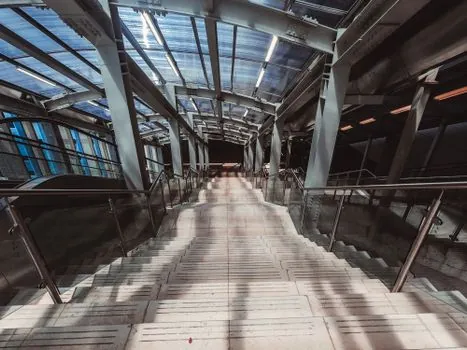
Five criteria dominate a spec-gate decision. Stiffness (modulus-driven deflection) matters most for platforms, bridge decks and handrail spans; pultruded GFRP at 17 to 30 GPa versus steel at 200 GPa means span-to-depth ratios shrink roughly 2.5× unless section depth is increased, per the FRP composite stiffness note [S6].
Fire, smoke and toxicity rating is the gating criterion for anything inside the carbody or in a tunnel platform environment, with EN 45545-2 hazard level 1 to 3 plus TB/T 3138 for Chinese rolling stock [S2][S3]. Dielectric strength and arc/tracking resistance decide fastener and barrier grade, with SMC compounds providing integrated insulation that removes pad-and-bushing stacks [S2][S4].
Weight drives the energy and emissions case: FRP slab platforms are roughly 80% lighter than concrete, and FRP interior panels at 5 mm thickness weigh no more than 10 kg/m², both figures cited in the OEM datasheets [S3][S9]. Install method is a logistics criterion: pultruded profiles and molded panels are cut-and-bolt on site, allowing rapid on-the-spot assembly around live train windows [S1][S7].
Options compared on the five criteria
Pultruded profiles score high on stiffness-per-kg and on rapid assembly but require EBA or equivalent national approval per network and are stiffness-limited for very long unsupported spans [S1][S6]. SMC fasteners win on dielectric integration and parts-count reduction but do not contribute to FST performance in the same way a fully formulated interior laminate does, so they are paired with a separate insulation system in cab barriers [S2][S4].
FRP interior panels (pultruded or molded GFRP/GRP) meet the EN 45545-2 / TB/T 3138 FST envelope and are shape-flexible for curved ceilings and luggage racks, with the 5 mm / ≤10 kg/m² weight target as the dominant design constraint [S3][S8]. Composite sandwich panels (Permaglass® design, up to 50 mm thick with FRP laminate outer skins) are the only family that delivers crash-energy absorption for cab fronts, so they are used where the locomotive crashworthiness standard applies, not as a general interior skin [S2].
FRP platform slab panels beat concrete on weight and corrosion against de-icing salts but require design verification for live load deflection and slip resistance, and they are not a drop-in for steel-grit-topped concrete without the right gritted surface treatment [S7][S9].
Use cases mapped to the four families
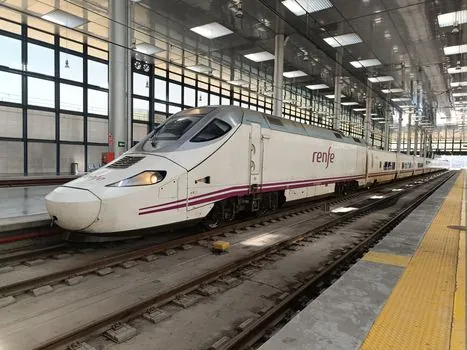
Trackside and station infrastructure (handrails, level crossings, bridge decks, cable ducts) maps to pultruded FRP profiles with EBA or equivalent national rail approval, where electrical insulation and corrosion resistance are the primary value drivers over galvanized steel [S1]. Interior carbody and cab components (side walls, ceilings, partition panels) map to FRP sheet and sandwich panel laminates that meet EN 45545-2, TB/T 3138, or RSE/STD/013 & /014 depending on the operating network [S2][S3][S8].
Rail fastening and electrical isolation (baseplates, sleeper interfaces, third-rail-sleeper zones) map to SMC molded FRP, which folds the insulation function into the fastener body and removes the pad-and-sleeve stack [S4]. Passenger-facing platform edges and slab panels at stations map to FRP slab platform panels, sized for live load, slip resistance and de-icing chemical exposure rather than just compressive strength [S7][S9].
Limits, failure modes and design traps
Low modulus is the primary design trap: an FRP beam deflects roughly ten times more than an equivalent steel beam at the same span and section, so specifying FRP by allowable stress without a deflection check is the most common engineering error in rail platform and handrail design [S6].
FST compliance is non-substitutable across standards: an FRP that passes EN 45545-2 hazard level 3 for a European mainline is not automatically compliant with TB/T 3138 smoke density and oxygen index for Chinese rolling stock, so cross-border refurbishment programmes must run the second test pass explicitly [S2][S3]. Insulating fasteners must be specified together with the rail pad and clip system; substituting an SMC fastener into a metallic baseplate assembly that still uses separate insulating pads gives no real parts-count benefit and re-introduces the original failure mode the SMC design was meant to eliminate [S4].
Platform slab panels in cold-climate networks must be checked for de-icing salt and freeze-thaw durability, not just for 80% weight saving versus concrete, because salt ingress and cyclic freeze-thaw are the dominant field-failure drivers for any composite platform near track level [S7][S9].
Standards, sources and what to track next
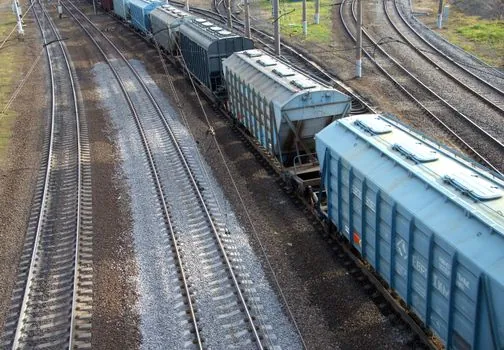
Core standards to keep on the spec sheet: EN 45545-2:2013 for European rolling stock FST, TB/T 3138 for Chinese rolling stock fire behaviour, RSE/STD/013 & /014 for UK rolling stock, BS 6853 and B2 476 Parts 6 & 7 for London Underground legacy compliance, UL94 V0 as a baseline laminate rating, and the EBA approval 21.51-21izbia/030-2101#008-(011/18-ZUL) for pultruded profiles in German and adjacent networks [S1][S2].
The next spec signals worth tracking are: (a) whether EBA-equivalent approvals for pultruded FRP profiles expand to additional European networks beyond the seven currently listed by the krafton/Fiberline group, since that list directly governs cross-border tender eligibility [S1]; and (b) the rate at which SMC molded FRP fasteners are adopted on electrified mainline and metro tracks, because parts-count reduction at the tie is the clearest economic case in the field, and procurement contracts are the earliest observable signal [S4].
The underlying component specifications are covered under steel plastic composite pipe, and pressure transmitter.