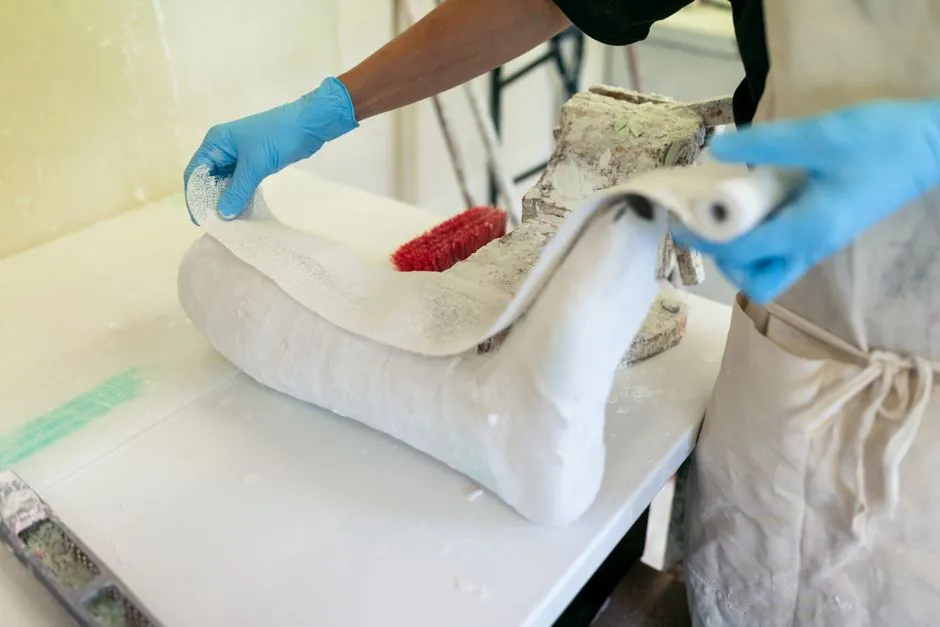
For mold and die applications, FRP grade choice is not a single material call but a stacked decision: reinforcement architecture, resin system, molding process, and the mold's own duty cycle. A Type 1 filament-wound roving laminate reaches flexural strength above 67 kg/mm² and tensile strength above 78 kg/mm² in the standard condition, while a Type 6 hand layup with chopped mat sits at 11-16 kg/mm² flexural and 5-6 kg/mm² tensile [S1].
The economic gap between these grades is roughly an order of magnitude in mechanical performance, which is why mold buyers usually over-specify the reinforcement when the tooling itself is the product. The mold must withstand repeated exothermic cure cycles without warping, and that requirement alone narrows the field to a handful of grade-and-process combinations. Buyers evaluating FRP composite tooling should anchor the spec to flexural modulus and heat distortion temperature, not to resin brand.
Grade map: from FRP1 structural to FRP7 cosmetic
Seven grade tiers, FRP1 through FRP7, cover the full strength-to-cost spectrum used in Japanese industrial FRP practice [S1]. FRP1 is specified for the highest unidirectional strength and rigidity, produced by press molding or filament winding of continuous roving. FRP2 and FRP3 use satin cloth under pressurized cure, reaching 31-35 kg/mm² flexural and 26-20 kg/mm² tensile at the FRP2/3 boundary. FRP4 through FRP7 step down through plain cloth, mat combinations, and finally mat-only contact-pressure layup, where the FRP7 cosmetic class accepts flexural values as low as 8-11 kg/mm² [S1].
For mold bodies, pultrusion dies, and compression molds carrying hydraulic tonnage, FRP1 and FRP2 are the practical floor. Hand layup at FRP4-FRP6 level is reserved for pattern shells, gel-coat backers, and prototype tooling where the part is the FRP piece, not the mold for FRP pieces. Buyers looking at closed-mold routes should consult the casting mold reference for how metal pattern practices translate, because the same draft, venting, and surface-class logic applies to FRP tooling.
Reinforcement architecture drives mold life
Fiber form and orientation are the dominant levers in FRP mold life, not resin upgrades. Directional roving and woven satin cloth raise stiffness along the load axis, while chopped mat and contact-pressure layup give isotropic but lower performance [S1][S5]. For a mold expected to survive thousands of cure cycles, continuous roving aligned with the dominant thermal-stress direction is the spec to write; balanced fabric is the right call only when the load is multi-axial.
Sandwich construction with foam or honeycomb cores is increasingly common in large FRP mold shells, adding bending stiffness at minimal weight for patterns above roughly 2 m² [S5]. A 3-6 mm gel-coat surface plus a structural laminate behind it remains the standard finish stack for cosmetic FRP parts, and the same stack is what boat builders use for hull mold surfaces [S6]. Edge zones and clamping flanges get localized extra plies, because those are where the cure exotherm concentrates and where the mold is most likely to warp on the first 50 cycles.
Process match: hand layup, RTM, compression, pultrusion

Hand layup (wet layup) suits FRP4 through FRP6 grades and small-batch or large-pattern work where tooling cost must be held down; surface class depends entirely on the pattern finish and roller consolidation. Resin transfer molding (RTM) and light RTM move the process into the FRP3-FRP4 band with two finished surfaces and predictable wall thickness, which is why RTM is the default for vehicle body shells and repeatable panels [S5]. Compression molding of sheet molding compound or bulk molding compound pushes the mold into the FRP1-FRP2 mechanical band, with hydraulic clamp tonnage and heated matched-metal tooling.
Pultrusion is a separate case: the die itself is the mold, and an unplanned die blockage typically requires 4-8 hours to clear, including line cooling, die extraction, cleaning, and requalification before production restarts, which can erase an entire day of output on a two-shift line [S3]. For pultrusion dies, the spec gate is wear resistance at the die entrance, chrome or hardened steel liners, and heating uniformity along the die length. Buyers comparing closed-mold options across resin systems will find a useful side-by-side in this FRP composite selection map for automotive body panels, which lines up the same processes against different cost-and-volume targets.
Resin system: polyester, vinyl ester, epoxy
Polyester is the default for general-purpose FRP molds and die backers, vinyl ester is the upgrade when chemical or moisture exposure is in scope, and epoxy is reserved for high-mechanical-stability tooling where creep and elevated-temperature performance matter [S5]. For mold exotherms, the resin's peak exotherm temperature and the laminate's heat distortion temperature together set the safe cycle ceiling; vinyl ester typically allows faster cycles than general-purpose ortho polyester, but epoxy is the only practical choice for tools running above roughly 120°C continuous mold surface.
Boat mold practice reinforces the same rule: the mold must release heat from the resin cross-linking reaction without distorting, which is why high-heat-distortion gel coats and post-cured epoxy tooling are the standard for production hull molds [S6]. Buyers writing RFQs for FRP tooling should specify the resin family, the peak exotherm, and the post-cure schedule, not the resin trade name, because the same trade name can hide a 20°C swing in heat distortion between grades.
Selection criteria for B2B mold buyers
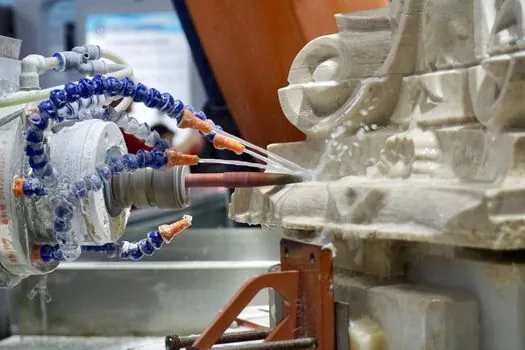
A practical spec gate for FRP mold and die selection runs on five checkpoints: part geometry and surface class, FRP material system and process window, production volume and cycle time target, tooling durability under repeated exotherm, and supplier engineering support [S4]. A mold that meets the first three but fails on the fourth will warp; a mold that meets all four but lacks supplier process data will underperform on cycle stability. The cheapest quote on a 50,000-cycle automotive panel mold is rarely the lowest total cost.
For low-volume pattern work (under roughly 500 parts), FRP4-FRP6 hand layup on a master pattern is the economic choice, and the master itself is often an FRP-faced composite over a wood or plaster backup. For medium volume (500-20,000 parts), RTM or light-RTM with an FRP2-class tool is the default. For high volume (above 20,000 parts) or tight tolerance, compression molding against a metal tool is usually specified, and FRP is then the part material, not the tooling material. Buyers tracking mold-class decisions alongside the casting-mold logic for adjacent parts can cross-reference this casting mold spec gate for how the telecom enclosure industry handles enclosure-grade tooling under similar volume bands.
Limitations and failure modes
FRP molds fail in three predictable ways: surface microcracking from repeated exotherm, warping at clamping flanges from uneven reinforcement, and gel-coat delamination from poor cure or contamination. The 4-8 hour die-blockage window in pultrusion is a process-control failure rather than a mold failure, but it shows up at the tooling stage as the cost of inadequate die-entry geometry [S3]. A mold quoted without a stated reinforcement schedule and a stated post-cure is a mold that will be re-quoted within the first year.
FRP is also not the right call when the part is metallic, when the cure temperature exceeds the resin family's heat distortion by a wide margin, or when the part specification demands mold life above roughly 100,000 cycles without resurfacing. For telecom enclosures, structural automotive panels above Class A surface, and high-volume packaging, the spec gate typically routes to metal tooling or hybrid FRP-faced metal [S4].
Sourcing and supplier qualification
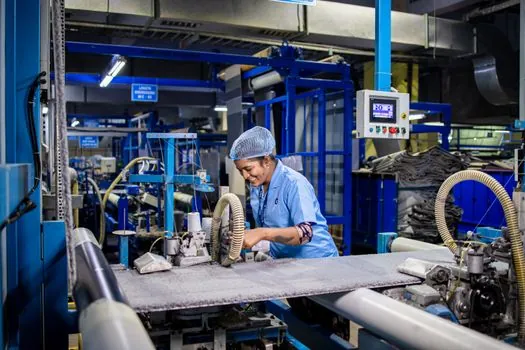
Qualify an FRP mold supplier on five items before issuing a PO: written reinforcement schedule by zone, resin system and post-cure record, mold cycle life warranty with a stated cycle count, in-house machining and pattern capability, and a sample part with dimensional report on the first article. ISO 9001 certification is the minimum floor; for automotive Tier 1 buyers, IATF 16949 process discipline on the mold line is the practical requirement, and a supplier that cannot produce first-article dimensional reports is not qualified for production FRP tooling [S4].
For buyers in construction, infrastructure, and industrial equipment, the steel-plastic composite pipe and sand casting mold encyclopedia entries cover adjacent tooling decisions where FRP and metal compete as the mold material. Tool-and-die shops that already run pultrusion, RTM, and compression molding in-house are the lowest-risk suppliers, because the mold quality tracks the shop's process discipline more than the quoted reinforcement stack. For B2B buyers tracking the broader tooling and equipment supply chain, the construction machinery and equipment reference maps where FRP and metal tooling decisions show up across plant and infrastructure work.
Track three signals over the next two quarters: the published flexural-strength bands for FRP1-FRP7 grades across at least two independent supplier datasheets (target: agreement within 10% on FRP2 flexural), the average quoted pultrusion-die life in production runs above 5,000 hours, and the cycle-time penalty between hand layup and RTM for the same panel geometry on supplier test reports. A divergence of more than 15% on any of these between suppliers is the cue to re-qualify.