The weld and heat-affected zone in the AA6082 study had a fine-grained microstructure and high tensile strength compared with welds produced by conventional arc-welding methods [S3].
The comparison depends on alloy temper, joint geometry, loading direction and defect acceptance, but controlled solid-state FSW commonly outperforms arc-welded aluminum in tensile and fatigue performance [S3][S5].
Why FSW Retains More Strength in 6000-Series Alloy
FSW joins aluminum without melting it, so the joint does not develop a cast weld structure or the porosity and solidification cracking associated with a liquid pool [S5]. The rotating tool softens and forges the material while producing a fine-grained weld and narrow heat-affected zone, conditions associated with higher mechanical strength than conventional arc welds [S3].
That mechanism matters for aluminum alloy because 6000-series alloys derive much of their strength from heat treatment, and solid-state joining reduces the extent of melting that can alter the local metallurgical condition [S7].
These are process-level results, not a guarantee for every product. Joint efficiency must still be tied to the exact alloy, temper, thickness, tool design, parameter window and qualification tests, rather than inferred from a general statement about FSW.
AA6082 Evidence: Tensile, Fatigue and Distortion
AA6082-T4 tests on 5 mm plate used specimens with the weld transverse to the stress direction, and S-N tests were conducted in pulsating tension at R = 0.5, with reference tests made on the base material [S3].
The same study described the FSW bead as flush with the plate surface with little distortion, while the weld and adjacent narrow heat-affected zone had a fine-grained structure and high tensile strength [S3]. The study made reference tests on the base material [S3].
These results apply most directly to the tested AA6082-T4 extrusion geometry. They are stronger evidence than a general process claim, but they do not remove the need for coupon testing when the production joint changes thickness, temper or loading orientation.
Decision Comparison: FSW Against MIG and TIG
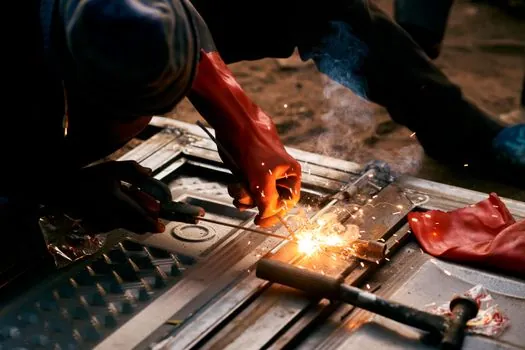
On the four criteria that matter most in production, FSW leads MIG on fatigue retention, joint efficiency potential and repeatability, while MIG remains stronger on one-off fabrication and restricted access. [S5]
TIG remains useful where a one-off design, difficult access or repair outweighs production economics [S5]. For 6000-series aluminum, process choice should therefore be based on required fatigue life and strength retention, not on tensile strength alone.
Where FSW and MIG Each Fail
MIG carries established disadvantages for aluminum: it melts the material, requires shielding gas and filler consumables, and can leave hydrogen porosity, solidification cracking and distortion [S5]. Aluminum conducts heat roughly five times faster than steel and dissolves hydrogen while molten, increasing the sensitivity of fusion welds to process control [S5].
FSW removes the melt-pool failure mechanisms but adds equipment and geometry constraints. The process depends on a backing surface, a rotating tool, axial force and travel speed; a joint that cannot react the process forces is unsuitable [S3][S5]. Conventional FSW also has geometric limitations that have produced refill friction stir spot welding, stationary-shoulder FSW and bobbin-tool FSW variants for different structures [S1].
Tool wear and parameter control remain engineering constraints. One published FSW example reports that a single tool could weld more than 2,000 m in 6000-series aluminum alloys [S8]. This demonstrates production potential, but it does not establish a universal tool life because wear varies with alloy, thickness, tool material and travel speed.
Applications Where Strength Retention Drives the Choice
Aerospace structures are a strong FSW application because low-softening-temperature aluminum alloys can be joined with consistent quality and geometric accuracy, while FSW has been developed for aerospace applications, including third-generation aluminum-lithium alloys that have become successfully weldable by FSW with fewer welding defects and improved weld quality and geometric accuracy [S1].
Automotive and battery-related structures favor repeatable machine-controlled welding, while marine and rail applications can benefit from a flush bead and low distortion. Those figures compare FSW with riveting, not directly with MIG, and should not be transferred to a welding-speed calculation without matching geometry and acceptance criteria.
For a 6000-series component carrying cyclic loading, transverse orientation is particularly important because weld orientation changes fatigue behavior. The AA6082 evidence used specimens with the weld transverse to the stress direction at R = 0.5 [S3]. A parallel or differently oriented weld needs separate qualification data.
Qualification Data Needed Before Process Selection
Qualification should separate tensile strength, fatigue resistance, distortion and defect control rather than accepting a single “stronger weld” label. The AA6082 study investigated 5 mm plate in the T4 condition, with specimens oriented transverse to the stress direction and S-N tests conducted in pulsating tension at R = 0.5 [S3]. Those concrete test conditions define what the result actually proves.
Production acceptance should also check macrostructure, weld geometry, hardness distribution, porosity, cracking and tool marks under the specified inspection regime. The broader review notes that 6000-series alloys are commonly used and gain strength from heat treatment, while FSW can compete with MIG in strength terms [S7]. That makes temper and post-weld thermal history central variables, not footnotes.
Decision rule: specify FSW for repeatable aluminum joints where fatigue performance, distortion control and high joint efficiency justify rigid tooling and access constraints; specify MIG for one-offs, field repairs and complex access where process forces cannot be reacted or where an existing qualified arc-welding procedure is required [S5].
The next trackable signals are coupon results from the intended alloy and temper, fatigue data at the actual weld orientation, and demonstrated FSW travel speed and defect rate on representative production geometry.