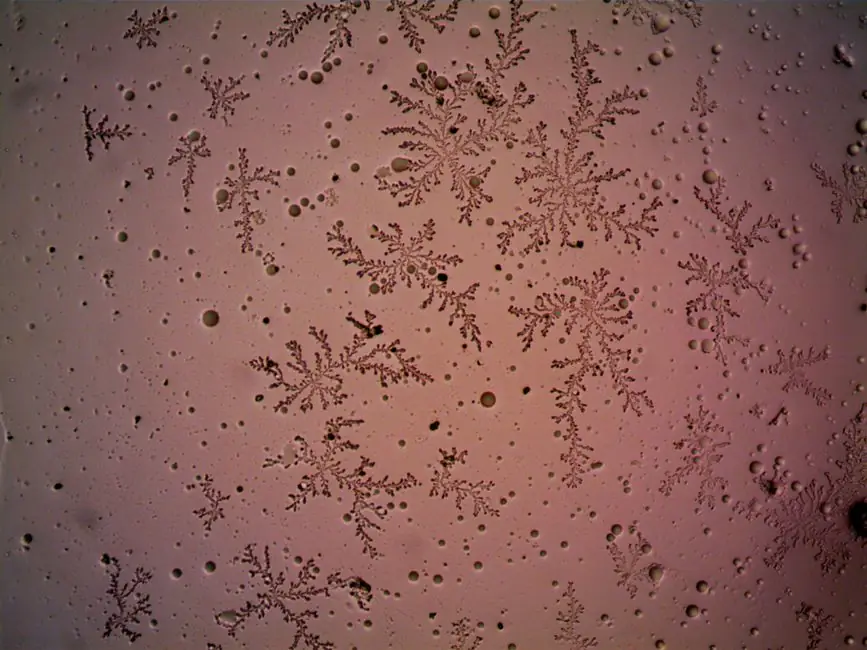
Electrolytic dendritic copper provides substantially stronger green parts because its branched particles interlock during compaction, while atomized copper supports higher packing density and easier powder feeding.
Choose CU-ED-type material when green strength and compressibility are priorities, or CU-AT-type material when flowability and apparent density are priorities.
Decision Criteria for Copper Powder Selection
CU-ED and CU-AT differ mainly in particle morphology, apparent density, flow and green strength. The named comparison grades list dendritic CU-ED at 0.65–2.7 g/cm³ apparent density and non-flowing behavior, versus spherical CU-AT at 4.0–4.8 g/cm³ apparent density [S1].
Use green strength as the primary criterion when an unpainted compact must survive ejection, transfer or handling before sintering. For continuous powder feeding or automated filling, prioritize flow rate and apparent density instead.
Why Particle Shape Controls Green Strength
Electrolytic deposition produces branched, tree-like particles, whereas atomization breaks a molten stream into droplets that freeze as spheres or irregular particles [S1][S3]. Under press pressure, dendrites mechanically interlock and resist springback, creating a green body that retains its shape before heat treatment [S1][S5].
The quoted processing requirement captures the practical consequence: “The dendritic structure of electrolytic powder (such as CU-ED) interlocks under pressure, giving excellent compressibility and green strength” [S1].
Atomized spherical powder provides excellent flowability and high apparent density, but has little green strength when pressed [S1]. Electrolytic copper powder sinters more easily at lower temperatures, while atomized copper powder can achieve higher final density if the process is well controlled [S4].
Production Variables That Modify the Comparison
Electrolytic powder is formed from a copper sulfate and sulfuric acid electrolyte, with the deposition conditions controlling particle shape and size.
After deposition, the powder is washed to remove electrolyte, annealed in a reducing atmosphere, impact-milled to break clusters, screened, classified and blended into the required particle-size distribution. Annealing temperature and reduction conditions materially affect the final properties [S3].
Atomization variables include the atomizing medium, applied pressure, metal flow rate and small deoxidizer additions. Oxide control during atomization, reducing annealing and final processing then affect apparent density, flow and green strength [S3]. As with copper powder, grade selection must therefore include particle-size distribution and chemistry, not morphology alone.
Application Fit and Failure Modes
Specify electrolytic dendritic powder when handling strength and green strength in pressing applications are important [S1]. Electrolytic powder is the better choice when compaction integrity outweighs free-flowing behavior.
Do not use dendritic powder without qualification for automated dosing or high-speed filling, because its low apparent density and non-flowing behavior can cause erratic die filling. Atomized powder has little green strength when pressed, so it is less suitable where pressing performance and green strength are critical [S1][S7]. For conductivity applications, evaluate oxide content, sintered density, pore distribution and interparticle contact resistance; powder purity alone does not determine part conductivity [S4].
Purity, Oxidation and Sourcing Requirements

Electrolytic copper powder is produced by electrodeposition, while the purity of atomized powder depends on the purity of the raw material [S1][S3]. The named comparison grades show Cu 99.0% minimum for CU-ED and Cu 99.9% minimum for CU-AT [S1].
After atomization and annealing in a reducing atmosphere to decrease surface oxide formed during atomization, the product is milled, classified and blended to achieve the required particle-size distribution [S3].
Issue the purchase specification against the selected grade, not the generic label “copper powder.” State particle morphology, apparent density, flow method and result, green-strength requirement, purity, oxygen control and particle-size distribution. For copper alloy or blended systems, require the supplier to demonstrate compaction and sintering on the production part because copper grade, additives, density and heat treatment all affect the result [S3].
Run a controlled comparison using the same press, die, fill mass and sintering cycle, and record green density, ejection load, compact integrity and final density. Treat green-strength results as route-specific: the CU-ED and CU-AT ranges establish the direction of the trade-off, but part-level validation establishes the acceptable formulation [S1][S3][S4].