A modular PEM stack production line from Cube Energy runs feeding, stacking, pressing, fastening and blanking in continuous mode with a primary-process equipment qualification rate of ≥98%, CCD visual secondary positioning at ±0.1 mm, and a press stroke accuracy of ±0.02 mm with 0.2% FS press accuracy [S1].
The same class of line from Mingzheng targets graphite- and metal-plate stacks at 2 stacks/h, with stacking accuracy of 0.1 mm, press accuracy of ±1% FS, leak detection at ±(0.8% reading + 0.2% full scale), and pressure plate flatness ≤0.1 mm for stack openings up to 1100 mm high [S2].
Stack Power Class Defines the Line Architecture
Air-cooled stack lines cover a 0.5–10 kW power range, with stack counts from 0–120 cells, inter-sheet stacking accuracy of ±0.05 mm, stack height accuracy of ±0.05 mm, and air-tightness test pressures of 0–300 kPa on a 0–3 t pressure range [S3].
Liquid-cooled stack lines step up to a 20–300 kW power range with production capacity of 1000 sets/year above the 150 kW threshold, inter-sheet stacking accuracy of ±0.1 mm at a cycle time of ≤4 s per cell, and end-plate parallelism held at ≤0.1° [S4]. Module-stacking modes span automatic, manual, and human-machine collaborative, and AGV or human-assisted transfer moves stacks between in-line and offline stations [S4].
Press Subsystem: Servo-Hydraulic vs Servo-Mechanical Trade-Off
High-capacity stack presses for large-format PEM, AEM and flow-battery stacks use a heavy-duty frame with a servo-hydraulic actuator delivering micron-level control and assembly forces above 100 t, with pressure repeatability accuracy ≤±0.5% FS via dual closed-loop control of pressure and position [S5].
For sub-3 t class lines, the same 0.1% FS pressure control accuracy is achievable on air-cooled systems running 0.7–5 N·m nut-lock torques [S3]. Lead Hydrogen's single six-axis stack assembly machine and modular stack assembly press are sized for R&D process tuning and small-batch trial production across multiple stack specifications [S6]. Selection between servo-hydraulic (higher tonnage, slower) and servo-mechanical (faster cycle, mid-tonnage) is driven by stack cell count and bipolar-plate material rather than by accuracy class, since both architectures now hold sub-±0.5% FS pressure repeatability [S5][S3].
Inline Leak Test, Fastening, and MES Data Capture
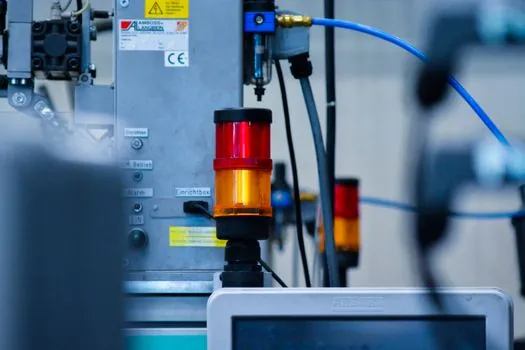
Every reviewed line integrates an online airtightness test station downstream of the U-press, with differential-pressure or flow detection selectable on the Mingzheng platform [S2]. Cube Energy's line adds an independent NG station to divert abnormal stacks without stopping throughput, and a code-scanning subsystem that binds each cell layer to the MES for full quality traceability [S1].
Fastening options split into three modes: screw, tie-rod, and side-plate, with a choice of steel-belt automatic feeding followed by laser welding on the Mingzheng line [S1][S2]. ETW International frames the stack press as the key sub-assembly that defines cycle time and compression uniformity, and pairs it with downstream cells for membrane-electrode assembly (MEA) and bipolar-plate handling [S7]. Shuntian's full stack assembly line then closes the loop with housing feed to finished-product offline on a modular frame compatible with both graphite- and metal-plate stacks of varied sizes [S8].
Comparison: Air-Cooled vs Liquid-Cooled vs R&D Stack Lines
Air-cooled lines (Jinchen [S3]) target 0.5–10 kW stacks, hold the tightest inter-sheet accuracy at ±0.05 mm, run up to 50,000 sets/year, and stay under 3 t of compression force. Liquid-cooled lines (Jinchen [S4]) jump to 20–300 kW, accept ±0.1 mm inter-sheet accuracy, and deliver 1000 sets/year at the >150 kW segment, with active end-plate parallelism control. High-capacity servo-hydraulic presses (Shuntian [S5]) and single six-axis R&D stations (Lead Hydrogen [S6]) cover the >100 t tonnage niche and the low-volume process-development niche respectively. Across all three, MES data exchange, automatic model identification, and online leak test are now standard rather than optional [S1][S2][S3][S4][S5].
Cell Count, Cycle Time, and Capacity Math
Capacity is set by two numbers: cell count per stack and per-cell cycle time. The Jinchen liquid-cooled line targets 4 s/cell on MEA plus bipolar-plate single-sheet stacking, which caps any single press at roughly 900 cells/h before downstream fastening and leak test become the bottleneck [S4].
The Mingzheng line's 2 stacks/h figure is set by the number of cells per stack, not by the pick-and-place head, and the Cube Energy line pushes higher throughput by adding parallel U-press stations and AGV-fed material flow, with the CCD camera still the binding accuracy node at ±0.1 mm [S1][S2]. For a 100-cell automotive-class stack at 4 s/cell, a single line lands near 90 stacks/shift; doubling to two presses brings a plant to the 1000–2000 stacks/year range that matches the Jinchen liquid-cooled benchmark [S4].
When a Custom Line Beats a Catalog Build
Catalog lines from Cube Energy, Mingzheng, Jinchen, Shuntian, and Lead Hydrogen cover the bulk of PEM stack formats, but specialty reactors with integrated hydrogen-purification, hydrogen-flow control, temperature control, and pressure control blocks fall outside the standard scope and require custom integration as sold by Jiuda Manufacturing's reactor assembly equipment [S9].
A process engineer should treat the catalog cell count (0–120 on air-cooled, up to 300 kW on liquid-cooled) and the press tonnage (<3 t vs >100 t) as the two hard gates, then verify the leak-test pressure range, fastening mode, and MES protocol before accepting any vendor's standard bill of materials [S3][S4][S5][S6]. For plants scaling beyond a single shift, a BMS production capacity planning reference translates the same line-balancing logic to the fuel-cell context, where stack cycle time and cell count drive the press count rather than cell format alone. Cross-link to the broader BMS PACK production line design map for the MES station architecture, and to the BMS manufacturing quality standards guide for the leak-test and torque-audit gates that now show up in nearly every fuel-cell stack RFP [S1][S2][S3][S4].
Trackable signals to monitor over the next two quarters: vendor disclosures of cycle-time gains below 4 s/cell on MEA stacking, integration of inline load cell force feedback for press control, and any move to vision-guided linear guide pick-and-place heads that tighten stacking accuracy below ±0.05 mm on liquid-cooled stacks [S4][S5].
For the relevant spec sheets and selection criteria, see additive manufacturing material.