
Industrial gas detectors in 2026 are sold in three core form factors — fixed wall-mounted units, portable single-gas units, and handheld or fixed multi-gas monitors — with the Hebei Zehong 4-gas handheld (O2, LEL, CO, H2S) listing at US$234.78-1,000.00 per piece at 10-piece MOQ and the certified industrial mining LPG fixed detector at US$93.90-110.00 per piece at the same MOQ on Made-in-China (2026-06-03) [S6].
The Sky2000 portable nitrogen (N2) detector with pump suction and LED display is listed at US$896/piece MOQ 1 from Safegas, with a 1-year warranty and customization available, illustrating the upper end of the single-gas portable band (2026-06-18). Buyers should match form factor, sensor family, and signal output (4-20 mA, relay, RS485) to the ATEX/IECEx zone, the target gas set, and the maintenance regime before comparing unit price.
Target Gas Set and Sensor Technology Pairs
Gas-Pro confined-space monitors from Crowcon cover carbon monoxide, flammable gas, O2, ammonia, carbon dioxide, hydrogen sulfide, chlorine dioxide, ozone, and sulfur dioxide in a single compact portable housing with digital display, audible + visual alarm, data logging and a fail-safe output, paired with the I-Test bump-test and calibration station (2026-06-03) [S1].
Embedded designers are also selecting discrete sensor modules: BME680, SCD41, SGP30, MH-Z19B, PMS5003, MICS-6814, CCS811 and the MQ series cover CO2/VOC/particulate/electrochemical gas detection on Arduino, ESP32 and Raspberry Pi builds (2026-06-28). The selection rule is straightforward: NDIR (MH-Z19B, SCD41) for CO2, electrochemical cells for CO/H2S/NH3, catalytic bead or NDIR for combustible CH4/C3H8, and metal-oxide-semiconductor (MQ series, MICS-6814) for VOC/ammonia broad-spectrum use where selectivity is secondary to cost.
Portable vs Fixed vs Multi-Gas: Use-Case Split
Portable single-gas units such as the GD200 series ship with a probe and calibration kit and target a single gas, suiting daily operator carry or single-hazard confined-space work; wall-mounted fixed gas detectors from GasDog provide different signal and relay outputs for 24/7 area monitoring (2026-06-28) [S4].
Handheld or fixed multi-gas detectors use multiple sensor channels to give the typical four-gas LEL/O2/CO/H2S picture, which is the minimum specified for utility, sewer and petrochemical entry; the same logic also drives fixed gas detector selection in plant rooms where 4-20 mA loops feed the DCS. The combustible gas detector sub-class, in turn, is dominated by catalytic-bead and NDIR methane sensors, while the broader gas detector category adds electrochemical toxic-gas channels.
Certification, Output and Reliability Constraints

Fixed industrial LPG detectors from Hebei Zehong carry ISO9001:2015 and ISO45001:2018 documentation and are described as "certified" for industrial and mining use (2026-06-03) [S6]. Buyers in European plants should require ATEX equipment group II category marking for zone 1/2 use, while IECEx is the parallel scheme accepted in IECEx member states — a fixed unit without one of these marks is not legal in a classified hazardous area.
Output protocol is a hard selection gate: 4-20 mA analog with HART overlay remains the workhorse for fixed gas detector loops into legacy DCS and SCADA; RS485 Modbus RTU is the common low-cost digital bus on Chinese-made fixed units; dry-contact relays drive local horns and shut-off valves without a controller in the loop. Sensor life, cross-sensitivity to humidity, and the bump-test vs calibration interval are the three reliability parameters that drive total cost of ownership, not the headline sensor specification.
Pricing Bands, MOQ and Sourcing Levers
The published price bands on 2026-06-03 listings cluster as follows: US$93.90-110.00 for a certified LPG fixed detector at 10-piece MOQ, US$234.78-1,000.00 for the 4-gas handheld at 10-piece MOQ, and US$896/piece MOQ 1 for the Safegas Sky2000 N2 pump-suction portable (2026-06-03, 2026-06-18) [S6].
MOQ tiering is the dominant cost lever for OEM buyers: the entry tier starts at 10 pieces from Hebei Zehong for both the fixed LPG and the 4-gas handheld, while Safegas on the Sky2000 N2 unit accepts 1-piece MOQ at a unit price roughly 8-9× the fixed-detector rate (2026-06-03, 2026-06-18) [S6]. Warranty is 1 year on the Sky2000 and "365 days" on the GasDog manufacturer-sale channel, which is the de-facto market norm for Chinese-made industrial gas detectors in 2026 (2026-06-18, 2026-06-28) [S4].
Application Sectors and Confined-Space Practice
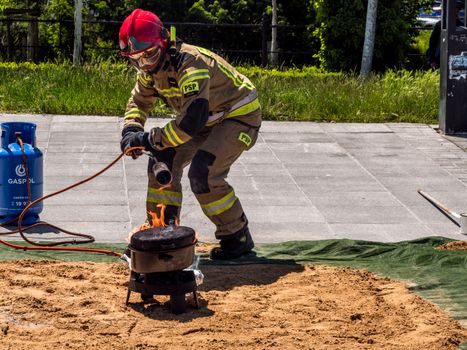
Invisible gases — CO, CH4, propane/LPG, CO2, radon, VOCs, and combustion smoke — accumulate indoors and create poisoning, fire, and explosion hazards, which is why domestic and small-commercial detectors are typically sold as multi-gas or CO/LPG dual-channel units for fixed mounting in kitchens and boiler rooms (2026-06-02) [S2].
Industrial buyers are better served by the confined-space entry pattern, where a worker enters with a portable multi-gas detector clipped to the chest, pre-calibrated and bump-tested on the I-Test station, with the Gas-Pro cited as one such confined-space solution (2026-06-03) [S1]. A bypass-quality cross check is also worth running — the crossed-roller guide encyclopedia entry is unrelated, but the same calibration-discipline mindset applies to bump-testing gas sensors before each shift.
DIY / Embedded vs Industrial Buy Decision
DIY Arduino gas-leak alarm projects using MQ-series sensors and discrete thermopile-based CO2 modules from Renesas are aimed at hobbyists and prototyping labs rather than certified safety systems (2026-06-06) [S5]. These builds trade selectivity, lifetime, and certification for low unit cost and open documentation.
For a 5-cm positional stage in a lab that also needs gas detection, the linear guide class of components is the parallel mechanical buy — same factory list, different safety class. The decision gate is unambiguous: certified industrial detectors (ATEX/IECEx, third-party test report) for any installation that protects people or process, DIY modules only for non-life-safety prototyping and education.
Selection Checklist and 2026 Watch Items

A practical 2026 selection runs in this order: (1) target gas + minimum four-gas LEL/O2/CO/H2S set; (2) sensor family — catalytic bead or NDIR for CH4/LPG, electrochemical for CO/H2S/NH3, NDIR for CO2, MOS for VOC; (3) certification — ATEX II 2G or IECEx for zone 1, IP rating for the install location; (4) output — 4-20 mA + HART for DCS, RS485 Modbus for low-cost fixed, relay for stand-alone shutoff; (5) warranty and sensor-life disclosure, ideally 24 months on the toxic-gas cell; (6) bump-test station compatibility, with the I-Test pattern as the field reference (2026-06-03) [S1].
Two trackable signals to monitor into the second half of 2026: the spread of NDIR methane sensors into residential LPG detectors (currently dominated by the lower-cost semiconductor cell), and the publication of updated IEC 60079-29-2 guidance on selection, installation, use and maintenance of detectors for flammable gases and oxygen, which historically drives the next refresh of OEM technical manuals. For a buying rule that is independent of the gas class, the same encyclopedia entry on gas detectors used as a reference above is the starting point for new specification work.
For related coverage, see VFD vs Servo Drive: 2026 Spec Cut for Motor Control Engineers.