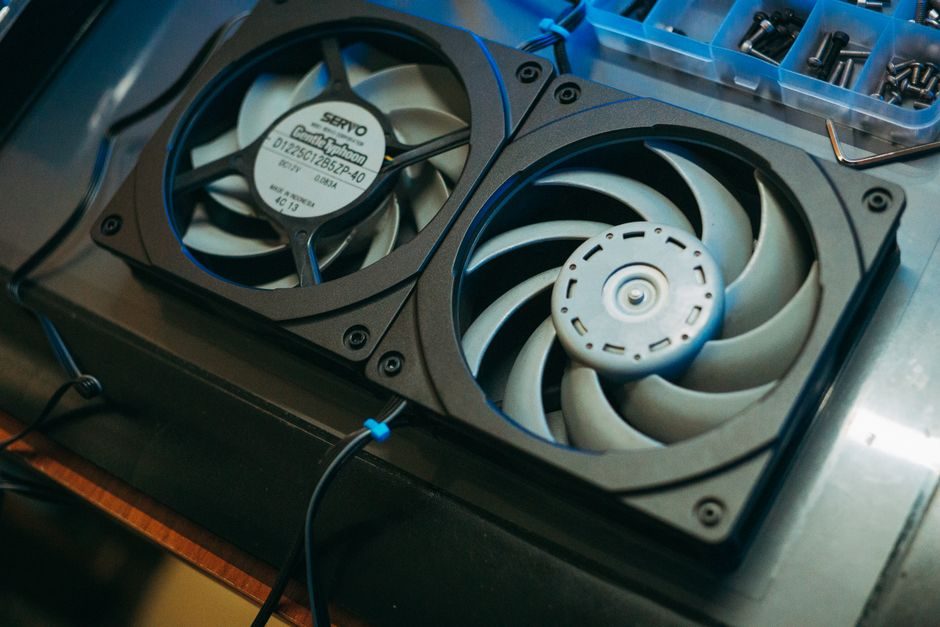
A Variable Frequency Drive (VFD) is a power-conversion device that varies the frequency and voltage supplied to an AC induction motor to control its speed and torque, while a servo drive is a closed-loop amplifier that commands a permanent-magnet servo motor to a precise position, velocity, or torque [S1][S3].
The two systems overlap on the motor side (both feed 3-phase stator windings) but diverge on feedback architecture, dynamic response, and application scope. For conveyor, pump, and fan duty the VFD dominates; for indexing, CNC feed axes, and robotics the servo drive dominates [S1][S3]. Engineers specifying motion control in 2026 should treat them as complementary tools, not interchangeable substitutes.
Working Principle: Open-Loop V/F vs Closed-Loop Field-Oriented Control
A VFD rectifies the incoming 50/60 Hz AC supply to a DC bus and re-inverts it as a pulse-width-modulated (PWM) waveform whose output frequency is adjusted to vary motor synchronous speed, which is n_sync = 120 × f / p, where f is the drive output frequency and p is the number of pole pairs of the induction motor [S5][S6]. Most general-purpose VFDs run in open-loop V/Hz mode without an encoder, which is sufficient for quadratic torque loads such as centrifugal pumps and fans.
A servo drive typically operates in a closed-loop vector or field-oriented control (FOC) mode using resolver or encoder feedback from the motor shaft, and is paired with a permanent-magnet (PM) motor rather than a squirrel-cage induction motor [S1][S3]. The PM rotor delivers higher torque density and lower rotor losses than an induction rotor, but requires the drive to know rotor angle at all times; that is why a servo drive without feedback simply cannot run a PM motor.
Control Loop Bandwidth and Dynamic Response
Servo drive current-loop bandwidths are commonly specified in the 1-3 kHz range, with velocity and position loops stacked on top, allowing step-and-hold settling times in single-digit milliseconds for typical industrial PM motors [S3]. VFD velocity-loop bandwidth in open-loop V/Hz mode is typically an order of magnitude lower, which is fine for processes where the setpoint changes slowly.
When the load is a high-inertia centrifugal pump, a VFD's slower response is actually an advantage because aggressive torque loops would trip on water-hammer or surge; here, soft-start ramp rates of 5-30 seconds are normal, and the cost of a VFD is a fraction of a servo system. For a CNC ball-screw feed axis, by contrast, the VFD's loop is far too sluggish: position errors of even 0.1 mm at 10 m/min feed rate are intolerable, and the servo drive's millisecond-level correction is mandatory [S3].
Precision and Repeatability
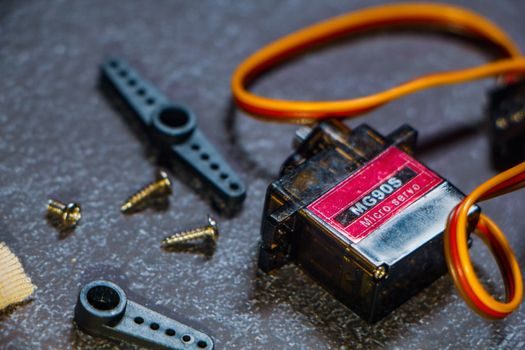
A VFD running an induction motor in open-loop V/Hz mode delivers speed regulation of roughly 1-3% of setpoint because rotor slip varies with load; adding an encoder and switching the drive to closed-loop vector mode tightens this to about 0.01-0.05% [S3]. A servo drive with resolver or absolute encoder feedback routinely achieves position repeatability of ±1 encoder count, which on a 20-bit encoder (about 1,048,576 counts/rev) translates to sub-arc-second angular repeatability at the motor shaft [S3].
If your process is a conveyor that just needs to run at 1.5 m/s ±2%, a VFD with open-loop induction motor is the rational spec. If the process is a pick-and-place head that must land within ±0.02 mm at 60 picks/min, only a servo drive with a PM motor will meet the window. For a deeper spec-side dive on the drive classes, see the 2026 VFD buying guide and the six-gate selection criteria for frame sizing and harmonic filtering.
Motor Compatibility: Induction vs Permanent-Magnet
The most common spec error in 2026 is bolting a PM servo motor onto a general-purpose VFD. PM motors have rotor magnets that produce a fixed flux; the VFD's V/Hz ramp will over-flux the motor at low frequency and under-flux it at high frequency, causing rotor demagnetization risk at high current or uncontrolled rotation when the field collapses [S1]. Some vector-rated VFDs can run PM motors in speed-control mode, but they still lack the servo drive's commutation accuracy and brake-control logic.
Conversely, a servo drive can command an induction motor, but the system's torque density, cost-per-kW, and thermal headroom all take a hit because the drive and motor are now over-spec for the job. The rational pairing stays the same as it has been for two decades: VFD with induction motor, servo drive with PM motor [S1][S3]. Reference pages on variable-speed drives, servo drives, and servo motors cover the component definitions in detail.
Use Case Matrix: Which System for Which Duty

For centrifugal pumps, fans, and compressors, specify a VFD + standard IE3 or IE4 induction motor in V/Hz mode; expected energy savings of 20-50% on variable-torque loads are well documented in VFD OEM literature and Sogou Baike entries on VFD principles [S5][S6]. For conveyors with single-direction steady speed, a VFD in open-loop is sufficient; add an encoder only if synchronization between belts matters.
For CNC feed axes, packaging indexing tables, delta robots, and semiconductor wafer-handling stages, specify a servo drive + low-inertia PM servo motor with absolute encoder; expect repeatability on the order of ±0.01-0.05 mm and acceleration of 5-10 g at the motor shaft. For high-torque machine-tool spindle duty above 15 kW, a vector-controlled induction motor drive is often chosen over a PM servo because of the higher continuous torque rating and absence of magnet material at high temperatures [S1][S3].
Standards, Ratings and Sourcing Reality
VFDs for industrial service are commonly rated to IEC 61800-2 (adjustable-speed electrical power drive systems, general requirements) and EMC-tested to IEC 61800-3, while servo drives typically add functional-safety options such as STO (Safe Torque Off) per IEC 61800-5-2 [S3]. Hazardous-location VFD cabinets in chemical plants carry ATEX category 2 or 3 ratings per IEC 60079 series, the same framework that governs explosion-proof motors. Sourcing in 2026 still routes through Chinese OEM channels for both VFDs and servo drives; reference the transformer suppliers and 2026 China sourcing map for parallel power-component sourcing context [S5][S6].
Limitations and Failure Modes

VFD failure modes center on DC-bus capacitor wear (typical service life 8-10 years at 80 °C), IGBT thermal cycling, and bearing currents from common-mode voltage that demand shaft-grounding rings on motors larger than about 30 kW. Servo drive failure modes center on encoder cable noise (use twisted-pair shielded with drain), resolver-to-digital converter faults, and regen-resistor overload on high-inertia decelerating loads. Neither system tolerates wiring between drive and motor longer than the OEM's spec (often 50-100 m for VFDs, 20-50 m for servos) without output filters or reactors [S3].
Track the shift toward integrated servo-VFD modules in 2026 product lines, where one drive platform accepts both induction and PM motors with software-configurable control modes; this blurs the line for low-power applications below 5 kW but has not yet displaced the dedicated VFD or dedicated servo drive at the high-power end [S3]. For broader mechanical-drive trade-offs upstream of the motor, see the fluid coupling vs jaw coupling spec cut.