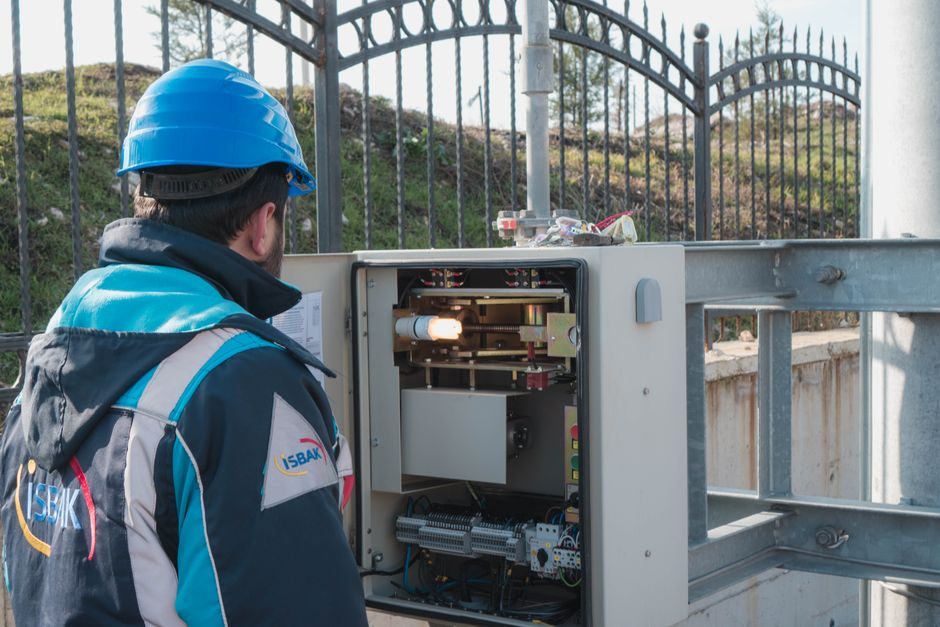
Specifying a gas detector for electrical work starts with a four-gas envelope — LEL, O2, CO, H2S — on a portable, transportable, or fixed platform that meets IEC 62990-2:2021 for toxic-gas measurement, with 4-20 mA or RS-485 wired back to a control room where fixed [S1][S2].
The hazard profile is dominated by hot-work byproducts and confined-space oxygen displacement rather than refrigerant leaks: arc-flash residue, lead-acid battery off-gassing, and solvent vapors from cable pulling compound drive the sensor mix, not exotic gas families [S2].
Standards Scope and Why IEC 62990-2:2021 Governs the Toxic-Gas Side
IEC 62990-2:2021 is the current IEC document covering the selection, installation, use and maintenance of electrical apparatus used to measure toxic gases and vapours in workplace atmospheres, and explicitly applies to fixed, transportable, and portable equipment whose sensor automatically generates an electrical signal when gas is present [S1]. Its stated purpose is to ensure safety of personnel and property by indicating concentration and warning of the presence of a toxic gas or vapour, and in some cases initiating automatic or manual protective actions [S1]. For electrical work this means the document directly governs CO and H2S monitoring on substation builds, switchgear rooms, and battery-string maintenance, while explosive-gas monitoring falls under the IEC 60079 / IECEx family rather than IEC 62990.
For selection on a job site, treat IEC 62990-2:2021 as the toxic-channel reference and pair it with the explosive-gas standard for the LEL channel; the two are not interchangeable, and a single detector claiming compliance with only one will leave a coverage gap on a four-gas rig [S1]. The combustible-gas-detector reference page covers the LEL-side channel logic.
Sensor Class by Target Gas
LEL is typically read with a catalytic-bead (pellistor) or NDIR channel; O2 with an electrochemical or galvanic cell rated for 0–25 %vol typical ambient range; CO and H2S with electrochemical cells, where CO cell cross-sensitivity to H2 must be checked against battery-room duty [S2]. The reason: battery rooms vent hydrogen during overcharge, and a CO cell that cross-reads H2 will false-alarm or mask a real CO event from hot work — so for those rooms the spec moves toward a dedicated gas detector channel mix rather than a generic four-gas unit [S2].
For H2-only battery-room monitoring, a portable detector with a 0–10 ppm to 0–40000 ppm selectable range and optional extension probe is a common configuration, while a fixed O2 unit on 4-20 mA plus RS-485 handles the 24/7 ventilation-failure alarm path [S2]. IR (NDIR) CO2 sensors of the dual-wavelength type are the workhorse for indoor-air-quality work adjacent to electrical rooms, with a 0–6000 ppm range and maintenance-free calibration cycle [S3].
Form Factor: Portable vs Transportable vs Fixed
Portable is the right pick for a working electrician moving between cabinets, transportable for site-shared rigs with calibration kit, and fixed for switchgear rooms, battery rooms, and UPS halls where a 24/7 watch matters more than mobility [S1][S2]. Fixed units are wall-mounted and offer different signal and relay outputs for control-room tie-in; portable single-gas units ship with a probe and calibration kit; handheld multi-gas units commonly read four or five channels at once with audible alarms [S2].
Serviceability drives the choice as much as measurement: vendors that bundle shipping, installation, and post-installation support, or 24/7 islandwide backup with one-hour response, are aimed at the fixed-system buyer, while a multi-gas handheld buyer is buying ergonomics and sensor swap time more than integration [S4]. The explosion-proof-electrical reference page is the right context where the detector itself must be certified for the zone it sits in.
Comparison of Detector Types on Selection Criteria
Across the three form factors, the decision criteria are coverage, output, certification, and lifetime cost. A four-gas handheld is the lowest-capex, fastest to deploy, and covers LEL/O2/CO/H2S, but offers no plant-side output and depends on the worker keeping it on; a transportable four-gas rig adds a calibration kit and a sturdier enclosure at moderate cost; a fixed wall-mounted unit adds 4-20 mA and RS-485 outputs and 24/7 unattended monitoring at the highest capex but the lowest lifetime cost per alarm event [S2][S4].
On certification depth, IEC 62990-2:2021 governs the toxic-channel measurement and selection logic for all three, while the LEL channel sits under the IEC 60079 / IECEx family, and IP65 is the floor most electrical-room specifications will accept; a fixed O2 unit exposed to dust or wash-down will be specified higher [S1][S2]. On output, handhelds are essentially alarm-only, transportables add data logging, and fixed units add analog and digital outputs for control-room tie-in [S2][S4].
Use Cases Inside Electrical Work

Switchgear and cable basement work: a transportable four-gas unit covers solvent vapor from cable pulling compound, CO from hot work, and O2 displacement in low-lying vaults. Battery room and UPS hall: an H2-dedicated portable with selectable range, plus a fixed O2 unit on 4-20 mA, is the minimum credible rig, with attention to CO-cell H2 cross-sensitivity [S2]. Indoor air quality around control rooms: an NDIR CO2 meter with 0–6000 ppm range and a 20,000-record data logger feeds ventilation logic rather than safety logic [S3].
For coal-handling, conveyor, or mining-adjacent electrical rooms, the spec is closer to a mining-grade rig than a generic electrical-room rig; the mining gas-detector selection map covers the sensor-class and certification differences, and is worth reading before re-using an electrical-room four-gas on a mineral-processing site.
Limitations, Failure Modes, and What IEC 62990-2:2021 Will Not Catch
Two failure modes dominate the field. First, sensor poisoning: electrochemical H2S cells are consumed by the gas they measure, and the cell will read zero long before the detector alarms; bump-testing before each shift is the only defence, and IEC 62990-2:2021 covers selection but the bump-test cadence is a site procedure, not a standard clause [S1]. Second, the wrong sensor family for the gas: a catalytic-bead LEL cell will not see hydrogen at low concentrations reliably, and an NDIR LEL cell will not see every solvent family; the standard does not pick the sensor for the application, the specifier does [S1][S2].
Third, wireless dropouts on WiFi home-style detectors: a 4-gas WiFi unit with an 85 dB alarm is fine for an RV or kitchen and wholly unfit for a switchgear room, where a hard-wired 4-20 mA or RS-485 path to the control room is the auditable link [S2]. Fourth, calibration drift on dual-wavelength NDIR CO2 sensors is described as negligible, but the spec should still require a calibration protocol in the box rather than relying on the sensor's reputation [S3].
Sourcing, Calibration, and Signal Wiring

On the supply side, distributor-integrators in Singapore bundle shipping, installation, and 24/7 islandwide service with a stated one-hour response, which is the operating profile a fixed-system buyer should be benchmarking against rather than the box-only price [S4]. For portable rigs, the calibration kit is part of the deliverable, not an accessory, and the spec should require a calibration certificate per unit rather than a generic factory certificate [S2]. For fixed O2, the wired output is 4-20 mA analog plus RS-485, which is enough to drive both a DCS analog input and a Modbus poll from a substation gateway [S2].
Two trackable signals to watch: a 24-month service interval on the H2S electrochemical cell is the industry-typical planning number, and any vendor offering 365-day warranty plus lifetime technical support is signalling that they expect the cell to outlast the warranty in normal service [S2]. A typical indoor CO2 meter with a 0–4000 ppm range, 10–90 %RH humidity, 0–50 °C temperature, and an SD-card data logger defines the comfort-monitoring envelope adjacent to, not inside, the safety envelope [S3].