
A four-gas or five-gas portable detector weighing 200-400 g, certified ATEX or IECEx, and clipped to the worker's harness is the baseline specification for any work-at-height job that also carries an atmospheric hazard (e.g. tank top, sewer vent, roof vent stack, scaffold over a chemical process).
Work at height is defined under the UK Work at Height Regulations 2005 as any location where a fall from one level to a lower level could cause personal injury [S2]. When that work also occurs in a potentially toxic, flammable, or oxygen-deficient atmosphere — a common situation on aerial work platforms used for process-vessel inspection, flare-tip maintenance, or rooftop HVAC work — a gas detector becomes part of the personal protective equipment stack rather than an optional extra.
Baseline Sensor Stack: What a Height-Work Detector Must Carry
For work at height where the operator is also exposed to process or combustion gases, the minimum sensor stack is a 4-gas configuration: O2 (0-30% volume), LEL (0-100% LEL), CO (0-500 ppm or 0-1000 ppm), and H2S (0-100 ppm) [S3]. The 5-gas add-on is typically a second toxic sensor (SO2, NO2, or CO2) or a photoionisation detector (PID) for solvent vapour.
Sensor technology selection matters at height because the device is often dangling, dropped, or knocked against steel. Catalytic-bead LEL sensors and electrochemical toxic sensors tolerate mechanical shock better than infrared point detectors, which require optical alignment. For environments with chronic high-H2S exposure (e.g. refinery turnarounds), a higher-range H2S sensor (0-500 ppm) reduces nuisance lockouts from sensor saturation.
The portable multi-gas detector format typically integrates audible alarms at 85 dB minimum, visual strobes, and vibration alarms — all three channels are required because wind, distance, and hearing protection at height can mask any single channel [S1]. A loud 85 dB audible alarm is a common specification across consumer and light-industrial home units and translates upward to the industrial segment as the recognised audibility threshold for noisy work environments [S1].
Form Factor and Mounting for Fall-Prone Work
A detector worn on a harness must survive a 2 m drop onto concrete, weigh under 400 g to avoid neck strain during extended use, and clip to a chest strap or harness D-ring rather than swinging free. Detector mass above 500 g causes measurable posture drift during overhead work, increasing fall risk over a full shift. [S2]
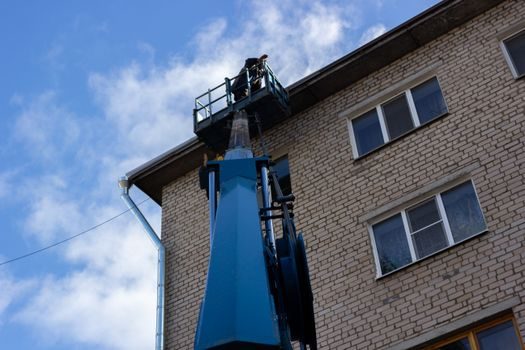
For aerial work on boom lifts or scissor lifts, the aerial work truck basket is itself a confined space with limited ventilation, so a fixed gas detector is often impractical; the portable unit must operate continuously for the full shift, typically 12-16 hours on a single charge, with a clear battery-status indicator visible to the operator at arm's length.
Cold-weather or winter-shutdown work at height drops battery capacity by 20-40% on lithium-ion packs; specifying units with operating temperature ratings down to -20 °C avoids mid-shift failures. For hot-work above process columns (summer ambient 35-45 °C is common), an upper operating limit of 50 °C minimum prevents sensor drift and false alarms.
Compliance: ATEX, IECEx, and Work-at-Height Regulations

In Europe, any portable detector carried into a potentially explosive atmosphere must be ATEX-certified for Zone 1 or Zone 2, with the marking visible on the housing (e.g. Ex d ia IIC T4 Ga) [S1]. IECEx is the equivalent for Australia, parts of Asia, and offshore work; many OEMs supply dual-certified units to avoid duplication of inventory.
The Work at Height Regulations 2005 require that all work at height is properly planned, that risks are assessed, and that appropriate work equipment is selected and used; competence of the worker and proper inspection of the equipment are also mandatory [S2]. A gas detector is part of that equipment selection when an atmospheric hazard exists, and its pre-use bump test and calibration record form part of the inspection chain — typically a bump test before each shift and a full calibration every 30-180 days depending on sensor type and manufacturer guidance.
For UK sites, the COSHH regulations (Control of Substances Hazardous to Health) overlay the work-at-height duties, requiring exposure assessment for any substance assigned a workplace exposure limit (WEL). The detector's data-logging function — typically 24 hours of continuous recording at 1-minute intervals — provides the documentation trail COSHH audits expect.
Selection Criteria Comparison: 4-Gas vs 5-Gas vs Single-Gas
Three detector formats compete for the work-at-height slot, and the right choice depends on the hazard envelope, not the budget. The 4-gas portable is the workhorse: O2, LEL, CO, H2S, 12-16 hour battery, 200-400 g, ATEX/IECEx Zone 1, typical 2 m drop test. The 5-gas portable adds a fifth sensor slot (SO2, NO2, CO2, or PID 0-2000 ppm isobutylene equivalent) for confined-space tie-ins or solvent-heavy work, with the same battery life and a 50-100 g weight penalty. [S3]
The single-gas detector is the right call only for one well-defined hazard: a CO clip for boiler-stack inspection, an H2S unit for sewer man-entry, or a H2 unit for battery-room overhead work. Single-gas units are typically 100-150 g, 6-12 month battery life, and 50-70% cheaper than a 4-gas unit, but offer no protection if the atmosphere deviates from the assumed single gas.
For most work-at-height tasks where the atmosphere is not fully characterised, the 4-gas portable is the defensible default. The 5-gas variant is justified when the confined space gas detector selection logic applies — i.e. the worker must enter a vessel, pit, or duct where VOC or NO2 presence is credible. For defined electrical or laboratory work at height, the sensor stack shifts: a gas detector selection for electrical work typically drops H2S and adds a refrigerant or SF6 sensor, while a gas detector selection for laboratories profile adds formaldehyde or VOC PID coverage.
Use Cases: Tank-Top, Flare-Tip, and Rooftop Work
Tank-top work on floating-roof storage tanks combines a fall hazard (3-15 m) with hydrocarbon vapour risk; the detector must run continuously while the operator unbolts the primary seal, often inside a Zone 1 area where the combustible gas detector LEL sensor is the primary life-safety channel. A 4-gas unit with IR LEL (immune to silicone poisoning from adjacent sealants) is the preferred spec. [S3]
Flare-tip inspection and derrick work on offshore platforms combines a major fall hazard with H2S exposure from upstream sour service; a 5-gas unit with an H2S sensor rated 0-500 ppm, plus SO2, captures both the release gas and the combustion product. Offshore workers typically carry a 4-gas unit plus a personal H2S single-gas as a redundant belt clip — the failure of one unit must not strand a worker in a hazardous atmosphere 20 m above the deck.
Roooftop HVAC and chiller work often involves refrigerant leaks (R-1234yf, R-410A, ammonia) rather than combustion gases; the sensor stack diverges here, and a refrigerant-specific or gas detector selection for firefighting format may be specified instead. The general rule: if the job description overlaps with confined-space entry, treat the detector selection as a confined-space problem, not a height problem.
Limitations and Failure Modes
Sensor poisoning is the dominant failure mode at height: catalytic LEL sensors are poisoned by silicones, lead, and halogenated compounds; electrochemical CO sensors are cross-sensitive to H2 (a common false alarm in battery rooms) and to alcohol-based hand sanitiser if the worker handles the unit after sanitising. Infrared LEL sensors solve the silicone issue but cost 2-3x and weigh 30-50 g more. [S3]
Bump-testing discipline is the second most common failure point. A detector left in a truck cab for six months without a bump test may pass the self-test but fail the real atmosphere; the pre-shift bump test on a known gas concentration (typically 50% LEL for LEL, 25 ppm for H2S, 50 ppm for CO) takes 30-60 seconds and is the only field check that confirms sensor response, not just electronics.
Wind and temperature extremes at height cause sensor baseline drift; a unit calibrated at 20 °C on the ground may read 2-3% low in LEL at 5 °C on a winter tower. The detector's manual zero and span sequence must be run in the working environment, not the office, before the shift begins.
Verifiable Selection Signals for Q3-Q4 2026
Trackable procurement signals for the next 6 months: ATEX-certified 4-gas portable detector pricing has stabilised in the USD 250-450 range for OEM-direct purchases; the 5-gas variant remains USD 600-1100; rental fleets are increasingly common for short-duration turnarounds at USD 25-45 per day. Battery-room hydrogen detection work at height — a growing segment driven by data-centre and substation backup-power installations — is the segment to watch for spec evolution, with detector range scaling toward 0-40000 ppm H2 for room-level monitoring [S1].