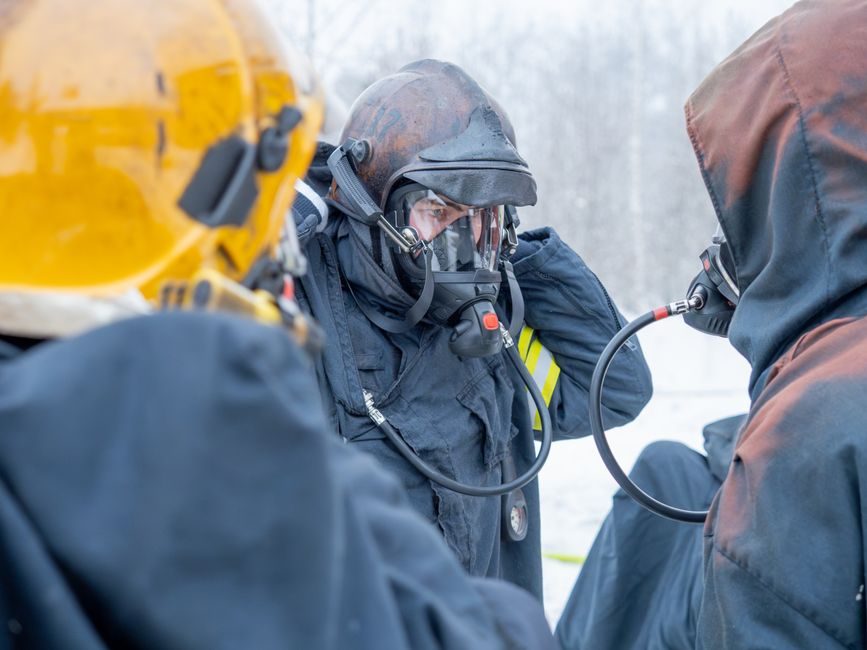
Fireground gas monitoring requires a two-layer detector stack: a portable multi-gas unit worn by each entry team to measure lower explosive limit (LEL), oxygen (O2), carbon monoxide (CO), and hydrogen sulfide (H2S) in real time, plus fixed or open-path detectors arrayed around the perimeter to track smoke-layer stratification and post-knockdown off-gassing [S1].
Detector families split into three sensing technologies relevant to fire service work — catalytic bead / pellistor for combustible gases, electrochemical cell for toxic gases, and non-dispersive infrared (NDIR) for hydrocarbons and CO2 — with photoionization (PID) added where volatile organic compounds (VOC) are expected [S1][S2].
Fireground Hazard Map: Which Gases Firefighters Actually Face
The fireground hazard envelope is broader than just smoke. Combustion of common structure fuels releases CO at lethal concentrations within minutes; smoldering synthetics release HCN; decomposed electrical insulation emits HF; and any unburned hydrocarbons (LPG, natural gas, gasoline vapor) create an explosion risk at the doorway or basement [S1].
Firefighters must monitor four gas classes simultaneously: combustible (CH4, C3H8, C4H10, H2, VOCs) for explosion prevention, asphyxiant (O2 depletion below 19.5% by volume, CO2 above 5%), toxic (CO, H2S, HCN, NH3, Cl2, SO2, HF), and oxygen-enrichment above 23.5% which itself raises ignition probability [S1].
Toxic exposure thresholds are graded into four operational bands — TWA (8-hr weighted average), STEL (15-minute), IDLH (immediately dangerous to life or health), and MAC (maximum allowable concentration) — and entry-team detectors must alarm at or below the STEL and IDLH values for each target gas [S1].
Portable vs Fixed: Decision Criteria for the Fire Appliance
Portable multi-gas detectors are mandated for the entry team because they move with the crew and sample the breathing-zone atmosphere at chest height. Fixed detectors are deployed at the command post, doorways, stairwells, and mechanical rooms to give incident command a continuous perimeter read on gas accumulation and ventilation effectiveness [S1][S2].
For entry-team portables, specify a 4-gas sensor pack (LEL/O2/CO/H2S) with audible alarm at 95 dB at 1 m, visual strobe at 180° visibility, and a vibratory alarm for high-noise environments; runtime should exceed 14 hours on a single charge to cover a full structural fire overhaul [S1].
For perimeter fixed units, the relevant options are point infrared detectors (single-beam, narrow-path, fast response under 3 seconds T90) and open-path infrared detectors (multi-meter beam, ideal for monitoring an entire doorway or warehouse aisle without per-point installation) [S2].
Sensor Class Selection: Matching Chemistry to the Fire Load
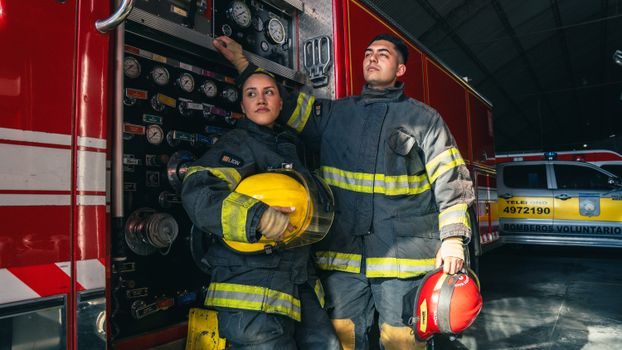
Catalytic bead sensors respond to any combustible gas above its LEL but are poisoned by silicone vapors, lead, and halogenated compounds, so they are not the right choice in a chemical-plant or paint-shop fire where silicone or chlorinated solvents may be present [S1].
Infrared (NDIR) point and open-path detectors are non-consuming, immune to catalytic poisons, and fail-safe (they read zero on sensor failure rather than drifting low), making them the preferred fixed detector for hydrocarbon fire scenarios in refineries, fuel storage, and LNG facilities [S2].
Electrochemical cells for CO and H2S give parts-per-million resolution and low power draw, which is why every entry-team 4-gas monitor uses them; their limitation is a 2-3 year service life and cross-sensitivity to other reducing gases, requiring bump-testing every 30 days as a minimum [S1].
For VOC-rich fires (plastics, solvents, paint lockers) a PID sensor at 10.6 eV lamp is needed because neither catalytic bead nor standard electrochemical cells will quantify aromatic or chlorinated hydrocarbons in the low-ppm range [S1].
Certification and Standards: What Markings Must Appear on the Label
Any detector used in a flammable atmosphere must carry ATEX (EU) or IECEx (international) certification for the zone of use — typically Ex d (flameproof enclosure) for Zone 1, Ex i (intrinsically safe) for Zone 0, with a temperature class matching the auto-ignition of the gas cloud (T4 = 135 °C max surface, T6 = 85 °C) [S1].
For US fire service, NFPA-compliant detectors should meet the performance requirements for combustible-gas indicators used by emergency responders, with intrinsic safety ratings to UL or FM standards for Class I Division 1 hazardous locations [S1][S2].
Approved detector families supplied to Indian fire and process safety markets are typically certified to BIS and CCE standards, and may carry CRISIL-verified manufacturer ratings, which is one verifiable procurement signal for government and refinery tenders [S2].
Limitations and Failure Modes Engineers Must Plan For
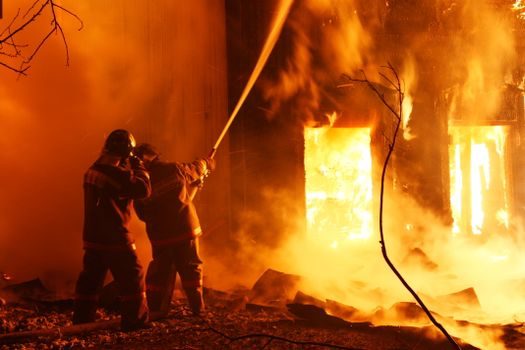
Catalytic bead sensors give false-low readings in oxygen-deficient atmospheres (below 10% O2) because combustion requires oxygen; this is a critical failure mode in a sealed structural fire where the entry team could walk into a 5% LEL reading that is actually 100% LEL [S1].
Electrochemical CO sensors cross-react with hydrogen and acetylene at significant percentages of reading, which matters in a vehicle-bay fire or acetylene cylinder leak; H2S sensors are poisoned by high-concentration SO2 exposure and may need replacement after a single heavy exposure [S1].
Open-path IR detectors are defeated by heavy black smoke, dense fog, or direct sunlight into the receiver; they need a clear beam path and a regular cleaning cycle on the optics, and they will not detect a gas that is heavier or lighter than air pooling off the beam axis [S2].
Portable detectors left on the charger past the calibration-due date will not alarm on bump test, so the standard practice is to bump-test before every entry, with calibration gas at 50% LEL for the combustible channel and at the STEL value for each toxic channel [S1].
Procurement Spec: Minimum Requirements for a 2026 Fire Appliance Build-out
Specify a portable 4-gas detector with IP66/67 rating, 14+ hour battery, ATEX/IECEx Ex ia IIC T4 Ga or equivalent, 95 dB audible plus 180° visual plus vibratory alarm, data logging for post-incident reconstruction, and a price band that allows one spare unit per entry team [S1].
Specify a fixed point IR detector for each mechanical room and basement stairwell, an open-path IR beam across every vehicle-bay doorway and warehouse aisle wider than 6 m, and PID-equipped portable units on hazmat vehicles; total detector count should be a function of floor area and ventilation layout, not a flat ratio [S2].
For mining and tunnel applications the sensor load shifts toward CH4 continuous monitoring and H2S-resistant cells, which is a separate spec profile covered in mining gas-detector selection criteria.
For electrical work (substations, switchgear rooms) the priority is SF6 leak detection and O2 monitoring in confined cable vaults, addressed in gas detector selection for electrical work; warehousing and logistics fire loads, by contrast, are dominated by CO and HCN from polymer combustion, with a different ventilation-integration spec covered in warehouse gas detector selection.
One trackable signal for the next planning cycle: incident commanders should log every entry-team bump-test result alongside CO/H2S peak readings and correlate against NFPA incident reports, so the 2-year electrochemical replacement cycle can be replaced with a measured-by-data interval rather than a calendar interval. Another: the 2026 refresh of ATEX equipment directives continues to push Ex d fixed detectors toward Ex i designs in Zone 1, with cost-neutral migration paths now available from major OEMs [S1][S2].
The underlying component specifications are covered under gas detector, combustible gas detector, and fixed gas detector.