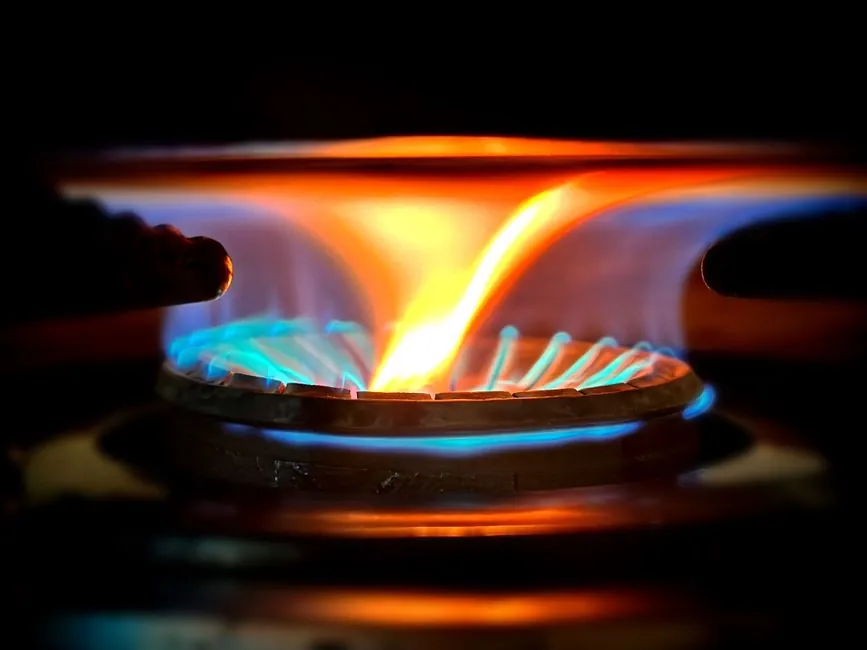
Foundry core-making plants that still rely on gas-fired core box heating increasingly run a parallel evaluation against electric cartridge heaters, because cartridge units deliver rated sheath temperatures up to 1400°F (760°C) and convert close to 100% of input electrical energy into useful heat at the metal interface [S1][S2][S4]. The choice is no longer driven by habit; it is governed by core box geometry, cycle time, and total cost of ownership over a 10-year window.
Gas systems remain attractive where the tooling is large, where radiant flux across a wide platen beats point-of-contact heating, and where a natural gas or propane header already exists. Electric cartridge arrays win where the core box has machined heater pockets, where the process needs tight ramp/soak control, and where maintenance crews would rather swap a 0.5-inch diameter element than relight and tune a burner [S1][S5].
Heat Transfer Mechanism: Radiant Combustion vs Contact Resistance
Cartridge heaters are cylindrical elements built around a nickel-chromium resistance coil wound on a ceramic core, insulated with magnesium oxide, and sealed in a stainless steel or Incoloy sheath; the element is inserted into a drilled hole so heat conducts directly into the surrounding metal [S1][S2]. Maximum working temperature is 1400°F (760°C) for standard Incoloy-sheathed units, and the hole is typically drilled 0.003–0.008 inch over nominal with a reamed finish for high watt density service to keep the sheath cool and extend life [S1].
Gas-fired core box heating uses an external burner that fires into a plenum or radiant face; heat reaches the tool by radiation and convection across an air gap, then conducts into the box wall. The combustion path introduces efficiency loss at the heat exchanger, plus stack losses, while the cartridge path loses energy primarily through radial conduction into the parent metal, where a snug fit (.009–.014 inch clearance) determines the actual interface temperature [S1][S4].
Energy Efficiency and Cost Structure
Resistance-based electric heating converts essentially 100% of consumed electrical energy into heat, versus the typical 70–85% thermal efficiency of a gas combustion system once stack and jacket losses are netted [S4]. On the operating-cost side, electric systems eliminate the annual inspection, flue cleaning, and filter changes that gas systems require, and the absence of a combustion byproducts stream means no emission monitoring on the tool itself [S4].
The capital picture inverts that pattern: gas burners and their gas trains are cheaper at purchase and install, while a multi-zone cartridge array plus control SCRs costs more up front. Over a 10-year horizon, the higher gas-side maintenance burden and roughly half the service life of combustion components versus resistance elements tends to flip the total cost of ownership toward electric on shops that run two or three shifts [S3][S4].
Temperature Capability, Watt Density, and Cycle Time
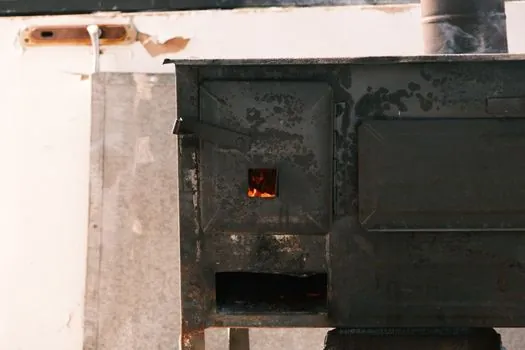
Standard cartridge heaters cover low, medium, and high watt density tiers and reach 1400°F (760°C) sheath temperature, with Incoloy recommended above 1000°F for durability and heat transfer [S1][S2]. Watt density is selected from a graph that uses the part temperature measured roughly 0.5 inch away from the heater, which means a reamed, close-tolerance hole is mandatory at high density to keep the element below its maximum sheath rating [S1].
Gas radiant heating is not limited by a contact interface, so a wide platen can reach uniform soak temperature without density gradients, but ramp rates are governed by burner modulation and the thermal mass of the plenum. Cartridge arrays heat locally first and then conduct outward, so a heavily pocketed box reaches setpoint faster per kilowatt installed, but a thin-walled box without pockets will show large center-to-edge deltas that a gas-fired plenum evens out naturally [S2][S5].
Reliability, Maintenance, and Service Life
Electric resistance systems are widely described as more reliable than their gas-fired equivalents in the published comparison literature, with no combustion hardware to leak, soot, or drift out of calibration [S4]. When a cartridge fails, the fix is a slipped-out element and a replacement slipped in, with no tooling teardown beyond cover plate access on most core boxes [S1].
Gas burners carry ongoing combustion-side maintenance: orifice inspection, igniter replacement, flue-side cleaning, and leak checks on the gas train; published industry data puts the gas heater service life at roughly half that of an electric resistance unit in the same duty cycle [S3]. The trade-off is that a single bad cartridge can take out one zone of a multi-zone core box, while a gas burner failure usually means a full-box downtime event rather than a partial loss.
Selection Criteria: When to Use Gas, When to Specify Cartridge
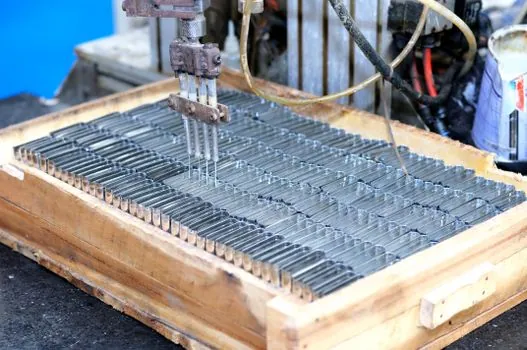
Specifying gas-fired core box heating makes sense for large platen tools without machined heater pockets, for processes that need uniform radiant soak across a wide face, and for foundries that already operate a gas header with existing combustion safety infrastructure. Electric cartridge arrays make sense for small to mid-size core boxes with machined pockets, for short cycle times where local ramp matters more than face uniformity, and for sites targeting lower maintenance headcount or pursuing electrification roadmaps [S3][S4].
For tooling that crosses both regimes, a hybrid is common: a gas-fired radiant plenum for the main soak and cartridge heaters in the high-wear sprue and vent bosses where local heat flux dominates. The mechanical fit requirement is non-negotiable on the cartridge side: a high watt density application needs drilled and reamed holes within the .009–.014 inch clearance band, otherwise the sheath overheats and life drops sharply [S1].
Comparison Matrix: Decision Criteria at a Glance
Across four foundry-relevant criteria, the two technologies line up as follows. Energy efficiency: electric at essentially 100% versus gas at roughly 70–85% net thermal once stack losses are counted [S4]. Maximum interface temperature: 1400°F (760°C) for Incoloy-sheathed cartridges versus typical box soak temperatures in the 350–600°F range for gas-fired plenums on phenolic and furan core work. Maintenance burden: annual combustion-side service versus element swap on failure for electric [S3][S4]. Service life: gas roughly half the electric equivalent in matched duty cycles [S3].
For cycle-time-critical cores, a 6-zone cartridge array sized at 30–60 W/in² will typically outpace a gas radiant plenum on ramp, while a large deep-draw core box that demands face uniformity will favor gas. Procurement should also weight local energy pricing: regions where electricity and gas have converged in unit cost tilt the 10-year economics toward electric even before maintenance savings are included [S4].
Standards, Sourcing, and Reference Material
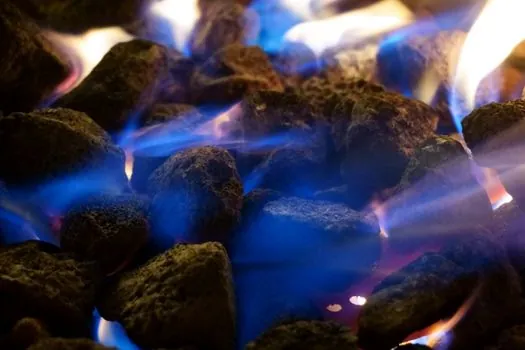
Cartridge heater design references cite nickel-chromium resistance wire, MgO insulation, and Incoloy or stainless sheath as the standard build of materials, with high-purity MgO filling all internal voids to raise dielectric strength and improve heat transfer [S2]. Hole-preparation practice is documented in the OEM technical bulletins: .003–.008 inch over nominal drill, reamed for high watt density, with the temperature sensor placed between the working surface and the heater and the control sensor located about 0.5 inch from the heater body [S1].
For broader process context, see our write-up on the Furan hot-box vs phenolic hot-box resin selection map, which covers the resin systems whose cure windows most strongly influence what the core box heating source has to deliver. The hot-box core machine encyclopedia entry lists the gas and electric configurations that pair with the heating source itself.
Trackable signals to watch over the next two quarters: published 2027 utility tariff filings in foundry-heavy US Midwest counties (these have flipped gas-versus-electric parity repeatedly since 2023), and any updates to Incoloy sheath maximum temperature ratings from the major cartridge OEMs. A third monitor point is the number of new cold-box core machine installations shipped with factory-integrated electric cartridge cores versus field-retrofitted gas burner modules; that ratio is the cleanest leading indicator of where the foundry market is landing.
For component-level specifications, see fired brick.