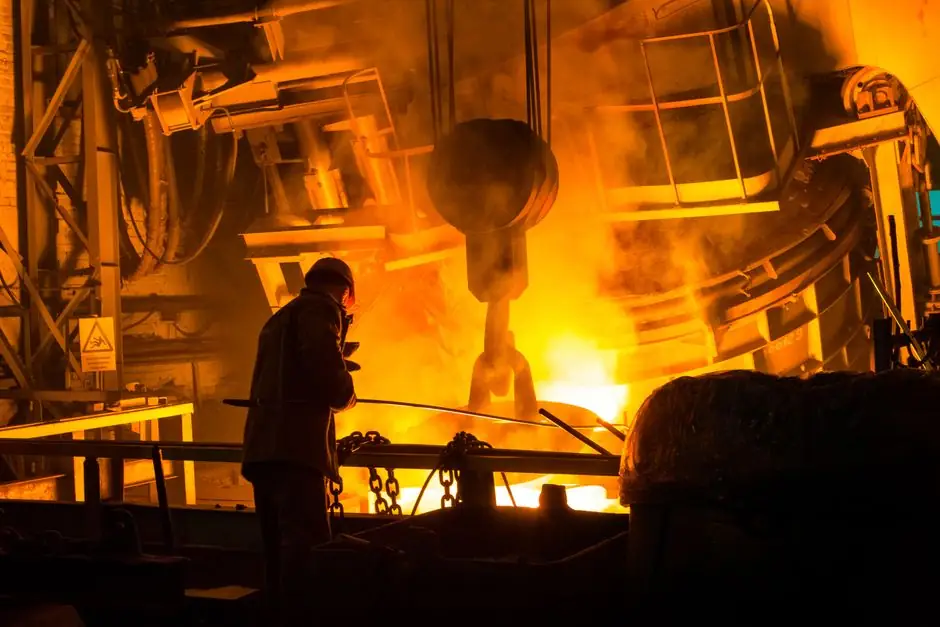
Foundry coke for cupola iron-melting furnaces is graded against fixed carbon ≥88% min, ash ≤10% max, sulfur ≤0.6% max, volatile matter ≤1.5% max, and moisture ≤5% max in mainstream export-grade A10 shipments from Shanxi origin (ash 10% specification) [S5].
Within a single shipment the operator is buying a carbon-plus-fuel package, not just an energy carrier, because the same lump supplies three jobs at once: heat for melting, permeability support for the descending burden, and carbon pickup into the dripping iron [S4][S5].
Fixed carbon: the headline specification that drives fuel rate
Fixed carbon (FC) on a dry basis is the master parameter and the principal reason foundry coke trades at a premium versus generic metallurgical coke: a 90% FC minimum is offered in export Grade A against 85% FC in Grade B [S3], and an 88% FC floor appears in the standard "ash 10%" SKU loaded at Tianjin [S5].
Bureau of Mines cupola work showed that dropping from a high-FC baseline toward a medium-FC charge (coke bed replacement experiments with anthracite and bituminous coal up to the 40 pct level) measurably changed iron carbon pickup and stack emissions, which is why FC bands rather than single numbers govern purchase orders [S1].
A common practical floor cited by Chinese exporters is "at least 85 percent carbon content" for general foundry use, with Grade A reserved for ductile-iron and high-grade gray iron where melt loss is expensive [S3].
Ash content: 7.6% to 13% by grade, with 10% as the export default
Ash sits at the top of the specification because every kilogram of ash absorbs blast heat, dilutes slag, and erodes refractory; the VDG R80 grade ladder codified in the German foundry lexicon sets ash ceilings from 7.6% (Grade A end) up to 8.5% (lower grades) [S2].
Chinese Grade A holds ash ≤8% and Grade B tolerates ash ≤13%, demonstrating the same upward tolerance trend at higher tonnage [S3], while the standard A10 export grade from Shanxi uses an ash ≤10% max as the published working point with a 10000 MT/month supply capability [S5].
The same A10 SKU is sold with M40 ≥85% min and M10 ≤8% max, which means buyers get both an ash cap and a mechanical-strength window in one datasheet, useful when the cupola bed height is fixed and a softer coke would collapse the permeability profile [S5].
Sulfur limits: 0.5% to 0.95% depending on iron grade

Sulfur is the metallurgical gating parameter because every 0.1% of extra coke sulfur walks directly into the melt and inflates FeS and MnS inclusions; the VDG R80 ladder caps sulfur from 0.80% to 0.95% across the A-to-H grades [S2].
Chinese suppliers pitch tighter numbers: Grade A at S ≤0.5% max, Grade B at S ≤0.75% max, and a generic "useful quality" target of 1% maximum sulfur on commodity tonnage [S3].
The 10%-ash Tianjin-shipment SKU is specced at sulfur ≤0.6% max with a stated iron-casting benefit of "low sulphur, secure the quality of iron castings" [S5], which lines up with the 0.5–0.6% range most gray-iron melt shops treat as the practical ceiling before desulfurization outside the cupola becomes mandatory.
Moisture, volatile matter, and calorific value
Moisture must be held to ≤2% max under VDG R80 [S2]; export SKUs typically relax this to ≤5% max to absorb voyage and storage gain [S3][S5], so a buyer should treat 5% as the receiving number and 2% as the as-coked reference.
Volatile matter (VM) is held extremely low because any residual VM burns in the upper stack and steals heat from the tuyere zone: 1.5% max is the standard ceiling across both Chinese grades and the Tianjin-shipment A10 product [S3][S5], and a separate datasheet pins VM at 2% max with ash at 14% max in a softer specification [S7].
Calorific value on the A10 product is listed at 7000 kcal/kg min [S5], which is the working number when sizing cupola coke ratio in kilograms of coke per ton of iron.
Grain size and the M40 / M10 strength window
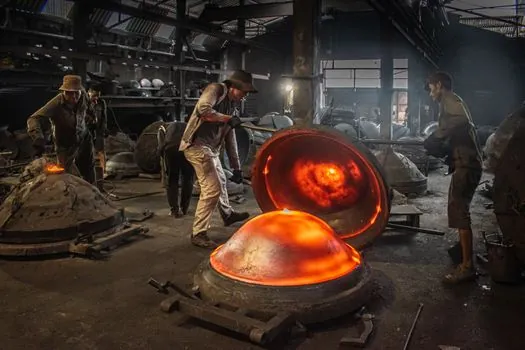
VDG R80 splits cupola coke into "normal" grade with grain >80 mm and "special" grade with grain >100 mm, with undersize (below nominal grain) capped at 5% of the lot [S2]; the Chinese size ladder extends from 30–80 mm up to 200–400 mm for very large cupolas, with 80–120 mm and 90–150 mm as the workhorse bands [S3].
Mechanical strength uses the Micum drum indices: M80 and M100 for fracture resistance and M10 for abrasion, with M10 defined as the percentage of coke that breaks below 10 mm after 100 revolutions [S2].
The A10 specification lists M40 ≥85% min and M10 ≤8% max for a 120–250 mm size with 90% min in that band, which is the typical package for a mid-sized hot-blast cupola [S5].
Selection criteria: matching grade to iron type and cupola design
Selection reduces to four numbers read together: fixed carbon, ash, sulfur, and M40/M10, with grain size set by the cupola diameter. [S2]
For ductile iron, compacted graphite iron, or high-grade gray iron with tight carbon-equivalent control, specify FC ≥90% min, ash ≤8% max, S ≤0.5% max, VM ≤1.5% max (Grade A envelope) [S3].
For general gray iron and structural castings on a cold-blast or moderate hot-blast cupola, FC ≥88% min, ash ≤10% max, S ≤0.6% max, M40 ≥85% is the cost-effective envelope, which is exactly the A10 Tianjin-shipment configuration [S5].
For ferro-alloy or copper-base melting where higher VM and ash are tolerable, a relaxed FC ≥84% min / ash ≤14% max / S ≤1% max grade is acceptable on economic grounds [S7].
Comparison table: VDG R80 vs Chinese Grade A vs Chinese Grade B vs A10 export

Reading the four reference points side by side lets a buyer place any quote in the right tier before price negotiation.
According to VDG bulletin R80 [S2], foundry coke specifications are ash 7.6–8.5% max, sulfur 0.8–0.95% max, moisture ≤2% max, with the drum resistance M10 (abrasion, defined as the percentage of coke smaller than 10 mm after 100 revolutions) controlled per grade.
Chinese Grade A (premium ductile-iron work): FC ≥90%, ash ≤8%, S ≤0.5%, moisture ≤5%, VM ≤1.5%, N ≤0.03% [S3].
Chinese Grade B (general cast iron): FC ≥85%, ash ≤13%, S ≤0.75%, moisture ≤8%, VM ≤1.5%, N ≤0.03% [S3].
Chinese A10 export (Shanxi origin, Tianjin load): FC ≥88%, ash ≤10%, S ≤0.6%, VM ≤1.5%, moisture ≤5%, M40 ≥85%, M10 ≤8%, CV ≥7000 kcal/kg, size 120–250 mm 90% min [S5].
The key trade-off is sulfur-vs-cost: each 0.1% step down in S from the VDG 0.95% ceiling toward the Grade A 0.5% floor typically adds a price premium that has to be justified against external desulfurization cost on the iron side.
Standards, sourcing, and verification
The dominant codified reference for European buyers is the VDG bulletin R80 grading system, which defines grain classes, drum indices, moisture, ash, and sulfur bands across eight lettered grades A through H [S2].
Chinese producers publish two-tier internal grade sheets rather than a national mandatory standard, with Grade A and Grade B as the dominant commercial categories and a third "ash 10%" export SKU sitting between them on the cost/spec curve [S3][S5].
A 1980 US Bureau of Mines investigation (Report of Investigations 8488) remains a useful baseline reference for cupola fuel-replacement behavior, with documented 40 pct anthracite or bituminous coal substitution trials and stack-water chemistry [S1].
Verification at receiving should include ISO-style proximate analysis (FC, VM, ash, moisture), sulfur by IR detection or Eschka, M40/M10 drum test on a representative 50 kg sample, and sieve analysis on the 80–250 mm size band; the A10 spec sheet bundles all of these into one datasheet, which is the practical template to demand from any supplier [S5].
Limitations and failure modes
High FC alone does not guarantee cupola performance: low M40 lets the bed compact, raising tuyere pressure and starving the melt zone of air, so a 90% FC coke with M40 in the 70s will underperform an 88% FC coke with M40 ≥85%. [S5]
Low ash does not compensate for high sulfur, since S partitions into the iron and shows up as brittle FeS networks along grain boundaries in the final casting, regardless of how clean the combustion looks in the stack [S3][S4].
Excess moisture (above the 5% receiving cap) acts as a hidden FC penalty because it dilutes the dry-basis carbon number and consumes blast heat in the tuyere zone; this is why the VDG R80 moisture ceiling of 2% max is tighter than the 5% commercial receiving number [S2][S5].
Wrong grain size is the most common field failure mode: undersize coke burns too fast and overloads the tuyere zone with fines, while oversize coke starves the bed of surface area and produces a cold bottom; the cure is to lock the 80–250 mm window with a 90% min tolerance band at the loader [S5].
Practical procurement checklist
Tie the spec to the iron grade first: ductile and CGI demand Grade A envelope (FC ≥90%, S ≤0.5%, ash ≤8%); general gray iron runs comfortably on the A10 envelope (FC ≥88%, S ≤0.6%, ash ≤10%, M40 ≥85%) [S3][S5].
Lock the size band to the cupola diameter: 80–120 mm for small cold-blast units, 90–150 mm for mid-size, 120–250 mm for hot-blast production cupolas, and cap undersize at 5% per VDG R80 [S2][S3].
Demand proximate analysis, sulfur, M40/M10, and sieve results on the certificate of analysis, with a 100 MT minimum order typical for export A10 cargoes out of Tianjin [S5].
For a deeper reference on how lump physical properties govern furnace permeability, see the cupola-related coverage in the construction machinery and equipment specification reference; for a parallel view on fixed-carbon carriers, the carbon material encyclopedia entry is a useful cross-check on the FC concept.
Trackable next signals: monitor VDG R80 grade revisions for any tightening of the 0.80–0.95% sulfur band, watch Chinese Grade A FC floors for movement above the 90% line as Shanxi coal blends shift, and confirm M40 ≥85% retention on every A10 shipment as a leading indicator of bed-permeability trouble.
Component reference pages worth checking: foundry.
This topic is covered further in Counter-UAS Architecture Converges on Open C2 and Layered Sensing.