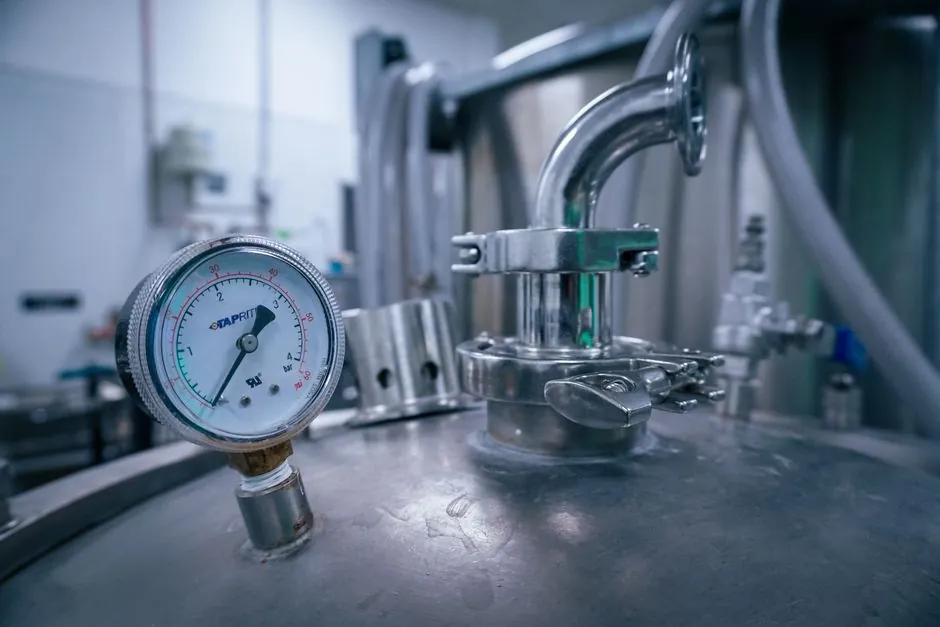
A pressure sensor does not measure pressure absolutely; it measures the difference between the process force on the front of its diaphragm and whatever is held on the back side, and that back side, called the reference, is what splits the three common types apart [S1][S4].
The practical range to remember: 0 PSIG equals 14.7 PSIA at sea level, and 1 bar equals roughly 14.5 PSI, so the same physical force looks very different on a transmitter display depending on which reference the sensor was built around [S5].
What Each Reference Actually Is
An absolute (non-vented) sensor has its back side sealed against a hard vacuum, so the diaphragm always sees the full process force referenced to true zero, the same baseline used in barometric and vacuum work [S4][S5]. A vented gauge sensor exposes the back side of the diaphragm to live atmosphere through a vent tube in the cable or a porous housing, so the sensor continuously subtracts whatever barometric pressure is present at the moment of measurement [S1][S3][S4]. A sealed gauge sensor closes the vent, traps a known charge of air at roughly 1 bar (about 14.7 PSI) behind the diaphragm, and then behaves like a gauge sensor that cannot breathe [S1][S2][S5].
Two operational consequences follow directly: vented gauge units read zero on the bench at local barometric pressure; absolute and sealed-gauge units read whatever the back-side charge amounts to on the bench, which is why absolute bench readings drift if the unit is moved to a different elevation [S5][S8].
Selection Criteria the Reference Side Forces
Pressure range is the first cut. Sealed gauge sensors are recommended for 1500 PSI and above, where the ~0.5 inHg barometric swing becomes a small percentage of full scale and the cost of running a vent tube is harder to justify [S5]. Absolute sensors make sense anywhere the process must ignore barometric drift, including large temperature swings and elevation changes between calibration and service [S5][S8]. Vented gauge wins for open-vessel level, low-pressure pneumatic control, and any job where the reference truly is the surrounding air [S3][S4].
Cable and access is the second cut. A gauge pressure sensor must be connected to a vented communication cable so the reference side breathes, while an absolute pressure sensor can be deployed on a sealed communication cable because nothing on the back side has to move [S4]. Submerged water-level probes are the canonical case: a vented gauge cable brings atmospheric pressure down a tube to the back of the diaphragm, and the front face then reads the water column alone, so P gauge = P water without a separate barometer correction [S4]. A sealed-gauge probe, by contrast, needs an external barometric reading to back the trapped charge out of the answer, which is exactly what absolute units need as well [S4][S6].
Accuracy, drift, and environment are the third cut. Absolute and sealed-gauge readings are less affected by environmental pressure shifts because the reference is fixed at build time, while vented-gauge accuracy tracks the live barometric reference and is therefore tied to how clean and dry the vent path stays [S2][S4].
Side-by-Side Comparison: Absolute, Vented Gauge, Sealed Gauge

On a typical industrial selection matrix, the three reference styles line up against four decision criteria: typical working range, venting requirement, barometric sensitivity, and best-fit applications. Absolute sensors cover low to high ranges, need no vent, ignore live barometric pressure entirely, and fit barometric, vacuum, and high-accuracy process work. Vented gauge sensors cover the low and mid range, demand a vented cable or vented housing, follow ambient barometric drift by design, and fit open-tank level, HVAC, and pneumatic control. Sealed gauge sensors cover mid to very high ranges, need no vent, are insensitive to ambient barometric drift within the trapped-charge tolerance, and fit hydraulic, refrigeration, and high-pressure industrial work of 1500 PSI and above [S1][S2][S3][S4][S5][S7].
In pressure-unit notation this maps to PSIA, PSIG, and PSIS respectively, with the SI equivalents expressed in bar(a), bar(g), and bar(s); 0 PSIG equals 14.7 PSIA at sea level and 1 bar equals about 14.5 PSI, so a 30 bar absolute unit and a 15.3 bar gauge unit can describe the same process pressure once the atmospheric component is stripped out [S5][S3].
How the Reference Side Is Built
The three types all share a deflecting diaphragm, and the engineering work is in sealing the back side correctly. A vented gauge unit is the simplest: the back of the diaphragm is open to atmosphere through a vented path, and the outside pressure applied through that vent or a porous surface cancels the atmospheric component on the front face, leaving only the gauge reading [S1][S4]. An absolute unit evacuates the back side and seals it permanently, so the reference is a hard vacuum that never changes with weather or altitude [S4][S5]. A sealed-gauge unit takes a vented-style body, closes the vent, and traps roughly 1 bar (about 14.7 PSI) of air behind the diaphragm, so it behaves like a gauge sensor with a frozen reference rather than a true vacuum reference [S1][S2][S6][S7].
Sealed gauge is also the only practical option where a vent path cannot be provided at all, for example in a fully sealed depth probe, an oil-filled high-pressure housing, or a small sanitary fitting with no cable gland for a vent tube [S6][S9].
Limits, Failure Modes, and Common Misreads

The reference choice creates a specific set of failure modes engineers have to design around. A vented gauge sensor plugged with moisture, dust, or oil in its vent tube will read barometrically wrong, with the error growing as the trapped air column slowly equalises against a stale reference [S2][S4]. A sealed-gauge sensor with the wrong local barometric assumption baked in at the factory will show a small offset that cannot be field-trimmed away because the reference is mechanically fixed [S5][S7]. An absolute sensor dropped on a humid bench can pick up enough micro-leakage over years to drift its vacuum reference, and only a stable hard vacuum behind the diaphragm keeps its long-term accuracy honest [S4][S8].
For high-pressure work, sealed gauge is the more common pick because absolute sensors capable of, say, 5000 PSI full scale need to be evacuated against a vacuum across the full process range, which is harder to manufacture repeatably than trapping 1 bar and referencing from there [S5]. Gems explicitly states that sealed gauge is the better choice for ranges of 1500 PSI and above, on the grounds that high-pressure applications are not greatly influenced by changes in temperature and a variable reference near 14.7 PSI is not required [S5].
Matching Reference to Use Case
Open-tank hydrostatic level, HVAC duct pressure, and clean-room pressure monitoring all want a vented gauge pressure transmitter so the sensor cancels barometric drift on its own and outputs a true gauge reading [S1][S3][S4]. Closed-vessel hydrostatic level, well monitoring, and any submerged deployment where the vent tube would flood want either an absolute unit paired with a separate barometer, or a sealed-gauge unit treated the same way, because the back side has no air path to atmosphere [S4][S6].
Hydraulic power units, refrigerant high-side lines, compressor discharge, and most high-pressure industrial machinery above 1500 PSI want a sealed-gauge pressure transducer because the trapped reference is good enough at that range and the cable, gland, and housing stay simple [S2][S5][S9]. Barometric reference stations, vacuum furnaces, and altitude-corrected flow computers want absolute sensors, since their job is to read pressure against true zero rather than against a moving weather front [S4][S5][S8].
The same logic explains why process pressure gauge dials on a plant floor are almost always gauge referenced, and why a weather station and a portable pressure calibrator almost always carry an absolute reference inside; the work itself has decided the reference side, not the supplier [S3][S5][S8].
Standards, Calibration, and What to Specify

Pressure reference style is not dictated by a single IEC or ISO clause, but the underlying measurement principles are covered inside the broader pressure measurement framework that suppliers use to define psia, psig, psis, bar(a), bar(g), and bar(s) units on their datasheets [S3][S5][S7]. When ordering, three data points settle the choice: required full scale (the 1500 PSI threshold for sealed gauge is a useful decision boundary), environment (vented access available or not), and tolerance to barometric drift (live cancellation needed or not) [S2][S5][S6].
Field calibration of an absolute unit needs a vacuum reference, while calibration of a vented or sealed-gauge unit can be done against a known barometric day plus a calibrated pressure source; this is why a single shop typically stocks both absolute and gauge standards rather than one universal reference [S4][S5][S7].
Track the next decision node when the reference style is fixed: confirm the process connection (thread form, flange class, or sanitary fit), the wetted material compatibility, the electrical output (4-20 mA, HART, IO-Link, or a Foundation Fieldbus / PROFIBUS PA digital protocol), and the hazardous-area certification for the installation zone, since each of those can override the reference-side choice on the final datasheet [S3][S4][S8].
Related analysis: RMU Load Break Switch: 400 A vs 630 A Selection for Ring Feeders.