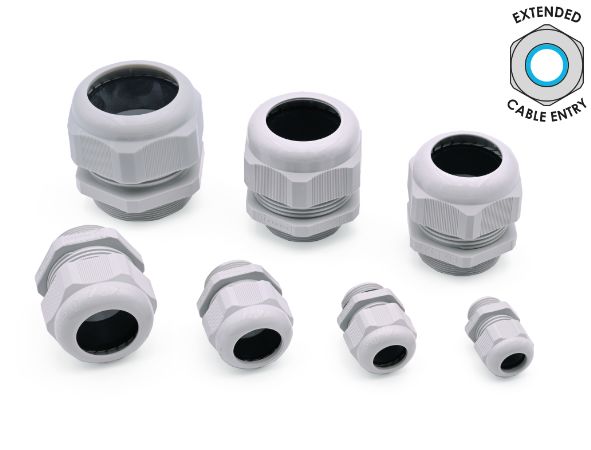
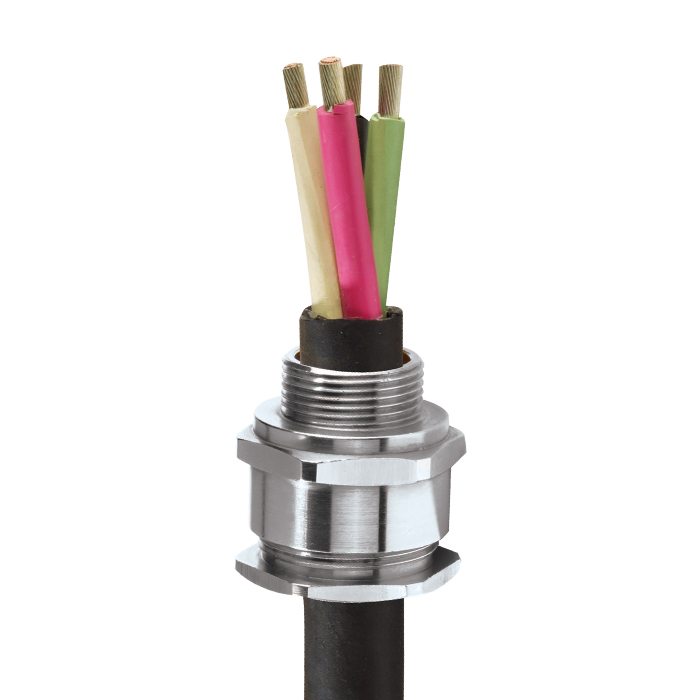
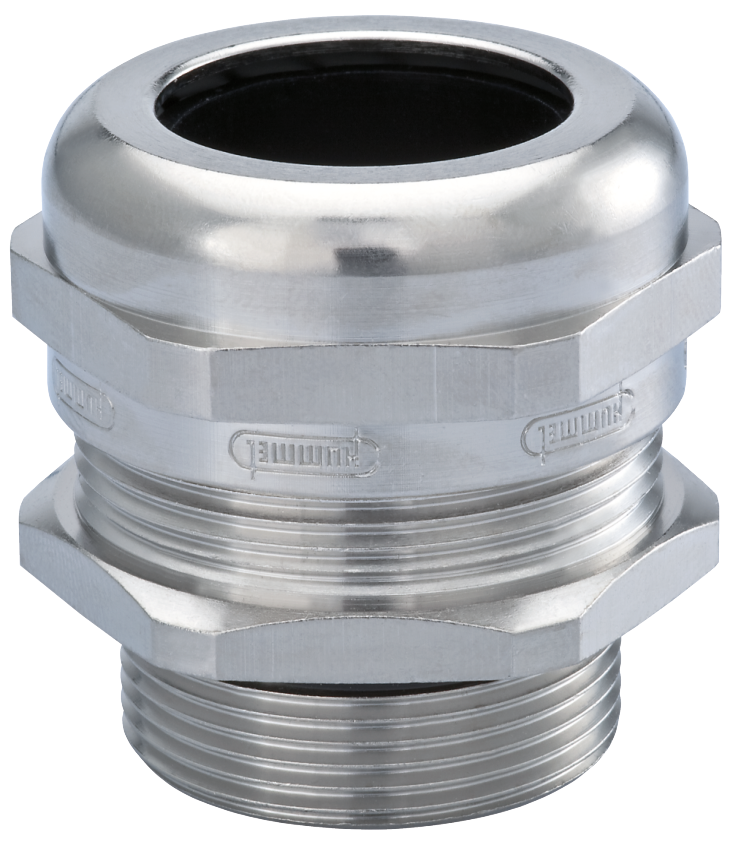
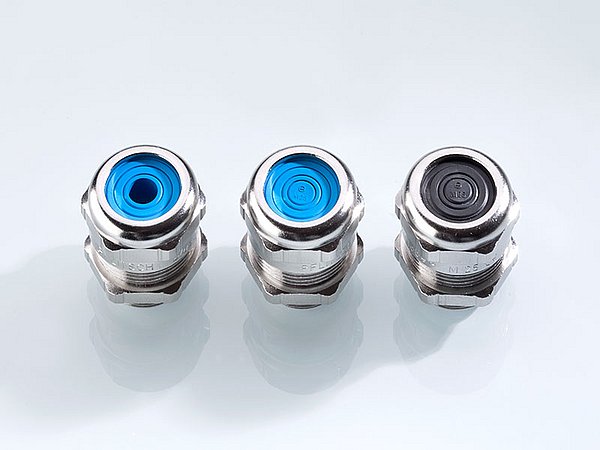
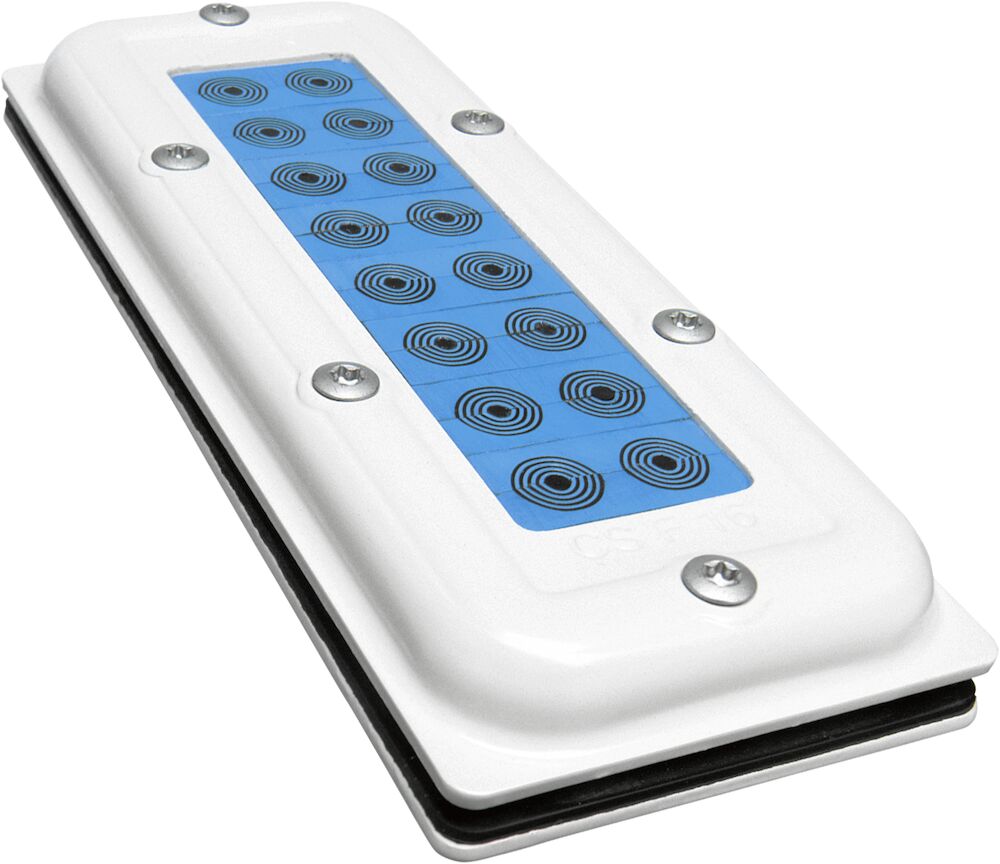
A cable gland, known in North America as a cord grip or cord connector, is a mechanical fitting that secures a cable or wire where it enters an electrical enclosure. It performs three jobs at once: it seals the entry against dust and water to maintain the enclosure ingress protection rating, it provides strain relief so pulling on the cable does not load the terminals, and, on armour glands, it anchors the steel wire armour and carries earth fault current.
Although a single gland costs only a few units of currency, its correct selection governs whether an entire enclosure holds its IP rating, whether an installation in a hazardous area remains compliant, and whether the earth path is continuous. Cable glands are governed by IEC 62444 for industrial use, BS 6121 for armoured cable, IEC 60529 for ingress protection, and the IEC 60079 series for explosive atmospheres.
This guide is written for industrial purchasing engineers and design engineers. It covers 6 chapters spanning what a cable gland does, the industrial and hazardous-area type families, body and seal materials, thread and ingress-protection decoding, sizing and the governing standards, and the selection decision sequence, with 7 selection FAQs and verified manufacturer series. All parameters reference the IEC 62444 (EN 62444), BS 6121, IEC 60529, ISO 20653, and IEC 60079 series public standards.
Chapter 1 / 06
What is a Cable Gland
A cable gland is the interface between a cable and the wall of an electrical enclosure, junction box, motor terminal box, or field instrument housing. It is one of the most numerous components on any industrial site, a single switchgear lineup or motor control centre may carry hundreds, yet it is also among the most frequently mis-selected, because it looks trivial and is bought late in a project. The gland does three things simultaneously. First, it seals: an elastomer ring is compressed onto the cable outer sheath so dust and water cannot follow the cable into the enclosure, preserving the ingress protection (IP) rating the enclosure was designed to hold. Second, it provides strain relief: a clamp grips the sheath so that tension, vibration, and thermal cycling on the cable are transferred to the gland and the enclosure wall, not to the screw terminals inside. Third, on armoured cable, it anchors the metallic armour and forms part of the earth-continuity path that carries fault current back to source.
Structurally, a basic industrial gland has four functional zones. The entry component carries the male thread (metric, PG, or NPT) that screws into the enclosure and seats against an IP washer. The seal nut compresses an elastomer outer seal, typically nitrile (NBR), neoprene, or silicone, onto the cable sheath. The clamping mechanism, on armour glands a cone and ring or a displacement ring, grips the armour or the inner bedding. The shroud, locknut, and earth tag are accessories added per the duty. The seal works by compression: as the seal nut is tightened, the elastomer is squeezed radially inward against the cable, and the quality of that seal depends entirely on the cable outer diameter sitting comfortably inside the gland clamping range. Most field waterproofing failures trace to a cable diameter at or beyond the edge of the seal range, where water simply follows the path of least resistance past an under-compressed seal.
The historical lineage runs through electrical safety standardisation. British Standard BS 6121 codified armoured cable glands and their mechanical performance classes for the UK and Commonwealth and oil and gas markets, and remains widely cited today. In Europe, EN 50262 standardised general-purpose glands before being superseded by IEC 62444 (harmonized as EN 62444), which now defines classification, marking, and the full battery of mechanical, sealing, and strain-relief type tests. For explosive atmospheres, the IEC 60079 series and its certification routes (ATEX in the EU, IECEx internationally) impose additional construction and test requirements layered on top of IEC 62444. North American practice follows a separate lineage under UL 514B and the National Electrical Code, where the term cord connector dominates.
In application scale, cable glands span an enormous range of cable sizes and severities: from a 3 mm instrument cable entering a sensor head, through 50 mm power feeders into a transformer, to subsea umbilicals demanding IP68 at tens of metres of head. The same word, cable gland, covers a 0.5 unit-currency nylon dome nut and a several-hundred-unit-currency stainless steel deluge-rated barrier gland certified Ex d IIC. A universal gland does not exist. The essence of selection is mapping four variables, cable construction, environment, thread, and certification, onto a specific body, seal, and accessory set.
Four engineering attributes determine whether a gland is fit for purpose: the cable clamping range relative to the actual cable diameter, the ingress protection rating relative to the real water exposure, the body and seal material relative to the corrosive and thermal environment, and the certification relative to the area classification. Get any one wrong and the gland fails, not necessarily at commissioning, but months later when a seal weeps, an armour clamp slips, or an inspection flags a non-compliant Ex entry. The chapters that follow decode each of these in turn.
Chapter 2 / 06
Industrial and Ex Type Families
Cable glands divide first by whether they grip armour and second by whether they are certified for hazardous areas. The industrial general-purpose families, standardised under BS 6121 nomenclature and widely used across IEC markets, are designated by short type codes. The table below summarises the principal type codes for industrial and armoured glands, using the long-established CMP and BS 6121 designations that most suppliers mirror.
Type code
Cable construction
Seals
Typical duty
A2
Unarmoured / braided
1 (outer)
Indoor and outdoor unarmoured cable
BW
SWA armoured
0
Indoor SWA, armour clamp only
CW
SWA armoured
1 (outer)
Outdoor SWA, weatherproof single seal
E1W
SWA armoured
2 (inner + outer)
Hazardous and severe SWA, double seal
CX / C2K
Braid, strip, pliable armour
1 to 2
Braided and SY-type cable, deluge
A2 is the workhorse unarmoured gland: a single outer seal grips the cable sheath, providing IP-rated entry and strain relief for control, power, and instrument cable that has no metallic armour. BW is the simplest armour gland, a cone and ring that clamps single-wire steel armour (SWA) for earth continuity, but with no environmental seal, so it suits dry indoor enclosures only. CW adds an outer weatherproof seal on top of the BW armour clamp, making it the default outdoor SWA gland: it seals the sheath and anchors the armour in one body, and CMP rates its CW range to IP66, IP67, and IP68 and to ATEX, IECEx, IEC 62444, EN 62444, and BS 6121-1. E1W is a double-seal armour gland, sealing on both the inner bedding and the outer sheath, which both improves ingress protection and isolates the armour from the conductors, the construction most often specified for severe and hazardous duty.
The second axis is the explosive-atmosphere family, governed by the IEC 60079 series. Hazardous-area glands fall into two protection concepts. Flameproof (Ex d), defined by IEC 60079-1, is built on containment: the enclosure is designed to withstand an internal gas explosion and prevent its propagation to the surrounding atmosphere, so the gland must preserve the certified flamepath and thread engagement. Increased safety (Ex e), defined by IEC 60079-7, instead prevents ignition arising in the first place, so its glands emphasise sealing and clamping integrity. Glands are marked with the equipment protection level, gas group (IIA, IIB, IIC, with IIC the most demanding hydrogen and acetylene group), and temperature class.
A critical subtype is the barrier gland. IEC 60079-14 requires a barrier gland on flameproof equipment when the cable is not effectively filled (open interstices between conductors, as in most unfilled multicore cable) and the equipment is in Zone 1, or where the cable length and routing conditions demand it. The barrier gland packs a two-part setting compound or resin around the individual conductors inside the gland, so an internal explosion cannot travel down the cable cores. Filled or thermoset-bedded cables, and Ex e increased-safety equipment, can often use a non-barrier flameproof gland, but the equipment certificate and the area classification always govern the choice. Barrier glands are always certified Ex d, and an Ex d gland may also be used in an Ex e environment, but not the reverse.
A third functional family cuts across the others: the EMC gland. Where the cable is screened, as on shielded cable, an EMC gland adds a conductive spring, comb, or braid that makes a low-impedance 360-degree contact onto the exposed cable screen as the gland is tightened, terminating the screen to the enclosure around its full circumference. This is essential on variable-frequency-drive motor cables, servo cables, and sensitive instrumentation, where high-frequency common-mode currents must be shunted to earth to meet emissions and immunity limits. Lapp SKINTOP MS-SC and Pflitsch blueglobe are representative EMC series, the latter rated for shielding categories up to 8.2.
Chapter 3 / 06
Body and Seal Materials
Material selection splits into two decisions: the body metal or polymer, which governs mechanical strength, corrosion resistance, and earth continuity, and the elastomer seal, which governs the temperature and chemical envelope of the actual seal. The three mainstream body materials are polyamide (nylon), nickel-plated brass, and austenitic stainless steel. The table below compares their key engineering properties and typical applications.
Body material
Typical temp range
Corrosion / earth
Relative cost
Typical applications
Nylon (PA66)
-20 to +100 °C
Good chemical, non-conductive
Low
Indoor panels, light industry
Nickel-plated brass
-20 to +100 °C
Good, conductive
Medium
General industrial, outdoor, Ex
Stainless steel 316/316L
-60 to +200 °C
Excellent, conductive
High
Marine, offshore, food, pharma
Aluminium
-20 to +100 °C
Light, conductive
Medium
Weight-critical, marine topside
Nylon (polyamide PA66) glands are light, economical, and electrically non-conductive, with a typical continuous service range around -20 to +100 degrees Celsius. They resist many chemicals and splash and are the default for indoor control panels and light industry. Their limitation is exactly their non-conductivity: where the gland must form part of the earth path, as on armoured cable or in many Ex installations, a polymer gland cannot be used. Polyamide also has a lower mechanical and UV rating than metal, so prolonged outdoor exposure may require a UV-stabilised grade.
Nickel-plated brass is the industrial default. The base alloy is CW614N (CuZn39Pb3) free-cutting brass to EN 12168, which machines cleanly and offers good strength; electroless nickel plating adds corrosion resistance and a consistent finish. Brass is conductive, so it carries earth continuity through the gland body, and it is the standard material for the great majority of outdoor, process plant, and hazardous-area glands. Its weakness is chloride pitting: in marine spray, coastal, or chemically aggressive atmospheres the nickel plate can break down and the brass beneath corrode.
Austenitic stainless steel (316 or 316L) is specified where chlorides or aggressive chemistry would attack plated brass: marine and offshore installations, food and beverage and pharmaceutical plant requiring wash-down and hygienic finishes, and chemical process areas. The molybdenum content of 316 gives strong pitting and crevice corrosion resistance, and stainless glands tolerate a wider temperature band, with some rated to +200 degrees Celsius depending on seal choice. The trade-offs are higher cost and harder machining. Aluminium bodies serve weight-critical applications such as marine topside and aerospace ground support, conductive and light but less corrosion-resistant than stainless.
The seal elastomer is a separate decision that frequently sets the true temperature limit. Nitrile (NBR) is the common general-purpose seal, with a typical range around -20 to +90 degrees Celsius and good oil resistance. Neoprene (CR) offers similar performance with better weathering. Silicone extends the range, roughly -60 to +180 degrees Celsius, for cold climates and hot equipment, at the cost of poorer abrasion resistance. For aggressive chemical exposure, fluoroelastomer (FKM, Viton) seals are specified. The headline body temperature rating means little if the seal elastomer fails first, so always check both the body and the seal ratings against the real ambient and process temperatures.
Chapter 4 / 06
Thread, Sizing and Standards
A gland has two independent dimensions that must both be correct: the entry thread that mates with the enclosure, and the cable clamping range that grips the cable. Confusing the two is a frequent ordering error. The entry thread comes in three principal systems. Metric (ISO) threads, designated M with the nominal diameter and pitch, for example M20 x 1.5, are the IEC-market standard and the most common worldwide, ranging from M12 to M63 and beyond, with M20 x 1.5 the single most common size. PG (Panzergewinde) is a legacy German standard with a shallow 80-degree thread profile, still widespread on older European equipment, with PG7 through PG48 common. NPT (National Pipe Thread) is the North American tapered standard, with a 1:16 taper that seals on the thread flanks; 1/2 inch, 3/4 inch, and 1 inch NPT are typical.
The table below gives the approximate hole and cable correspondence for common metric glands. Clamping ranges vary by manufacturer and by gland type, so the figures are indicative; always confirm against the specific datasheet and, critically, measure the actual cable outer diameter before ordering.
Entry thread
Approx. clearance hole
Indicative cable OD range
Common NPT equivalent
M16 x 1.5
16.5 mm
5 to 10 mm
3/8 inch NPT
M20 x 1.5
20.5 mm
7 to 13 mm
1/2 inch NPT
M25 x 1.5
25.5 mm
11 to 18 mm
3/4 inch NPT
M32 x 1.5
32.5 mm
16 to 25 mm
1 inch NPT
M40 x 1.5
40.5 mm
22 to 32 mm
1-1/4 inch NPT
M50 x 1.5
50.5 mm
30 to 40 mm
1-1/2 inch NPT
The clamping range, also called the cable acceptance range, is quoted in millimetres of cable outer diameter and is the single most important sizing figure. A typical M20 gland accepts roughly 7 to 13 mm of cable OD, but the figure is type-specific and the seal performs best near the middle of its range. The standards-defined IP performance is only guaranteed when the cable diameter falls inside the stated band. Where a cable's outer sheath and its inner armour bedding fall in different size brackets, as often happens on braided or pliable wire-armoured cable, suppliers offer combination glands that pair the forward half of one size with the rear half of the next size up, so both seals compress correctly.
On the standards side, four documents govern most selections. IEC 62444 (EN 62444) is the general-purpose industrial gland standard; it superseded EN 50262 and defines classification by material and sealing system plus the mechanical, sealing, and strain-relief type tests. It mandates a minimum ingress protection of IP54 for a compliant gland. BS 6121-1 remains the reference for armoured-cable glands and their mechanical performance classes, particularly in the UK and the oil and gas sector. IEC 60529 defines the IP code, and ISO 20653 defines IP69K high-pressure wash-down. For explosive atmospheres the IEC 60079 series applies: 60079-0 general requirements, 60079-1 flameproof, 60079-7 increased safety, and 60079-14 the installation rules that decide when a barrier gland is mandatory. Conformity is declared under ATEX (EU directive 2014/34/EU), the international IECEx scheme, or regional routes such as UL 514B and the NEC in North America.
One subtle point on thread sealing: parallel metric and PG threads do not seal on the thread itself, so an IP washer or O-ring under the entry is required to restore the enclosure IP rating, and a locknut may be needed on clearance holes. Tapered NPT threads seal on the flanks and are usually applied with a thread sealant. Mixing thread systems, for example fitting a metric gland into an NPT hole with an adaptor, is permissible but must be done with a certified reducer or adaptor, not by force, especially in Ex installations where the thread engagement is part of the certificate.
Chapter 5 / 06
Key Specification Parameters
A gland datasheet may list a dozen lines, but only a handful drive the selection decision: cable clamping range, entry thread, ingress protection rating, body and seal material, temperature range, and, where relevant, hazardous-area certification and armour clamping range. Each is decoded below.
Cable clamping range is the band of cable outer diameters, in millimetres, that the seal will compress correctly. It is the most failure-prone parameter because field cables vary and catalogue nominals are not actual. Measure the cable, then choose a gland whose range brackets that diameter with the cable near mid-range. On armour glands a second figure, the armour or bedding clamping range, governs the cone-and-ring clamp; both must be satisfied, which is why combination glands exist.
Ingress protection (IP) rating, to IEC 60529, is a two-digit code: the first digit is solids (6 being dust-tight) and the second is water. The practical water grades for glands are:
IP66: protection against powerful 12.5 mm water jets, tested at roughly 100 litres per minute from 2.5 to 3 m for at least 3 minutes. The minimum for outdoor jetting and washdown duty.
IP67: temporary immersion to 1 m depth for 30 minutes. Suits occasional flooding and submersion.
IP68: continuous immersion at a manufacturer-stated depth and time, commonly 2 m for 24 hours or deeper for a stated duration. Required for permanently submerged or buried entries.
IP69 / IP69K: high-pressure, high-temperature wash-down per ISO 20653, an 80 degrees Celsius jet at 80 to 100 bar from multiple angles. A distinct duty, not a superset of IP68.
Body and seal material together set the corrosion and temperature envelope, as decoded in Chapter 3. Note that the seal elastomer, not the body, usually fixes the low-temperature limit, and that Ex and armour glands require a conductive metal body for earth continuity.
Temperature range on a gland is the combination of body and seal limits. A nickel-plated brass body with a nitrile seal is typically rated about -20 to +90 degrees Celsius; a silicone seal can extend the cold limit toward -60 degrees Celsius and the hot limit toward +180 degrees Celsius; stainless steel bodies with appropriate seals reach +200 degrees Celsius. Always read both numbers, the body alone overstates the real seal envelope.
Hazardous-area certification is a structured marking string: the protection concept (Ex d flameproof, Ex e increased safety, Ex t for dust), the equipment group and category (II for surface industry), the gas or dust group (IIA / IIB / IIC for gas, IIIA / IIIB / IIIC for dust), and the temperature class. Conformity is declared under ATEX, IECEx, or a regional scheme. For flameproof equipment in Zone 1 with unfilled cable, IEC 60079-14 may mandate a barrier gland, so the certificate and area classification must be read together, never assumed from the gland body alone.
Two accessory-driven parameters round out the spec. Earth continuity on armour glands, the resistance through the armour clamp, matters for fault-current rating; where the enclosure is non-conductive or painted, a serrated earth tag bonds the gland to an earth stud. Deluge and severe-environment options, such as the CMP CX and C2K families, add extra seals and clamps for braided, strip-armour, and pliable-wire-armour cables and for deluge-rated offshore duty.
Chapter 6 / 06
Selection Decision Factors
To convert the preceding chapters into a specific part number, follow the decision sequence below. Most selection mistakes come not from one wrong answer but from settling a later step before an earlier one is fixed. These steps can serve as a fixed RFQ template.
Identify the cable construction first: unarmoured, single-wire-armoured (SWA), braided, strip-armoured, or pliable-wire-armoured. This sets the type family: A2 for unarmoured, BW / CW / E1W for SWA, CX / C2K for braid and pliable armour. The armour type dictates the clamp, which cannot be retrofitted to the wrong body.
Measure the actual cable diameters: outer sheath OD always, and inner bedding (under-armour) OD for armour glands. Choose a gland whose clamping range brackets each measured diameter near mid-range. Where bedding and sheath fall in different size brackets, specify a combination gland.
Match the entry thread to the enclosure: metric (M20 x 1.5 is the most common), PG, or NPT, with the correct length and the right washer or locknut. Use certified reducers or adaptors to change thread systems, never force a mismatch.
Set the ingress protection target: IP54 minimum for compliance, IP66 for outdoor jetting, IP67 for temporary immersion, IP68 for permanent submersion, IP69K for high-pressure hot wash-down. Specify the IP washer or O-ring to seal a parallel-thread entry.
Select body and seal material for the environment: nylon for indoor non-earthed duty, nickel-plated brass for general industrial and outdoor, 316 stainless for marine, offshore, food, pharma, and chloride-laden atmospheres. Check the seal elastomer (NBR, silicone, FKM) against the real temperature and chemical exposure.
Resolve the hazardous-area requirement: read the area classification (zone, gas or dust group, temperature class) and the equipment certificate. Choose Ex d flameproof or Ex e increased safety accordingly, and apply IEC 60079-14 to decide whether a barrier gland is mandatory for unfilled cable in Zone 1.
Specify earth continuity and accessories: earth tag where the enclosure is non-conductive or painted, locknut on clearance holes, shroud for outdoor cable-transition protection, and serrated washers where required for bonding. Confirm the gland earth-continuity rating against the fault-current duty.
Account for total installed cost and serviceability: a marginal gland that weeps or slips its armour clamp triggers an enclosure failure, an inspection non-conformity, or a hazardous-area breach whose remediation cost dwarfs the unit price. Factor in correct-first-time installation, spare-part availability, and certificate traceability.
One commonly overlooked dimension is installation and inspection discipline. A correctly specified gland still fails if it is over-tightened (crushing the bedding), under-tightened (an open seal), fitted without its IP washer, or installed with the wrong armour cone for the cable. For hazardous-area entries, the certificate, the thread engagement, and the barrier-gland decision are all subject to inspection under IEC 60079-17. Established manufacturers, CMP Products (CW, E1W, BW, A2, CX, C2K), Lapp (SKINTOP, including SKINTOP MS-SC EMC), Pflitsch (blueglobe and UNI Dicht, with EMC categories up to 8.2), Hummel (HSK series), and WISKA, maintain full type-test documentation, ATEX and IECEx certificates, and combination-gland selection tools, which makes traceability and inspection straightforward on audited projects.
FAQ
What is the difference between a cable gland and a cord grip?
The two terms describe the same family of components: a fitting that seals a cable where it enters an enclosure and provides mechanical strain relief. "Cable gland" is the British and IEC term, while "cord grip" or "cord connector" is the North American (NEC/UL) usage. The substantive distinction is not the name but the construction class: a basic industrial gland provides a single elastomer seal and strain relief on the cable sheath, while an armour gland adds a cone-and-ring clamp that anchors steel wire armour and carries earth fault current. Always match the gland to both the cable construction and the installation standard that governs the site, IEC 62444 and BS 6121 in IEC markets, UL 514B in North America.
How do I read a cable gland size and match it to my cable?
Two independent numbers matter: the entry thread and the cable clamping range. The thread (for example M20 x 1.5, PG16, or 1/2 inch NPT) must match the tapped hole in the enclosure. The clamping range, quoted in millimetres of cable outer diameter (for example 7 to 13 mm for a typical M20 gland), must bracket the actual measured diameter of your cable. The single most common waterproofing failure is a cable outer diameter sitting at or outside the edge of the seal range, so measure the cable, do not trust the catalogue nominal. For armour glands, a second range governs the armour bedding diameter, and combination glands mix two body halves when bedding and sheath diameters fall in different size brackets.
When do I need an Ex d barrier gland instead of a standard Ex gland?
IEC 60079-14 requires a barrier gland for flameproof (Ex d) equipment in two main cases: when the cable is not effectively filled (the interstices between conductors are open, as in most unfilled multicore cables) and the equipment is in Zone 1, or when the cable run exceeds the length and free-air conditions that would otherwise permit a non-barrier gland. A barrier gland packs a setting compound or resin around the individual conductors inside the gland body, so an internal explosion cannot propagate down the cable cores into the hazardous area. Filled or thermoset-bedded cables and Ex e (increased safety) equipment can often use a non-barrier flameproof gland instead, but the dossier always governs, read the equipment certificate and the area classification before choosing.
What do IP66, IP68 and IP69K mean for a cable gland, and is higher always better?
IP ratings are defined by IEC 60529. The first digit is solids ingress (6 means dust-tight) and the second is water. IP66 means protection against powerful 12.5 mm water jets, IP67 means immersion to 1 m for 30 minutes, and IP68 means continuous immersion at a manufacturer-stated depth and duration (commonly 2 m for 24 hours or deeper for a stated time). IP69K, defined in ISO 20653, is a separate high-pressure, high-temperature wash-down test, not a strict superset of IP68. Higher is not automatically better: a gland is only as good as its weakest seal, and over-specifying a wash-down rating where you actually need long-term submersion can leave you with the wrong seal geometry. Match the rating to the real failure mode, jetting, immersion depth, or hot pressure-wash.
Brass, stainless steel or nylon: which gland material should I choose?
Nylon (polyamide PA66) glands are light, non-conductive, and economical, suited to indoor control panels, light industry, and corrosive splash where no earth bonding is needed through the gland, with a typical service range around -20 to +100 degrees Celsius. Nickel-plated brass (CW614N / CuZn39Pb3 to EN 12168) is the industrial default: strong, conductive for earth continuity, and corrosion-resistant for most outdoor and process plant duty. Austenitic stainless steel (316/316L) is specified for marine, offshore, food and pharmaceutical, and aggressive chemical atmospheres where chlorides would pit plated brass. Material also interacts with the certificate: Ex and armour glands must keep metallic continuity, so non-metallic glands are generally not used where the gland forms part of the earth path.
Do I always need an earth tag, locknut, shroud and washer with a gland?
Accessories are duty-driven, not decorative. A serrated earth tag is used when the enclosure is non-conductive or painted, so the armour and gland body bond to the earth stud rather than relying on the entry thread. A locknut (back nut) is required on clearance holes and on thin-wall enclosures to lock the gland and develop the seal. An IP washer or O-ring under the entry restores the enclosure IP rating at the entry, since the thread alone is not sealed. A PVC or LSF shroud protects the cable-to-gland transition outdoors and improves the cosmetic and corrosion seal. On a tapped hole in a thick metal enclosure with adequate thread engagement, a locknut may be unnecessary, but an IP seal almost always is.
What standards govern industrial and hazardous-area cable glands?
For general industrial use the governing standard is IEC 62444 (harmonized as EN 62444), which superseded EN 50262 and defines classification, marking, and the mechanical, sealing, and strain-relief tests a gland must pass. BS 6121-1 remains widely referenced in the UK and oil and gas sector for armour glands and their mechanical performance classes. Ingress protection is tested to IEC 60529 (IP code) and ISO 20653 for IP69K. For explosive atmospheres, glands must additionally comply with the IEC 60079 series: 60079-0 (general requirements), 60079-1 (flameproof Ex d), 60079-7 (increased safety Ex e), and the installation rules in 60079-14, with conformity declared under ATEX (EU 2014/34/EU), IECEx, or regional schemes such as North American UL 514B and NEC.
Cable Gland Manufacturers
Source-backed product routes. Open a company dossier for procurement scope and cited evidence.