A hydraulic power unit (HPU), also called a hydraulic power pack, is the self-contained source of fluid power that drives cylinders, hydraulic motors, and presses. It combines an electric motor or engine, a pump, a fluid reservoir, a valve manifold, filtration, and cooling into one packaged assembly. The HPU does not move a load itself: it converts electrical or mechanical energy into pressurized fluid flow, which actuators downstream convert back into linear or rotary force.
Because the unit bundles so many components, selection is a system exercise, not a single-spec lookup. Pump type sets the pressure ceiling and efficiency, the motor must be matched to worst-case power, the reservoir governs cooling and de-aeration, and the fluid and filtration set service life. This guide decodes each layer against the public standards that govern them.
Photo: PEO ACWA, CC BY 2.0, via Wikimedia Commons
This guide is written for industrial purchasing engineers and design engineers. It covers 6 chapters: what an HPU is and its scale, unit configurations, pump technologies, fluids and reservoir sizing, key spec parameters, and selection decisions, with 7 FAQs and manufacturer comparisons. Parameters reference the public standards ISO 4413 (system safety), ISO 4406 (cleanliness), ISO 3448 and DIN 51524 (fluids), and ISO 4391 / ISO 4409 (pump performance terminology).
Chapter 1 / 06
What is a Hydraulic Power Unit
A hydraulic power unit is a packaged assembly that generates and conditions hydraulic fluid power for downstream actuators. Its job is conversion: an electric motor (or in mobile equipment, a diesel or gasoline engine) turns a pump, the pump draws fluid from a reservoir and pushes it out as flow, and that flow develops pressure only when it meets resistance at a cylinder, motor, or closed valve. Pressure is not produced by the pump in isolation; it is the system load that establishes pressure, and the pump simply supplies the flow needed to maintain it. This distinction is the foundation of every sizing calculation that follows.
A complete HPU contains, at minimum, five functional groups. First, the prime mover: an electric motor sized to the worst-case hydraulic power. Second, the pump: gear, vane, or piston, fixed or variable displacement. Third, the reservoir or tank, which stores fluid, dissipates heat, releases entrained air, and lets contaminants settle. Fourth, the valve package: at minimum a pressure-relief valve to cap system pressure, plus directional and pressure-control valves mounted on a manifold to route flow. Fifth, the conditioning accessories: filters, an oil cooler or heater, level and temperature switches, a pressure gauge, and increasingly digital sensors for condition monitoring. Optional accumulators store energy and absorb shocks.
The governing system standard is ISO 4413:2010, Hydraulic fluid power, general rules and safety requirements for systems and their components. It applies to the design, construction, and modification of hydraulic systems used on machinery as defined by ISO 12100, addressing the significant hazards of fluid power and the principles to avoid them. ISO 4413 is the document a buyer cites to require that a delivered HPU is safe to assemble, install, adjust, operate, maintain, and clean. It also defines the roles a reservoir must perform, which Chapter 4 uses directly when sizing the tank.
The historical arc of fluid power runs from Joseph Bramah's hydraulic press patent of 1795, which exploited Pascal's principle of pressure transmission, through the shift from water to mineral oil as the working fluid in the early twentieth century, to the packaged electric-motor-driven power unit that became standard industrial equipment after the Second World War. The modern refinements are electronic: proportional and servo valves for closed-loop motion, and, most recently, variable-speed pump drives that let the motor slow down under partial load to cut energy use sharply rather than dumping surplus flow as heat.
In scale, HPUs span an enormous range. A compact 12 V DC power pack for a dump trailer or tail lift may hold under 10 liters of oil and produce a few liters per minute. A stationary machine-tool or injection-molding unit holds 100 to 400 liters and delivers tens to hundreds of liters per minute. The largest steel-mill, press, and dam-gate units hold thousands of liters and run hundreds of kilowatts. There is no universal HPU: every unit is an engineered match between a duty cycle and a set of components, which is exactly why a structured selection process pays for itself.
Chapter 2 / 06
Unit Configurations and Types
Beyond pump choice, HPUs are classified by physical layout and by drive type. Layout matters because it governs the suction condition at the pump inlet, the cooling surface available, the footprint, and the ease of maintenance. The most consequential layout decision is whether the pump sits below the fluid level (flooded suction) or above it (suction lift), because a starved pump inlet causes cavitation, noise, and early failure. The table below compares the mainstream configurations.
The L-shaped configuration places a vertical tank to one side of a wide base on which the pump and motor sit, so the fluid level in the tank is higher than the pump inlet. This positive suction head is the single most important reliability feature in tank design: it floods the pump on start-up and prevents the inlet vacuum that drives cavitation, extending the service life of any pump type. The vertical tank also presents a large surface area for passive heat dissipation. It is the default for continuous industrial duty.
The horizontal top-mounted unit bolts the motor and pump directly onto the reservoir lid. It is the most compact and lowest-cost arrangement and dominates small to mid-size catalog units, but it places the pump above the fluid, creating a suction-lift condition that must be limited by short, large-bore inlet piping and a viscosity ceiling. Vertical immersed units submerge the pump inside the tank, which eliminates suction lift entirely and is the quietest option, favored on machine tools and in noise-sensitive areas, at the cost of harder pump access.
By drive type, units split into fixed-displacement and variable systems. A fixed-displacement unit pairs a constant-output pump with a relief valve: simple and cheap, but any flow the system does not use is forced over the relief valve and becomes heat. A variable-displacement unit uses a pump (usually axial piston) that adjusts swashplate angle to deliver only the flow demanded, sharply reducing wasted energy. The newest variable-speed units keep a fixed pump but drive it with a speed-controlled servo motor; Bosch Rexroth states such drives can cut hydraulic energy demand by up to 80 percent in partial-load operation. Drive choice is therefore an energy and heat decision as much as a control one.
Chapter 3 / 06
Pump Technologies
The pump is the heart of the HPU and the component that sets the pressure ceiling, the efficiency, the noise floor, and a large share of the cost. Three positive-displacement families dominate industrial use: external gear, vane, and axial piston. Each has a sweet spot of pressure, efficiency, and price; there is no universal pump. The table below compares the key engineering metrics, with values drawn from general manufacturer practice rather than any single model.
Pump Type
Typical Max Pressure
Overall Efficiency
Relative Cost
Displacement
External gear
250 to 300 bar
80 to 90%
Low
Fixed
Vane
175 to 320 bar
85 to 92% (below 150 bar)
Medium
Fixed or variable
Axial piston
350 bar (400 bar peak)
up to 95% volumetric
High
Fixed or variable
Radial piston
up to 700 bar
high
High
Fixed or variable
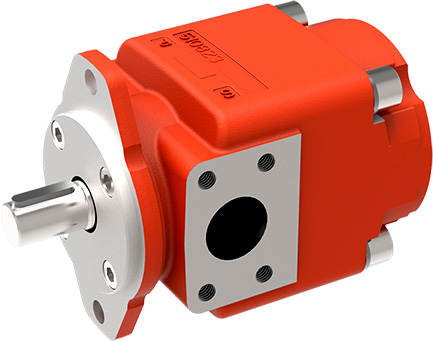
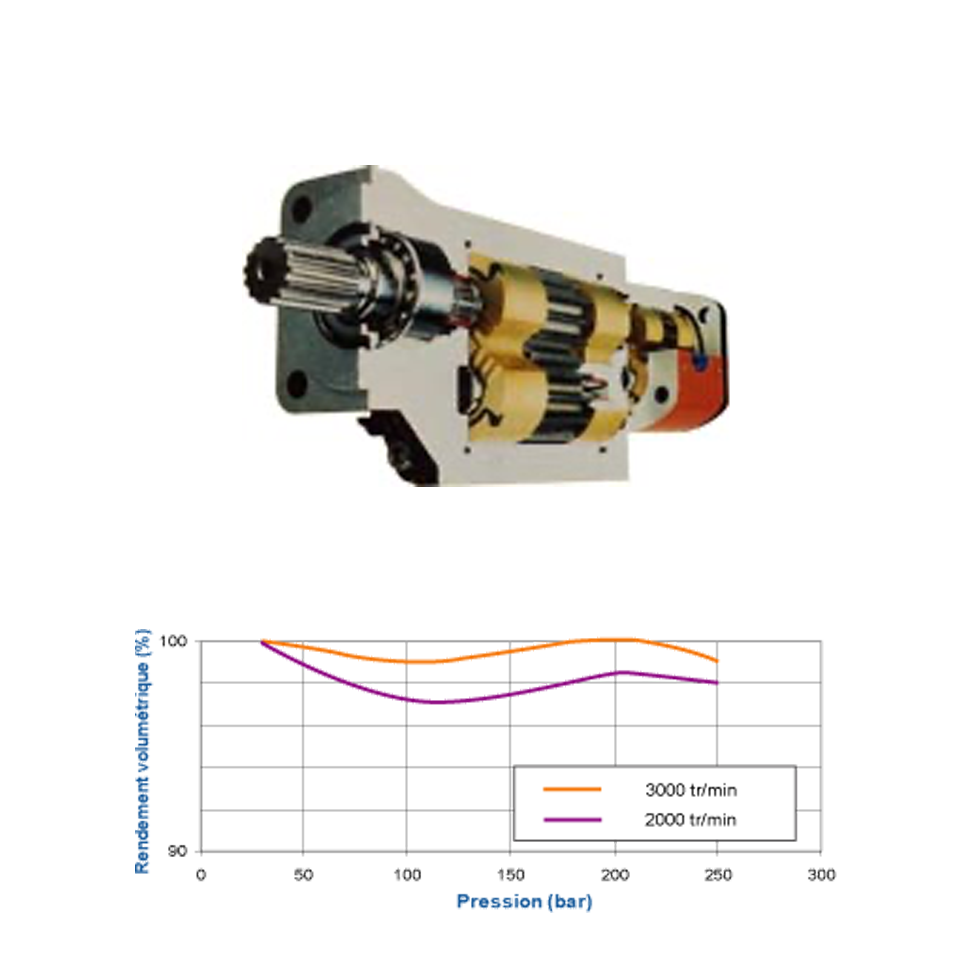
External gear pumps use two meshing gears that carry fluid around the casing from inlet to outlet. They are mechanically simple, compact, tolerant of contamination, and the lowest-cost option, which makes them the default fixed-displacement choice for general-purpose industrial and mobile duty up to roughly 250 to 300 bar. Overall efficiency runs about 80 to 90 percent. Their limitations are a fixed output (surplus flow becomes heat through the relief valve) and higher noise than vane pumps. They are ideal where robustness and price matter more than fine control.
Vane pumps use a slotted rotor whose vanes slide out against an elliptical or circular cam ring to form pumping chambers. They run quieter than gear pumps and reach volumetric efficiencies of about 85 to 92 percent below 150 bar, which makes them efficient for medium-pressure machine-tool and servo work, with pressure ceilings commonly cited from about 175 up to 320 bar. Balanced and variable-displacement vane designs exist. The trade-offs are sensitivity to contamination at the vane tips and a narrower pressure range than piston pumps.
Axial piston pumps drive a ring of pistons against a swashplate; tilting the swashplate varies the stroke and therefore the displacement. They are the high-pressure workhorse, running continuously at 350 bar with transient peaks to 400 bar, and reaching up to 95 percent volumetric efficiency. The decisive advantage is variable displacement: the pump produces only the flow the system needs, which cuts wasted energy and heat by 20 to 40 percent against a fixed-displacement equivalent. They cost the most and demand cleaner fluid. If a system needs more than about 310 bar continuously, axial piston is effectively the only viable choice. Radial piston pumps extend the principle to ultra-high pressures up to roughly 700 bar for presses and clamping circuits.
The pump choice cascades into the rest of the unit. A piston pump's tighter internal clearances demand a cleaner ISO 4406 target and finer filtration (Chapter 4). A fixed gear pump that dumps surplus flow demands more cooling capacity (Chapter 5). And the pump's allowable inlet viscosity and suction pressure constrain the tank configuration and fluid grade. Selecting the pump first, then sizing the unit around it, avoids the common error of fixing the tank or motor before the pressure class is settled.
Chapter 4 / 06
Fluids, Reservoir and Sizing
The hydraulic fluid is a working component, not a consumable afterthought: it transmits power, lubricates the pump and valves, carries heat to the cooler, and flushes contaminants to the filter. Most industrial HPUs run on mineral-based anti-wear hydraulic oil classified to DIN 51524 Part 2 as HLP, which adds anti-oxidation, anti-wear, and corrosion-protection additives to a refined mineral base. Where temperatures swing widely, HVLP fluids to DIN 51524 Part 3 hold viscosity more stable across the operating range. Fire-risk environments may mandate fire-resistant fluids: HFC water-glycol or HFDU synthetic esters per ISO 12922, which usually derate pump pressure and require verified seal compatibility.
Viscosity grade is set by the ISO 3448 viscosity classification, which fixes the kinematic viscosity at 40 degrees Celsius. The three dominant grades for HPUs are ISO VG 32, VG 46, and VG 68. The table below summarizes their typical placement; the correct grade is always the one that keeps viscosity inside the pump maker's allowed window at both cold start and full operating temperature, so ambient and pump speed drive the choice.
Grade
Viscosity at 40°C
Best Suited To
Notes
ISO VG 32
~32 cSt
Cooler ambients, higher pump speeds
Lower drag, thinner film
ISO VG 46
~46 cSt
General indoor industrial service
Common all-round default
ISO VG 68
~68 cSt
Warmer ambients, higher loads
Thicker film, more drag when cold
Reservoir sizing follows the long-standing rule of thumb: usable volume equal to three to five times the pump flow per minute. A 40 L/min pump therefore points to a 120 to 200 liter tank. The reservoir is the unit's primary passive cooler and its de-aeration vessel: returning fluid must slow enough to release entrained air bubbles and let particles settle before the pump draws it back in. The larger multiplier suits continuous duty and hot ambients; the smaller end is acceptable for intermittent duty or where a dedicated oil cooler carries the heat load. Where accumulators handle peak demand, even smaller tanks are possible.
ISO 4413 enumerates the reservoir functions a designer must verify, and they map directly to features on the tank: hold the entire system fluid while keeping the level high enough never to starve the pump; provide headroom for thermal expansion; dissipate operating heat; slow the returning fluid so trapped air is released and contaminants settle; separate the return flow from the suction with a baffle plate or tank geometry; and provide access for cleaning. A return line that discharges below the minimum fluid level, fitted on the far side of a baffle from the suction strainer, is the practical implementation of those last two requirements.
Cleanliness is specified to ISO 4406, which reports contamination as three scale numbers counting particles per milliliter at sizes equal to or larger than 4, 6, and 14 micrometers. A widely accepted target for general fixed-displacement pump systems is 18/16/13. Servo and proportional valve circuits, with their tight spool clearances, demand cleaner fluid, typically 16/14/11 or better. The cleanliness target is delivered by filtration rated with a filter beta ratio: a Beta-10 of 200 or more removes 99.5 percent of particles at 10 micrometers. Pressure-line, return-line, and fill or breather filters together hold the target, and particle counting at commissioning verifies it is met.
Chapter 5 / 06
Key Specification Parameters
Reading an HPU datasheet means evaluating the unit as a system. The same nameplate may list two dozen numbers, but a handful drive the selection: operating pressure, flow rate, motor power, reservoir volume, fluid grade and cleanliness, cooling capacity, noise, and protection rating. Each is decoded below, with the calculations a buyer should be able to reproduce.
Operating pressure and flow are the two primary outputs. Pressure, in bar (or psi), is set by the system load and capped by the relief-valve setting and the pump's rated pressure. Flow, in L/min (or GPM), determines actuator speed. A well-designed unit operates around 70 to 85 percent of the rated maximum pressure, leaving margin for transients. These two values, taken at their worst-case simultaneous point in the duty cycle, are the inputs to every other size on the sheet.
Motor power follows directly from pressure and flow. In metric units, hydraulic power P (kW) equals pressure (bar) times flow (L/min) divided by 600. A unit delivering 40 L/min at 200 bar develops about 13.3 kW of fluid power. Dividing by the pump's mechanical efficiency, around 0.9, gives the required shaft input of about 14.8 kW, so a standard 15 kW motor is selected. The imperial form is HP equals psi times GPM divided by 1714. The motor must be rated for the unit's duty class and service factor, not merely the peak, because a motor that is adequate for a momentary peak can overheat under a high duty cycle.
Cooling capacity is specified in kW of heat rejection and must match the heat the system actually generates. Every kilowatt of fluid power that is throttled across a valve or dumped over a relief valve becomes heat. Oil temperature should generally stay below about 60 degrees Celsius for long oil and seal life, with 80 degrees Celsius a common alarm limit; above these, oxidation accelerates and viscosity falls. The escalation ladder runs from a larger reservoir, to an air-blast fan cooler, to a water-cooled exchanger, with variable-displacement or variable-speed pumps removing the heat at the source by not generating surplus flow.
Two further parameters belong on every specification:
Fluid grade and cleanliness: the allowed fluid type (HLP / HVLP / HFC / HFDU), the ISO VG grade, and the ISO 4406 cleanliness target with the matching filter beta ratio. These set service life as much as any mechanical part.
Noise and ingress protection: sound pressure level in dB(A) at one meter (vane and immersed units are quietest), the motor and enclosure IP rating (IP54 to IP66 for industrial duty), and the electrical supply and frequency.
Relief-valve setting and accumulator round out the safety and performance picture. The pressure-relief valve is the system's safety fuse and must be set above the working pressure but within the rated pressure of every component it protects. An optional accumulator stores energy for peak demand, smooths pulsation, and can let a smaller pump and motor serve a high-peak, low-average duty, but it adds a pressure-vessel inspection obligation and a gas-precharge maintenance task.
Chapter 6 / 06
Selection Decision Factors
To turn the preceding five chapters into a specific unit, follow the decision sequence below. Most selection errors come not from a single wrong number but from settling a downstream choice (tank, motor) before an upstream one (pressure class, pump type) is fixed. These nine steps double as an RFQ template.
Define the duty cycle: list the worst-case simultaneous pressure and flow, the average versus peak load, and whether duty is continuous, intermittent, or accumulator-assisted. Every later number derives from this point, so do not approximate it.
Set the pressure class and pump type: below roughly 250 to 300 bar a gear pump suffices; medium pressure with low noise points to vane; above 300 bar continuous requires axial piston; ultra-high pressure (to 700 bar) requires radial piston. Choose fixed versus variable or variable-speed based on the energy and heat budget.
Calculate motor power: P (kW) equals bar times L/min divided by 600, then divide by drive efficiency (~0.9) and pick the next standard IEC or NEMA motor frame, rated for the duty class and service factor.
Size the reservoir: three to five times pump flow per minute, biased high for continuous or hot-ambient duty, lower only with a dedicated cooler or accumulator. Verify the ISO 4413 reservoir functions, especially flooded suction and a baffle separating return from suction.
Select fluid and viscosity: HLP per DIN 51524-2 for standard duty, HVLP for wide temperature swings, fire-resistant per ISO 12922 in fire-risk areas; ISO VG 32 / 46 / 68 chosen to keep viscosity inside the pump window at cold start and operating temperature.
Set cleanliness and filtration: ISO 4406 18/16/13 for general systems, 16/14/11 or better for servo and proportional valves, with matching filter beta ratios on pressure, return, and fill lines.
Size cooling: run an energy balance on throttled and dumped flow, then choose passive tank, air-blast, or water cooling to hold oil below 60 degrees Celsius, or remove the heat at source with a variable pump.
Specify valves, manifold, and accessories: relief valve set within all component ratings, directional and pressure controls on a manifold, plus gauges, level and temperature switches, and condition-monitoring sensors as needed.
Confirm compliance and protection: ISO 4413 system safety, motor and enclosure IP rating for the environment, electrical supply and any hazardous-area requirement, and the pressure-vessel obligations if an accumulator is fitted.
One dimension that buyers routinely underweight is serviceability over the unit's life: an HPU is a serviced asset that runs for 10 to 20 years, so local spare-part availability, field service, the ease of changing filters and sampling oil, and the openness of any condition-monitoring data matter as much as the purchase price. Established suppliers such as Bosch Rexroth (the ABPAC standardized range covers 100 to 400 liter tanks with optional sensor packages and variable-speed Sytronix drives), Eaton, Parker Hannifin, Danfoss, HYDAC, Bucher Hydraulics, and Moog maintain service networks; for standard fixed-displacement units, regional builders assemble to the same component standards at lower cost. Whichever route, verify ISO 4413 conformity and the individual pump and valve certifications before signing.
FAQ
What is the difference between a hydraulic power unit and a hydraulic power pack?
The terms are used interchangeably in most catalogs. In common usage, hydraulic power pack tends to describe smaller, compact, often mobile or OEM-integrated units with reservoirs below roughly 30 liters, while hydraulic power unit (HPU) tends to describe larger stationary industrial assemblies with reservoirs of 100 liters and above, separate cooling, filtration, and condition-monitoring sensors. Both describe the same functional block: an electric motor or engine driving a pump that draws fluid from a reservoir and delivers controlled pressure and flow to actuators through a valve manifold. There is no formal standard that separates the two names, so always read the datasheet rather than the label.
How do I size the reservoir on a hydraulic power unit?
The classic rule of thumb is a usable volume of three to five times the pump flow per minute. A 40 L/min pump therefore points to a 120 to 200 liter reservoir. The larger multiplier suits continuous-duty or high-ambient systems because the tank is the primary passive cooler and de-aeration volume: returning fluid must slow enough to release entrained air and let particles settle before being drawn back into the pump. For intermittent or accumulator-assisted duties, or where a dedicated oil cooler is fitted, designers sometimes drop toward two times flow. ISO 4413 lists the reservoir functions to verify: hold the full system fluid, allow thermal expansion, dissipate heat, separate return from suction with a baffle, and provide cleaning access.
Which pump type should I choose: gear, vane, or piston?
Match the pump to pressure, duty, and efficiency need. Gear pumps are the low-cost, contamination-tolerant default for fixed-displacement duty up to roughly 250 to 300 bar, with overall efficiency around 80 to 90 percent. Vane pumps run quieter and suit medium pressures to about 175 to 320 bar with good efficiency below 150 bar, and are common on machine tools. Axial piston pumps are the choice above 300 bar continuous, reaching 350 bar continuous with 400 bar peaks and up to 95 percent volumetric efficiency, and are available as variable displacement to cut heat and energy by matching output to demand. If you need pressures above about 310 bar continuously, piston is effectively the only option.
What electric motor power does a hydraulic power unit need?
Start from the hydraulic power formula in metric units: P (kW) equals pressure (bar) times flow (L/min) divided by 600. A unit delivering 40 L/min at 200 bar needs about 13.3 kW of fluid power. Divide by drive-train efficiency to get the input shaft and motor rating: at roughly 0.9 pump efficiency the motor must supply about 14.8 kW, so a standard 15 kW motor is selected. The imperial equivalent is HP equals psi times GPM divided by 1714. Always size to the worst-case simultaneous pressure and flow, then confirm the chosen IEC or NEMA motor frame, duty cycle, and service factor against the actual load profile rather than the peak alone.
What hydraulic fluid and viscosity grade should the unit use?
Most industrial HPUs run on mineral-based anti-wear hydraulic oil to DIN 51524 Part 2 (HLP grade), with ISO VG 32, 46, or 68 the dominant viscosity grades per ISO 3448. ISO VG 46 is the common all-round choice for indoor industrial service at moderate temperatures; VG 32 suits cooler ambients or higher-speed pumps, and VG 68 suits warmer ambients or higher loads. Where wide temperature swings occur, HVLP fluids to DIN 51524 Part 3 hold viscosity more stable across temperature. Fire-risk areas may require HFC water-glycol or HFDU synthetic ester fire-resistant fluids per ISO 12922, which can derate pump pressure and require seal compatibility checks. Always confirm the pump maker's allowed viscosity window at startup and at operating temperature.
What ISO 4406 cleanliness level does a hydraulic power unit require?
ISO 4406 expresses contamination as three scale numbers counting particles per milliliter at sizes equal to or larger than 4, 6, and 14 micrometers. A widely cited target for general fixed-displacement pump systems is 18/16/13. Sensitive servo and proportional valve circuits demand cleaner fluid, often 16/14/11 or better, because tight spool clearances silt up and stick at higher particle counts. Cleanliness is set by the filtration rating: a filter beta ratio such as Beta-10 equal to or above 200 removes 99.5 percent of particles at 10 micrometers. Pressure, return, and an offline or fill filter together hold the target. Sampling and particle counting at commissioning and at intervals verify the level is actually met in service.
Why does my hydraulic power unit overheat, and how is it cooled?
Heat is generated whenever fluid power is throttled or dumped across relief valves rather than doing useful work: a fixed-displacement pump that runs at full flow while the system needs less converts the surplus directly into heat. Sustained oil temperature above roughly 60 degrees Celsius accelerates oil oxidation and shortens seal and oil life, with many makers flagging 80 degrees Celsius as a limit. Cooling options in order of escalation: a larger reservoir for passive dissipation, an air-blast (fan) oil cooler, a water-cooled shell-and-tube or plate exchanger, and on the source side a variable-displacement or variable-speed pump that only produces the flow demanded. Confirm the heat load with an energy balance before sizing any cooler.
Hydraulic Power Unit Manufacturers
Source-backed product routes. Open a company dossier for procurement scope and cited evidence.
Bucher Hydraulics documents serviceable GPP PowerPacks, Smart PowerPacks and compact mobile or industrial hydraulic power-pack routes.
Published product fact
GPP PowerPacks, Smart PowerPacks, Electro-Pumps ET, Series UP, M-Series mobile DC/AC packs, MT & T industrial/commercial AC packs and YBZ application-specific units.
Published product fact
QXEHX internal-gear hydraulic pumps for open circuits, fixed- or variable-speed drives and reverse operation, with published working pressure up to 280 bar and speeds up to 6,050 rpm.
HPI SAS describes itself as an independent French designer and manufacturer of custom hydraulic components and mini power packs.
Published product fact
2G modular mini power packs plus HPI Micro 2G, Micro 3G and Silent micro power-pack routes; the published micro route is available in DC or single- and three-phase AC configurations with 2.0–25.8 l/min flow and up to 300 bar.
Published product fact
Hydraulic gear pumps from 0.25 to 250 cm³/rev with published peak pressure up to 330 bar; the modular architecture supports multiple-pump configurations with two to five sections.
HYDAC's official website presents the company across hydraulics, electronics and filtration, while its retained catalogs document category-specific product families.
Published product fact
Hydraulic and lube-oil filter elements, including Stat-X element technology and high-efficiency depth media
Published product fact
Hydraulic and lube-oil filter elements with Stat-X technology and high-efficiency depth (absolute) filter media
Hydraproducts Ltd describes in-house hydraulic power-pack design and manufacture for mobile and industrial applications.
Published product fact
Standard hydraulic units, micro units, mini AC/DC units and bespoke hydraulic power units, including published standard, mini and micro range descriptions.
Moog publishes servo and proportional valves for industrial machines that control an actuator's position, force or speed through mechanical or electronic spool-position feedback.
Published product fact
Industrial mechanical-feedback servo valves, electronic-feedback servo and proportional valves, miniature servo/proportional valves and special-feature variants, including standard and customized configurations with analogue-signal or fieldbus options.
MTE Hydraulics Inc. documents AC and DC hydraulic power units alongside its hydraulic pumps, motors and flow dividers.
Published product fact
Custom DC hydraulic power units with 12–48 VDC motors and custom AC hydraulic power units with single- and three-phase motor options; both product pages retain MTE pump and reservoir options.
Parker's Accumulator Central catalog covers piston, bladder and diaphragm accumulator documentation.
Published product fact
Series A threaded piston, ACP crimped piston, BA bladder and AD diaphragm accumulators
Published product fact
Parker mobile cylinders: single- and double-acting telescopic cylinders plus welded rod cylinders; the published bore ranges are 3.25–48 in for telescopic and 1.5–30 in for welded rod cylinders.