Quality graphite rotors used for continuous aluminum degassing typically last 4 to 8 weeks, and matching shafts usually outlast the rotors [S3].
The choice should be based on melt exposure, erosion, oxidation, dimensional stability, and qualified service data; no industrial research establishes a defensible ceramic-rotor life range for aluminum degassing.
Graphite and ceramic wear comparison
Graphite is the documented baseline for rotary aluminum degassing because it remains stable at molten-metal temperatures above 700 °C, resists thermal shock, and is not wetted by molten aluminum [S3]. The published service benchmark is 4 to 8 weeks for quality graphite rotors under continuous operation, with shafts normally lasting longer than rotors [S3].
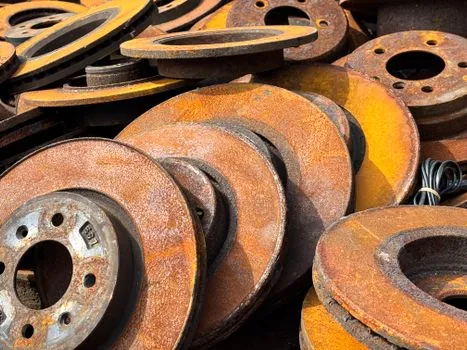
Ceramic has no equivalent aluminum-foundry service-life range in the supplied industrial evidence. The available ceramic wear material concerns carbon-ceramic brake discs, where disc mass can decrease while overall thickness remains largely unchanged [S2]. That observation cannot be transferred to a rotating rotor immersed in molten aluminum. A separate automotive discussion described heat-related oxidation and premature ceramic-disc wear after roughly 360 and 460 track miles, but that is not a degassing test [S4].
On cost, replacement frequency, and evidence quality, graphite leads because it has a documented 4–8 week operating benchmark and an established supply base. Ceramic cannot be ranked credibly for aluminum wear life, unit cost, or maintenance frequency from the available data.
Why graphite suits molten aluminum
Fine-grain molded graphite for general rotor duties typically has a bulk density of 1.75–1.85 g/cm³ and low-to-moderate porosity, while isostatic graphite reaches 1.85–1.95 g/cm³ with very low porosity and higher isotropic strength [S1]. Extruded graphite falls at 1.6–1.75 g/cm³, has higher porosity and lower strength, and is generally positioned for lower-cost, short-run applications [S1].
Silicon carbide and graphite blends are listed at 1.9–2.2 g/cm³ with low porosity and improved wear resistance for severe abrasion and long-life applications [S1]. These grades illustrate why material designation alone is insufficient: density, porosity, manufacturing route, treatment, and machining quality determine service behavior. The degassing unit drawing, gas flow, and rotor speed must also match as an assembly rather than as isolated parts.
Graphite is chemically stable in molten aluminum and is used for gas-injection rotors in aluminum, zinc, and copper alloy processing [S5]. Its intrinsic lubricity, low thermal expansion in suitable fine-grain grades, good machinability, and low chemical affinity with aluminum reduce contamination and mechanical stress at the melt line [S1].
Oxidation, erosion, and failure modes
Graphite rotor degradation concentrates at the melt line, where hot metal, gas, and oxygen exposure combine to accelerate oxidation and erosion [S1][S3]. Reinforced fiberglass coverings, including RFM-style protective sleeves, and specialized ceramic finishes reduce surface erosion and extend component life [S1][S6]. The useful conclusion is not that ceramic is a drop-in replacement, but that surface protection can improve the service life of the selected graphite system.
A worn rotor changes gas dispersion before it fails completely. That degradation reduces bubble dispersion and hydrogen removal, allowing porosity to carry into castings that already have machining cost [S3]. Other warning signs include thread damage, excessive runout, vibration, uneven wear, and reduction of the working head at the melt line. Poor threads and runout can produce vibration and early breakage, while nonuniform wear can disturb balance at speed [S3].
Preventive replacement is preferable to waiting for fracture. Graphite is brittle, and a rotor can survive furnace exposure yet still be damaged by careless handling or container loading [S3]. Inspection intervals should therefore be tied to operating hours, melt exposure, and observed wear rather than an arbitrary calendar date.
Selection criteria and machining controls
Rotor diameter, shaft length, thread type, and rotational speed must follow the degassing unit specification [S3]. Common geometries include vaned, notched or slotted, and pumping designs, and the selected geometry affects bubble size, gas distribution, stirring, and melt treatment [S3]. A materially stronger grade does not compensate for incorrect geometry or an undersized or overloaded drive.
For quality control, require lot-level material certificates covering density, grain structure, and treatment, plus dimensional inspection against the drawing [S3]. Fine, uniform grain is associated with predictable wear and stable balance at speed, while impregnation or coating can extend life at the melt line [S3]. Typical target density for this duty is 1.75–1.85 g/cm³, but final acceptance should follow the approved drawing and material grade rather than a generic density range [S1][S3].
The selection sequence is straightforward: approve the rotor geometry, select the graphite grade for the duty, verify machining and coating, commission the matched shaft, and define inspection points before production. The casting ladle and furnace conditions then determine exposure severity, including bath chemistry, temperature, treatment frequency, and the time each rotor spends submerged.
Where ceramic can fit
Ceramic finishes are used as a surface-protection option for graphite hardware, reducing erosion and extending life [S1][S6]. The cited figure compares a ceramic rotor without a sleeve with a sleeved configuration after two weeks of use, while the accompanying text states that reinforced fiberglass material covers graphite to reduce wear.
This makes ceramic most defensible as a protective finish or sleeve system within a qualified graphite rotor design, not as an unsupported full-rotor replacement. A supplier must still provide application-specific evidence for molten aluminum exposure, thermal cycling, chemical compatibility, retention method, and end-of-life inspection criteria. The available [S6] comparison does not provide a full 4–8 week lifetime benchmark for an unsleeved ceramic rotor.
For direct ceramic-versus-graphite purchasing, request 3 fields of evidence: operating hours or treatment cycles to defined wear limits, melt exposure and temperature history, and measured dimensional and mass loss. Without those data, a ceramic service-life claim would be less defensible than the published graphite benchmark of 4 to 8 weeks [S3].
Operating recommendation and service tracking
Use a qualified graphite rotor as the default for continuous aluminum degassing, with a 4–8 week starting expectation only as a planning benchmark, not a guaranteed replacement interval [S3]. Keep matched spares available, inspect the melt line, and record treatment cycles, operating hours, erosion, oxidation, thread condition, runout, and final failure mode for each installed rotor [S1][S3].
Track whether the line uses argon or nitrogen, and use the installed degassing unit operating parameters to connect wear with gas flow, rotation speed, and treatment time [S3]. If actual life falls materially below 4 weeks, examine overspeed, aggressive chemistry, surface protection, and machining tolerance before blaming the graphite grade. If life reaches or exceeds 8 weeks, preserve the wear record because it can establish a site-specific interval for future procurement and maintenance planning.