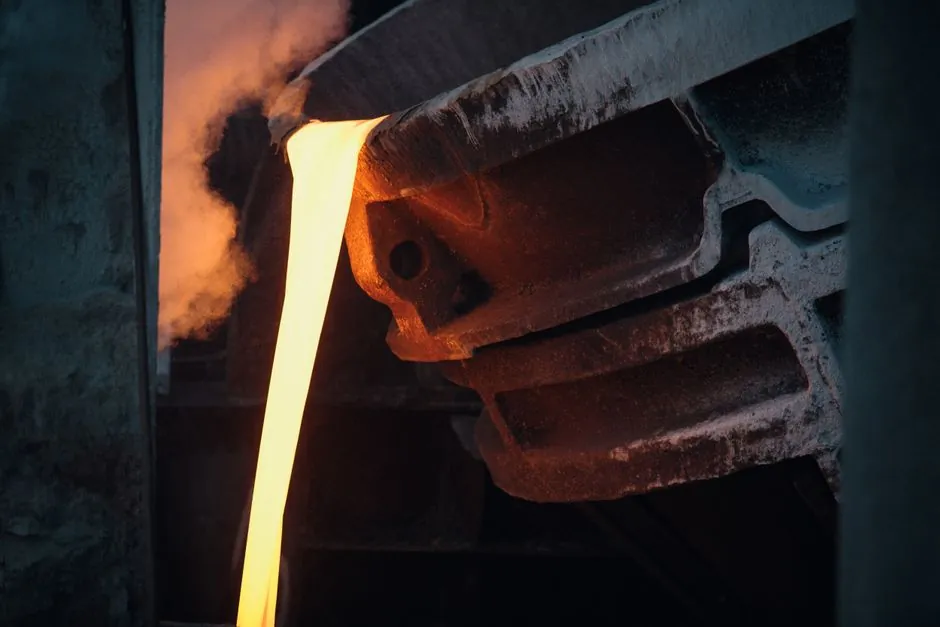
Grey cast iron ASTM A48 / DIN 1691 / EN 1561 ships at 1.23-1.35 USD per kg on a 5-2000 lb (2-1000 kg) basis, while carbon steel sand castings of equivalent weight sit at 2.30-2.70 USD/kg, a 70-90% premium for the same part geometry [S1][S2].
The gap widens once alloying enters the picture: 42CrMo alloy carbon steel sand cast runs 2.40-2.80 USD/kg, and AISI 316 stainless investment cast jumps to 9.21-10.15 USD/kg, roughly 7-8x the grey iron number [S2]. All quoted figures are EXW China and exclude machining, painting, packing, and delivery [S1][S3].
Side-by-side price matrix: grey iron, ductile iron, carbon steel, alloy steel, stainless
Five material/process rows on a 0.5-50 kg weight band, USD per kg EXW China [S1][S2][S3]:
Grey cast iron (ASTM A48 / EN 1561), sand cast, normal complexity: 1.23-1.38 USD/kg, with the 1-2 kg bracket at 1.35-1.38 USD/kg and 2-50 kg at 1.23-1.26 USD/kg [S1][S3]. Ductile cast iron (ASTM A536 / EN 1563), sand cast, same weight band: 1.34-1.48 USD/kg, roughly 7-10% above grey iron because of magnesium treatment and higher melt temperature [S1][S3]. Cast carbon steel C40 sand cast, normal/medium complexity: 2.30-2.50 USD/kg, with the small 0.1-1.0 kg bracket reaching 2.60 USD/kg [S2]. Alloy carbon steel 42CrMo sand cast, normal/medium: 2.40-2.50 USD/kg [S2]. AISI 316 stainless steel sand cast, normal/medium: 4.42-4.48 USD/kg; investment cast version: 9.21-10.15 USD/kg [S2].
The decisive spread on the chart is the 3-7x multiplier from grey iron to stainless, but the more useful decision line for most buyers sits between grey/ductile iron (1.23-1.48 USD/kg) and cast carbon steel (2.30-2.70 USD/kg), where the question is whether the part needs weldability, impact toughness, or magnetic-permeability behaviour that grey iron cannot deliver. Reference the cast iron properties page for the metallurgy behind the price delta.
What actually drives the steel premium
Steel castings carry two cost stacks iron does not: melt chemistry and post-casting thermal processing. Carbon and alloy steel routinely need normalizing, quenching and tempering, or annealing to hit the specified tensile and impact values, and each cycle adds furnace time, fixturing, and scrap risk [S2].
On the process side, grey and ductile iron pour cleanly into green-sand or shell-mould lines, while most steel jobs move to investment casting (lost wax), lost foam, or vacuum casting to hold dimensional tolerance and surface finish without the free-machining graphite that lubricates iron cuts [S2]. Those process routes add 30-200% to the per-kg casting cost on the same part, visible in the steel table where investment casting triples the sand-cast number for identical weight brackets (carbon steel 2.30 USD/kg sand-cast vs 6.80-7.60 USD/kg investment-cast) [S2]. Alloying elements Mn, Mo, Cr, and Ni compound the chemistry cost when wear, heat, or corrosion resistance is specified [S2].
Decision map: when grey iron wins, when cast steel wins
Specifying grey cast iron ASTM A48 / EN 1561 makes economic sense for static, compression-loaded housings, machine bases, pump bodies, and counterweights where the 1.23-1.38 USD/kg rate and excellent damping capacity outweigh the brittleness and low tensile strength (~150-300 MPa typical for class 20-40) [S1][S3]. For a deeper look at how part geometry and gating change those numbers, see the casting tooling reference.
Cast carbon steel (1.18-2.70 USD/kg sand-cast) is the right pick when the part sees dynamic or impact loading, requires weld repair in service, or operates below -20 degC where grey iron transitions toward brittle failure [S2]. Pressure-containing components under ASME or PED rules almost always end up in cast steel for this reason. Ductile iron ASTM A536 at 1.34-1.48 USD/kg often substitutes for cast steel in moderately loaded gears and hubs, capturing most of steel's toughness at roughly half the price of alloy carbon steel sand cast [S1][S3]. Stainless 316 (4.42-10.15 USD/kg) is reserved for corrosion service in chemical, marine, and food-grade skids where neither iron nor carbon steel survives the chemistry. Buyers weighing pattern and tooling amortisation across these routes should also consult the casting mold entry.
Weight bracket effect and hidden adders
Casting weight skews price in a non-linear way: sub-1 kg parts carry a fixed labour and setup burden that pushes the per-kg rate up by 8-15% versus the 5-50 kg sweet spot in both iron and steel tables [S1][S2]. Above 1000 kg the rate drifts back up because ladle handling, cooling time, and risk of scrap increase, though this is partly offset by volume discounts on the melt charge [S1][S2].
Beyond EXW, the line items that change a buyer's landed cost are machining (often 40-80% of the casting price on finish-machined iron parts), painting, packaging, and freight, all of which are excluded from the published Chinese rates [S1][S3]. For context on how those downstream costs interact with material choice in heavy-equipment builds, the die casting page is worth cross-referencing for high-volume ferrous alternatives, even though the material economics differ from sand casting.
Market signals worth tracking next

Cast iron scrap and pig iron indices on Procurement Tactics showed a daily print of 165.00 USD per gross ton on 26 September 2026, with a 30-day average also at 165.00 USD and a 365-day average of 164.12 USD, indicating a flat feedstock cost environment for the iron side of the table [S5]. Watch the LME nickel and molybdenum spot prints as the leading indicator for stainless 316 and 42CrMo alloy steel pricing, since Ni typically moves 6-12 months ahead of foundry surcharges. Exchange rate volatility between USD and RMB will continue to drive sub-3% week-to-week moves on the EXW Chinese rate bands quoted above [S1][S3].
See also our earlier report, Centers vs V-Blocks for Projecting Shaft Profiles on an Optical Comparator.