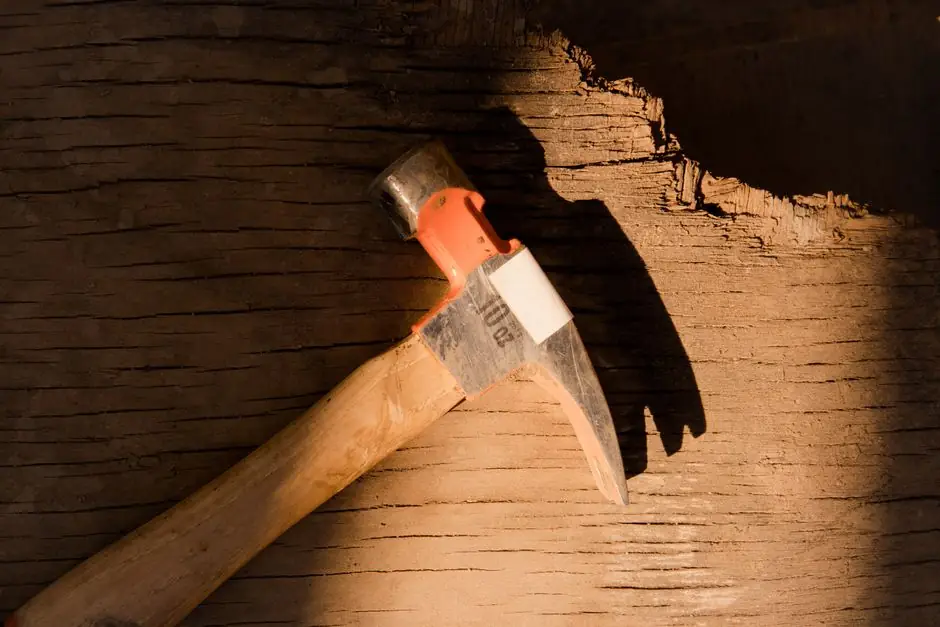
A hammer striking face must resist deformation while avoiding brittle fracture that can launch steel fragments toward the user or nearby workers [S1][S2].
The practical choice depends on the work: nail hammers serve unhardened nails, ball-peen hammers serve chisels and punches, and dedicated hammers serve scale, concrete, and masonry without crossing incompatible tool classes [S2][S3].
What Striking-Face Hardening Changes
Striking-face hardening changes the material response at the contact surface, but it does not make every hammer suitable for every impact duty. Hardened steel can chip when struck against another hardened object, and the detached fragment can penetrate skin or injure an eye [S1][S2].
Three interacting requirements govern the result: the face must be hard enough to resist wear and deformation, the impact must remain within the tool's intended duty, and the contact must be sufficiently square to prevent edge chipping or slippage [S1][S2][S3]. These are not interchangeable requirements, and a harder face cannot compensate for an incompatible hammer-to-chisel pairing.
Select the Hammer by the Struck Tool
Nail hammers are intended for driving and pulling common, unhardened nails and for breaking apart wooden structures; they may strike a nail set with the center of the face [S2]. A nail hammer must not strike steel chisels, nail pullers, or other hardened objects because its face may chip and create a serious eye or bodily injury hazard [S2].
Hardness Is Not a Universal Impact Rating

A face that is too soft develops a rolled or mushroomed edge, while a face exposed to the wrong impact can fracture and eject chips [S1][S8]. The hammer's body, striking face, peen, handle joint, and workpiece therefore have to be treated as a matched system rather than independent parts.
For a ball-peen hammer striking a chisel or punch, the specified face diameter provides a concrete geometry check: the hammer face must be at least 3/8 inch larger than the struck face [S2]. When striking a chisel or punch, the hammer’s striking face should have a diameter at least 3/8 inch larger than the struck face, and square blows help prevent chipping of the hammer’s face edge [S2].
For exact hardness selection, the separate engineering problem of specifying chisel and punch hardness is covered in Choose Rockwell C Hardness for Chisels and Punches. That distinction matters because the hammer face and the struck edge are separate components with separate failure modes.
Impact Direction Changes the Failure Mode
A glancing blow is not equivalent to a square strike because it transfers load toward an edge and can cause the face edge to chip [S2][S3]. The hammer face should meet the intended contact area squarely, and users should not strike with the side or cheek of a hammer [S2].
Hardened faces also change what counts as misuse. A ball-peen hammer is designed for chisels, punches, riveting, shaping, and straightening unhardened metal, but that authorization does not permit hammering another hammer, a sledge, or a maul [S2].
Where Hardening Does Not Belong
Soft faces are not less engineered than steel faces; they are intended to prevent marring or damaging the workpiece.
Specialized hammers are also duty-bound. A riveting hammer is designed for driving and spreading rivets on sheet-metal work, while a setting hammer is designed for forming sharp corners, closing, and peening [S2]. Nail hammers should never be used to strike another hammer, a hatchet, nail pullers, steel chisels, or other hardened objects because the face may chip and cause serious injury [S2].
Mechanical applications also need the correct impact class. Its value comes from controlled impact behavior, not from hardening a steel face.
Inspection Criteria Must Override Service Life
Inspect the striking face for mushrooming, chips, or cracks before use, and withdraw any affected tool from service [S1][S8]. A mushroomed striking end must be replaced rather than redressed because dressing alters the steel hardness and can contribute to failure [S8].
OSHA 29 CFR 1926.301(a) prohibits employers from issuing or permitting unsafe hand tools. Paragraph (c) requires impact tools such as drift pins, wedges, and chisels to be kept free of mushroomed heads, while paragraph (d) requires wooden handles to remain free of splinters and cracks and kept tight in the tool [S1]. The same safety objective applies to powered striking equipment, where tool-control details can be compared with the demolition hammer impact-energy criteria.
Steel chips can fly fast enough to penetrate skin and eyes, and hammer misuse can cause serious eye injury [S1][S2]. Heavy-duty gloves can protect against blisters, cuts, and impact while supporting grip, but gloves do not make an incompatible tool pairing safe [S7].
Process Controls for Chipping Prevention

A complete control plan combines material pairing, geometry, technique, inspection, and retirement. First, identify the workpiece and the struck tool. Second, choose the designated hammer class. Third, verify that contact is square and that the hammer face geometry is appropriate, including the 3/8 inch minimum diameter relationship for a ball-peen hammer striking a chisel or punch [S2].
Fourth, inspect before use for mushrooming, edge chips, cracks, and handle damage [S1]. Fifth, replace a mushroomed tool rather than attempting to dress it [S8]. This sequence is more reliable than adding face hardness alone because the documented chipping failures involve incompatible targets, glancing impact, damaged faces, and unsupported hard-on-hard strikes [S1][S2][S8].
The next verification point is the tool register: record the hammer class, approved struck-tool materials, face-condition checks, and withdrawal criteria. Then compare handling risk, including vibration and grip, with the impact-tool handle material choice before adding hammers to mobile work kits.