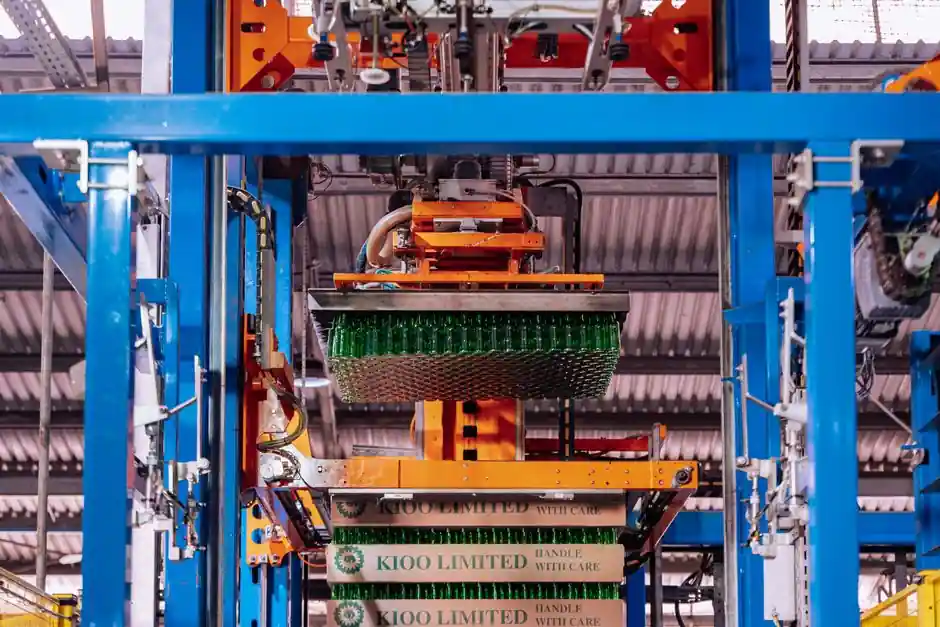
On a packaging line, the reducer is the mechanical component that decides whether a 0.5 g dose lands in the cup or short of it; published 2026 selection guidance now treats ratio and nominal torque as necessary but insufficient inputs, with torsional stiffness, lost motion, and the full torque-speed cycle as the binding constraints [S4][S6].
Packaging builds span filling, labeling, cartoning, flow wrapping, and palletizing, and the gearbox family chosen (planetary or harmonic reducer) is driven by which of those stations a machine builder is specifying. For servo-driven pick-and-place, delta robots, and robotic palletizers, the published fit is harmonic drive plus high-speed planetary, sized for zero backlash, high acceleration, and a compact envelope inside the machine frame [S5].
What a Harmonic Drive Actually Buys You on a Packaging Line
A harmonic drive (also called a strain wave gear) uses a wave generator, a flexspline, and a circular spline; the elliptical wave generator deforms the flexspline so its external teeth engage the circular spline at two diametrically opposite zones, and the tooth-count difference (commonly two teeth) produces the reduction ratio in a single stage [S3]. Because the mesh is continuous and pre-loaded, new-condition unloaded backlash is held to effectively zero, with published precision grades at ≤10 arc-sec for semiconductor-style packaging and ≤30 arc-sec as a general industrial cap [S4].
The same compliance that delivers near-zero backlash is the trade-off: the flexspline must deform to work, so under torque load it winds up elastically, and that wind-up is what shows up as lost motion at the output [S3]. Rated life for a packaged-unit harmonic drive is commonly stated at 10,000 to 20,000 hours under rated load, with the flexspline as the life-limiting element; payload fit is generally 1 kg through roughly 50 kg before flexspline fatigue becomes the binding constraint [S2].
Cup-Type vs Hat-Type: The First Branch on the Decision Tree
Packaging machine builders choosing between the two main harmonic families should look at tilting moment, axial envelope, and whether through-shaft cable routing is needed, not at rated torque alone. Cup-type units (flexspline cup with 90° output flange) deliver higher rigidity, stronger torsional stiffness, and higher load capacity, and are the published preference for robot bases, heavy machine-tool turntables, and cobot shoulder joints where tilting moments dominate [S4].
Hat-type units have a hollow profile that lets wiring, airlines, or a through-shaft pass the centerline, which is the published requirement for cobot wrists, humanoid wrists, surgical tools, and AGV wheel drives; the trade-off is that the diaphragm area concentrates stress, so the unit is shorter-lived in pure overload than the cup form [S4]. On a packaging line this maps cleanly: cup-type for shoulder and base axes that carry the end-effector mass, hat-type for delta pick-and-place wrists and hollow-shaft indexing stations where a center cable pass saves an external drag chain [S4][S5].
Selection Math: Ratio, Peak Torque, and the 2.0 Safety Factor

Published 2026 sizing logic for strain wave gears treats peak torque as the binding line, not rated torque, and the recommended safety factor is 2.0 or higher for start-stop impact loads (humanoid joints, high-acceleration pick-and-place) and 1.5 for smooth-running indexing turntables; "motor peak torque × ratio" alone is explicitly flagged as an inadequate sizing basis because mechanical impact overshoots theoretical peak [S4].
Strain wave gear ratios span 30:1 to 160:1 in the published range, with some sources extending to 320:1 in a single stage; pushing past 160:1 raises transmission error by 20-30% and slows system response because the flexspline deformation per output revolution grows [S2][S4]. The published precision targets for direct-on-line packaging axes are ≤10 arc-sec backlash for dosing, cutting, and label placement where short-term position repeatability is on the visible defect path, and ≤30 arc-sec for general cartoning and conveyor-indexing stations [S4].
Harmonic vs Planetary vs Cycloidal: When the Harmonic Is the Wrong Answer
Packaging stations that demand high torsional stiffness, higher efficiency, easier servo tuning, continuous-duty operation, and lower cost across many axes are usually a better fit for a precision planetary gearbox than a harmonic drive; the published difference is that the planetary mesh is rigid (higher stiffness, more predictable behavior under changing load) while the harmonic mesh is compliant (near-zero backlash, but elastic wind-up under load) [S3].
A criteria-based comparison drawn from the 2026 sources lines up roughly as follows: harmonic drive wins on single-stage ratio (up to 160:1 or 320:1, vs typically under 10:1 per planetary stage), unloaded backlash (effectively zero vs small-but-measurable in precision planetary grades), and compactness for a given ratio; planetary wins on torsional stiffness, efficiency (rigid gear mesh loses less power), torque density at larger frame sizes, continuous-duty thermal behavior, and total cost across many axes; cycloidal (including RV) sits between the two and is published as the family for heavy industrial base axes in larger-payload arms [S2][S3]. For a packaging line, that means: harmonic for delta wrists, cobot-style pick-and-place, and zero-backlash indexing; planetary for conveyors, long-axis transfer, and any station where efficiency losses sum across many drives; RV/cycloidal typically does not earn its cost on packaging cells below 50 kg payload [S2][S3][S5].
Failure Modes Specific to Packaging Duty Cycles
Published field data on strain wave sizing errors lists three packaging-relevant failure signatures: high vibration from an under-stiff drive, flexspline fatigue from chronic peak overshoot, and project delays of more than six months from re-sizing cycles after a wrong unit ships [S4]. The mechanism behind all three is the same: the torque-speed cycle, not the steady-state rating, is what the flexspline lives or dies on, and a drive that looks correct on a nameplate can still fail in months if start-stop peaks repeat at high frequency [S4][S6].
For a typical packaging machine running three shifts, the practical guardrails are: confirm peak torque with a measured cycle profile (not a calculated motor peak), apply the 2.0 safety factor for high-acceleration pick-and-place and 1.5 for indexing, keep ratio ≤160:1 unless transmission error is re-budgeted, and verify housing thermal expansion against ambient in washdown or cold-store cells; vacuum packaging machine stations in particular add thermal drift to the lost-motion budget because the chamber heats the gearbox mount [S4][S6]. The selection sequence that emerges from the 2026 guides is: (1) quantify the torque-speed cycle, (2) pick cup vs hat by tilting moment and through-shaft need, (3) pick ratio ≤160:1 with peak-torque safety factor 1.5-2.0, (4) set backlash target by station (≤10 arc-sec for dosing/labeling, ≤30 arc-sec otherwise), (5) re-check torsional stiffness against servo bandwidth, then commit to a unit [S4][S6].
Where to Cross-Check Against Other Spec Maps
For heavy-payload packaging cells (full-pallet stackers above 50 kg) the same flexspline fatigue limit that bounds cobot wrists begins to dominate, and the selection logic moves toward RV or rigid planetary; the harmonic drive reducer selection for steel mill drives spec map covers the upper end of that envelope and is a useful contrast for high-inertia, continuous-duty packaging cells. For a side-by-side read on which reducer family belongs on which packaging station, the harmonic reducer vs cement plant drives substitution map is a useful benchmark for cement-handling lines, while the cycloidal reducer spec map for textile mill drives frames the cycloidal/RV option that typically replaces harmonic above 50 kg payload. For line-level coding and marking stations, the coding machine selection for e-commerce fulfillment spec map lays out the small-payload, high-cycle-axis side of the same packaging envelope, and is the most direct cross-reference for the pick-and-place wrist sizing covered above. [S2]