
E-commerce fulfillment sites processing more than 10,000 orders per month typically specify continuous inkjet (CIJ) printers at the packing station because CIJ handles 1,200-3,000 units/hour on corrugated, paper, and polyethylene substrates without contact [S1].
Smaller operations under 1,000 orders per month usually run manual picking with printed pick lists, where thermal inkjet (TIJ) or small-character laser coders replace manual label writing for variable data such as lot codes and carrier tracking IDs [S1][S4].
Throughput, Substrate, and the Three Coder Families
CIJ printers remain the default for porous and non-porous substrates in 3PL warehouses because the printhead fires a continuous ink stream at 0.8-3.0 mm character height, tolerating line speed up to 300 m/min on corrugated cartons, paper mailers, and polyethylene film without a fixed print gap [S1]. TIJ (thermal inkjet) is a drop-on-demand, contact-adjacent technology limited to roughly 100-300 m/min and porous substrates only, but it delivers 300-600 DPI resolution suited to GS1-128 barcodes and 2D Data Matrix codes on shipping labels [S4]. CO2 laser coders ablate ink from labels and paperboard at 600-1,200 characters/second, with zero consumables, which fits high-velocity pick-and-pack lines that print expiry or batch codes on coated packaging where ink adhesion is poor [S1].
Selection logic in e-commerce hinges on three variable-data tasks: (1) shipping-label barcodes on the outer carton, where TIJ or laser on pre-printed label stock is standard; (2) batch or lot codes on inner packaging, where CIJ or laser is specified; (3) returns or compliance marks on polybags, where CIJ on flexible film is the common choice because the printhead maintains a 2-12 mm throw distance on irregular surfaces [S1][S4].
Picking Volume Cutoff: 1k vs 10k Orders per Month
The 1,000-order-per-month threshold marks the inflection point where manual picking with a printed or mobile pick list transitions to automated pick systems integrated with a WMS, and that same threshold typically drives the coder specification upstream [S1]. Below 1,000 orders/month, single-station hand-held TIJ coders or label printers handle variable data; above 10,000 orders/month, conveyor-mounted CIJ or laser systems fed directly from the WMS become standard because the pick-list, label, and pack operations must run at conveyor speeds above 60 m/min to keep the line balanced [S1].
Shopify's 2026 3PL guide reports that 87% of shippers have increased outsourcing of logistics, while 89% of brands rate their 3PL relationships as successful, indicating that 3PL-fulfilled warehouses concentrate coder purchasing decisions among a smaller number of large operators who specify multi-head CIJ lines rather than a fleet of single-station units [S5].
Ink Chemistry, Drying, and Substrate Matching
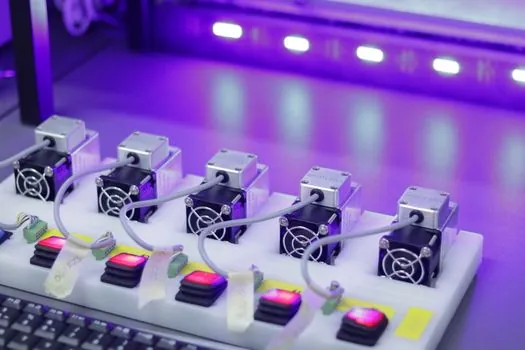
CIJ inks are typically MEK- or ethanol-based with a 1-2 second dry time on coated cardboard, and they remain the dominant choice for polybag coding because the solvent carrier evaporates before the bag stacks on the conveyor [S1]. Water-based TIJ inks dry in 0.5-1.0 second but require a porous label stock such as matte-coated paper; on glossy polyethylene or BOPP film, TIJ ink smears, forcing the specification to CIJ or laser for film-based packaging [S4].
Laser coders eliminate ink chemistry concerns entirely and reduce operating consumables, but they require a contrast layer (a laser-reactive coating or a pre-printed label) on the substrate, since a CO2 laser at 10.6 micrometers only marks materials that absorb that wavelength; clear polybags and uncoated kraft paper typically need an additive masterbatch or a label patch before a laser coder can produce a scannable mark [S1]. The coding machine category in the industrial equipment reference lists throughput, DPI, and substrate ranges across CIJ, TIJ, and laser families, which matches the decision matrix used by 3PL procurement teams.
Integration with WMS, OMS, and Carrier APIs
Modern e-commerce coders no longer run as standalone print stations; they sit on a serial or Ethernet bus to the WMS, which pushes the order data the moment a purchase is confirmed, so the coder prints the correct shipping label, carrier routing code, and tracking barcode without re-keying [S1][S5]. Shopify's unified data model keeps inventory, order, and fulfillment data synchronized across channels, so the coder receives the pick-list payload in the same transaction the warehouse issues, removing the manual scan-and-print step that historically introduced the 5-10% error rate seen in unautomated picking [S1].
For 3PL operations, the coder also feeds the carrier scan event back to the merchant's admin panel so tracking IDs propagate to the customer in real time, and this round-trip latency is the reason low-end USB-connected label printers are being replaced by network-attached TIJ heads in greenfield builds [S4][S5]. Coders that support REST or MQTT APIs can also push machine health telemetry (ink level, throw-up time, printhead cleaning cycles) into the same monitoring dashboard that tracks picking accuracy and conveyor OEE, which is the configuration most large 3PL integrators default to in 2026 [S5].
Selection Criteria: CIJ vs TIJ vs Laser Side-by-Side
A four-criteria comparison clarifies the decision: (1) line speed, where CIJ wins at 1,200-3,000 units/hour, laser reaches 800-1,800, and TIJ sits at 300-600; (2) substrate range, where CIJ handles porous and non-porous, laser needs a contrast coating on film, and TIJ is porous-only; (3) consumable cost per 1,000 marks, where laser is the lowest (zero ink), CIJ runs in the $0.40-0.90 range, and TIJ cartridges land between $0.80-1.50; (4) DPI for 2D barcodes, where TIJ delivers 300-600 DPI, laser 200-400, and CIJ 100-200 [S1][S4].
For operations already running case erectors and automated carton sealers, a strapping machine selection for e-commerce handling follows the coder decision since both feed the same WMS line, and most 3PL spec sheets published in 2026 issue a single SKU list for the pack-and-seal cluster [S1]. Operations that ship electronics with high static sensitivity often pair a CIJ coder with an antistatic strapping head on the same conveyor, since the coder and sealer must share the WMS handshake to keep the carrier label aligned with the carton tracking ID [S5].
Failure Modes and Operating Constraints
CIJ coders fail in three predictable ways on e-commerce lines: ink viscosity drift in hot warehouses (above 35 C ambient), which raises throw-up time from 30 seconds to 3-5 minutes; printhead clogging on dusty polybag lines, which requires a weekly flush cycle; and MEK vapor buildup in confined pack stations, which triggers LEV requirements and limits continuous duty to roughly 8 hours before a hood change [S1].
TIJ failure modes center on cartridge shelf life (typically 6-12 months from manufacture) and printhead burn-in on high-duty cycle lines above 500 prints/hour, which shortens head life from 18-24 months down to 6-9 months [S4]. Laser coders have the lowest maintenance burden but suffer focal-length drift on conveyors that vibrate, requiring re-calibration every 30-60 days; the machine safety reference lists Class 1 enclosure requirements for inline laser coders on open conveyors, which is the configuration most 3PL safety officers accept in 2026.
2026 Sourcing Signals and Standards
Two trackable signals will shape coder purchasing in the second half of 2026: first, GS1's continued migration of 2D barcodes from supplement to primary data carrier on shipping labels, which raises the minimum DPI requirement from 200 to 300 on every coder touching an outbound carton; second, the consolidation among 3PL operators reported in Shopify's 2026 guide, where 87% of shippers increased outsourcing and 82% credit 3PL partnerships with a better customer experience, suggesting that coder purchasing decisions will continue to migrate from individual brands to a smaller set of multi-site 3PL procurement teams [S5].
Buyers evaluating a coder line in 2026 should request a 30-day on-site trial with the exact substrate stack (corrugated, polybag, paper mailer) at production line speed, and they should verify WMS API coverage for at least Shopify, BigCommerce, and a Tier-1 WMS such as Manhattan or Blue Yonder before signing the PO [S1][S2][S5]. Operations scaling beyond 10,000 orders per month should also evaluate the upstream labeling machine integration, since a coder that prints a batch code on the carton while a separate labeler applies the shipping label is a common bottleneck in 3PL pack stations.