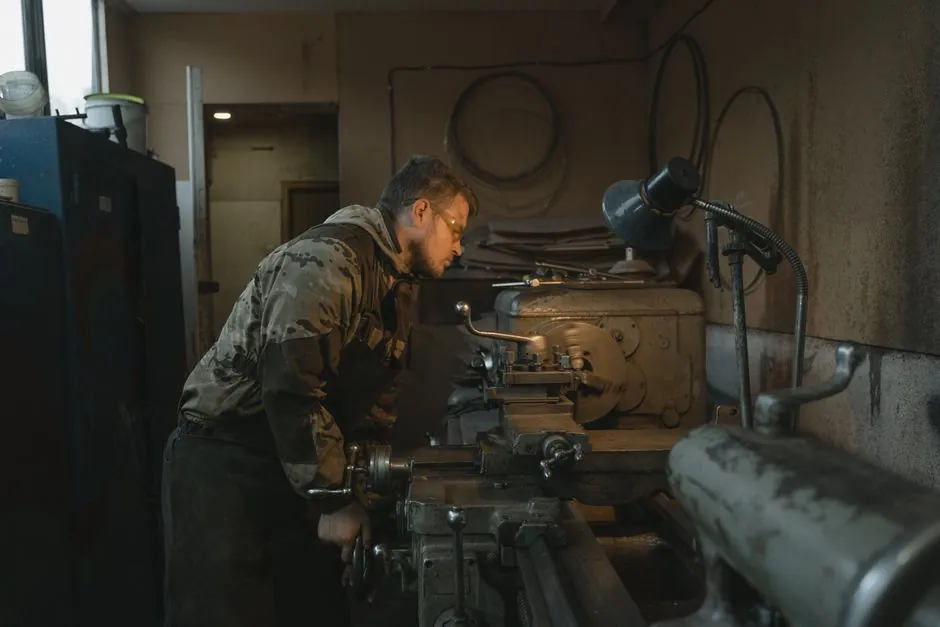
Very large Generation III+ reactor pressure vessels require forging presses rated at about 140–150 MN (14,000–15,000 tonnes), which accept hot steel ingots of 500–600 tonnes and are not common.
Heavy-forging capability for very large Generation III+ reactor pressure vessels is concentrated among a limited international network of qualified suppliers.
What Press Capacity Reactor Vessels Need
For very large Generation III+ designs, the typical requirement is a 14,000–15,000-ton press that can accept hot steel ingots weighing 500–600 metric tons [S2].
Integral construction matters because reactor vendors prefer large, single-piece forgings over welded ring assemblies. Welding together forged rings creates seams in a reactor pressure vessel. A vessel is still assembled from sections such as shell rings, heads, flanges, and forged nozzles rather than being produced as one seamless object [S5].
Doosan Enerbility owns a 17,000-ton press in Changwon, South Korea, that has forged vessels for the last four American AP1000 reactors. The broader heavy forging press build schedule therefore depends on a machine with three distinct requirements: adequate force, sufficient billet weight, and a qualified production route.
How Many Presses Can Produce Vessels
Capacity is not constrained by the forging press alone, because one seamless vessel also depends on a 500–600-ton ingot and the associated steelmaking, melt-shop, heat-treatment, machining, inspection, and welding chain [S2].
Press Force Is Not Ingot Capacity
Press tonnage alone does not establish reactor-vessel capability. A 15,000-ton press with a 175-ton ingot limit cannot replace a 15,000-ton press designed to accept 350-ton ingots, because press force does not increase the mass of steel that can be prepared, heated, transferred, and forged in one piece [S4].
The comparison shows why the answer cannot be reduced to counting machines. Press force, ingot capacity, annual throughput, commercial qualification, and access to nuclear-grade steel must all align. A 15,000-ton machine handling only 175-ton ingots is not equivalent to a machine of the same force handling 350-ton billets [S4].
Who the Capacity Is For and Who It Is Not
This capacity is for reactor vendors and utilities needing very large, low-weld-count pressure-vessel forgings, especially Generation III+ and AP1000-class projects [S2][S4]. It is not a general-purpose steel-processing surplus. A facility may possess the press force yet remain unsuitable because its ingot ceiling, steel integration, quality system, or nuclear qualification does not meet the component specification [S2][S4].
Doosan's 17,000-ton press has already supplied vessels for the last four American AP1000 units, demonstrating that qualification and vendor relationships matter as much as machine size [S4]. The July 2026 financing commitment of up to $17.5 billion could support long-lead procurement for as many as 10 AP1000 reactors, but it cannot create qualified press and ingot capacity on the proposed construction schedule [S5].
Where Forgings Are Made and What Limits Output
Operating heavy-forging capacity exists in Japan, China, South Korea, France, and Russia.
The physical limit is the workpiece. A one-piece forging requires enough hot steel for the vessel geometry, and a 500–600-ton ingot must be handled at forging temperature through die loading, reduction, forming, heat treatment, machining, and inspection [S2]. If the vessel must be made as one piece, rough-forged nozzles must also be incorporated into the forging, adding complexity to the machining and qualification sequence [S1].
Output remains limited even after a suitable press enters service. About four pressure vessels per year appears common for a large press fitted with other work, although the potential output is higher [S2]. The related 18–31 week heavy forging lead times sit downstream of this structural bottleneck: adding a second press does not remove the need for 350–600-ton ingots, qualified processing, and long-duration fabrication work.
Codes, Materials, and Manufacturing Limits
Candidate RPV steels identified for the NGNP program included ASME A508/A533 materials, annealed 2¼Cr-1Mo, and modified Grade 91 ferritic-martensitic steel, with design assessment focused on ASME Code status, temperature limits, and allowable stress [S1]. The NGNP reference design specified a 60-year plant design service life and an outlet gas temperature of 850–950°C, illustrating why material capability must be evaluated alongside forging capacity [S1].
ASME nuclear accreditation using the N-stamp is the qualification framework identified for commercial nuclear-grade component suppliers [S2]. The large vessel is produced from forged sections and welded into an assembly, while larger integral sections reduce the number of seams that must be examined during service [S4][S5].
Heavy forging compresses the steel while reducing metallurgical defects and improving structural integrity, but that does not remove the constraints of material certification, code compliance, heat treatment, dimensional machining, weld qualification, or lifetime inspection [S3]. The practical production question is therefore how many complete qualified forging routes exist, not how many hydraulic presses can deliver force in principle.
Track the number of qualified presses accepting at least 350-ton ingots, the announced ingot ceilings at the 14,000–17,000-ton facilities, and the number of vessels booked annually; these three signals determine whether global heavy-forging capacity can support a nuclear buildout faster than roughly four vessels per press-year [S2][S4].