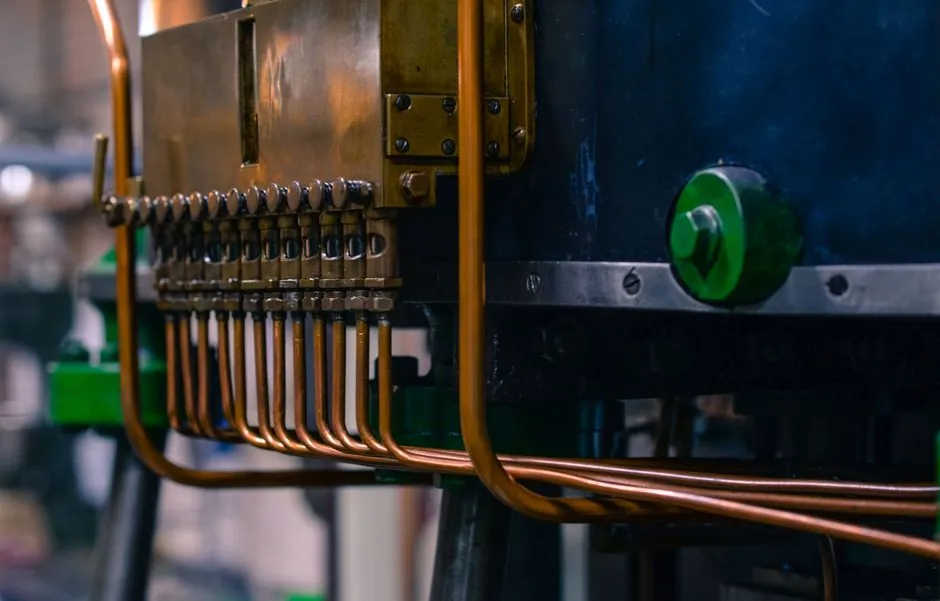
The high-purity copper segment, defined as 5N (99.999%) and 6N (99.9999%) grades used in integrated circuits, cable conductors, and semiconductor sputtering targets, is concentrated among eight named producers tracked in a GIR (Global Info Research) study published 2018-04-01: Aurubis, Hitachi Metals, Makin Metal Powders, ACI Alloys, DOWA Electronics Materials, IMC-MetalsAmerica, Luvata, and National Bronze & Metals [S1].
Copper's electrical conductivity (IACS in the high-90s% range for 5N+ grades), thermal conductivity, and ductility are the engineering properties that put it into semiconductor-grade applications, and the same report's regional segmentation, North America, Europe, Asia-Pacific, plus South America and Middle East & Africa, maps the manufacturer footprint across those same eight players [S1]. For sourcing teams that also handle industrial process instrumentation, this purity ladder is the same gating parameter that drives busbar, winding, and copper material selection downstream.
5N vs 6N: Purity Grade as the Primary Spec Gate
The high-purity copper market segments into two product types: 5N (99.999%) and 6N (99.9999%) purity, with 6N commanding a measurable price premium driven by tighter electrolytic refining and tighter residual-gas limits [S1]. Application demand comes from integrated circuits (sputtering targets, lead frames), cables & wires (where conductivity losses scale with impurity content), and semiconductor manufacturing (heatsinks, chamber components), with an "Others" bucket covering emerging R&D uses [S1].
5N is the workhorse grade for most cable, busbar, and pressure sensor winding applications where conductivity variance of a few tenths of a percent is acceptable; 6N is reserved for wafer-level processes where metallic contamination above ppb levels can scrap a lot. Selection criteria beyond purity include oxygen content (typically specified under 5 ppm for OF-grade and under 1 ppm for the toughest semiconductor specs), trace uranium/thorium limits for low-background instruments, and form-factor delivery (rod, billet, sheet, or powder).
Manufacturer Roster and Geographic Footprint
The eight named producers divide into three regional clusters. European production is anchored by Aurubis (Hamburg, Germany), the largest integrated copper refiner in Europe, and Luvata (Finland/UK heritage), both strong in 5N and 6N rod and billet for cable and electronics end-uses. North American capacity is held by Makin Metal Powders (UK-headquartered but with US powder operations), ACI Alloys (US specialty distributor/refiner), IMC-MetalsAmerica, and National Bronze & Metals, with a tilt toward powder, billet, and small-lot specialty forms rather than the high-tonnage wire-rod market [S1].
Asia-Pacific production, primarily Japanese, is represented by Hitachi Metals and DOWA Electronics Materials, both of which target semiconductor-grade 6N material with controlled oxygen and sulfur specifications. Regional demand analysis in the same report covers North America (US, Canada, Mexico), Europe (Germany, France, UK, Russia, Italy), Asia-Pacific (China, Japan, Korea, India, Southeast Asia), South America (Brazil, Argentina, Colombia), and Middle East & Africa (Saudi Arabia, UAE, Egypt, Nigeria, South Africa), reflecting that the manufacturer base is concentrated in only two of those five regions while consumption is global [S1].
Adjacent Copper Product Segments and Their Manufacturer Bases
Beyond bulk high-purity copper, three adjacent segments show their own manufacturer concentration. Rigid copper clad laminate (CCL), the base laminate for rigid PCBs, is dominated by Asian producers, including Nan Ya Plastic, Panasonic, ITEQ, EMC, Isola, DOOSAN, GDM, Hitachi Chemical, TUC, JinBao, Grace Electron, Shanghai Nanya, Ding Hao, GOWORLD, Chaohua, and WEIHUA, with grades spanning paper board, composite substrate, normal FR4, high Tg FR-4, halogen-free board, and special board [S3].
Instrument-level copper measurement is a smaller segment. Copper ion meters (bench/laboratory) and portable copper ion meters (handheld) are tracked as separate equipment markets, with manufacturers operating mainly in North America, Europe, and Asia-Pacific, and end-uses spanning industrial water, plating baths, and laboratory analysis [S4][S6]. Nano copper powder, with particle sizes from 1 nm to 1,000 nm, is a specialty sub-segment used in conductive inks, antimicrobial additives, and catalysts, with electrical and thermal conductivities above micro-grade copper and pricing that tracks particle size distribution [S5]. Clad metals (for example SUS/Al alloy laminates) sit adjacent to copper as a multi-metal engineering material where diffusion bonding replaces plating to prevent delamination, commonly used to cut cost while preserving corrosion or strength performance [S7].
Selection Criteria Comparison: Which Producer for Which Application
For procurement teams choosing among the eight high-purity producers, four decision criteria dominate: purity grade capability (5N only vs both 5N and 6N), form factor (rod/billet vs powder vs sheet), geographic logistics (LME-aligned European delivery vs Asia-Pacific shipping lead time), and certification depth (ISO 9001 baseline, plus semiconductor-customer audits). Aurubis and Luvata score high on tonnage capacity and LME-aligned European logistics, with 6N capability for semiconductor sputtering and lead-frame customers. Hitachi Metals and DOWA score high on 6N purity and on Japanese semiconductor-customer audit compliance, at the cost of longer trans-Pacific lead times. ACI Alloys, Makin Metal Powders, and National Bronze & Metals win on small-lot specialty forms and shorter North American lead times, typically at a unit-cost premium per kilogram. [S1]
The criterion matrix to run against any quote: minimum purity (5N or 6N, in N-grade integers), maximum oxygen (often 5 ppm OF, 1 ppm semiconductor), delivery form (rod, billet, sheet, powder), minimum order quantity (kilograms), and trace-element certificates (U, Th limits for low-background or analytical use). A 5N copper grade is sufficient for most industrial winding, busbar, and standard flow meter coil applications, while 6N is the floor for any process that contacts a wafer or an analytical cell where ppb metallic contamination matters.
Limitations of the Public Dataset and Sourcing Reality
The GIR-derived 2018 dataset explicitly withholds the manufacturer revenue split, stating only that the top manufacturers are profiled "with sales, revenue, and price of High Purity Copper, in 2016 and 2017" without giving the actual percentages [S1]. That is the main constraint a 2026 sourcing team faces: the named-manufacturer list is well-defined, but the precise market share percentages between Aurubis, Luvata, and Hitachi Metals are not in the public record, and the same gap exists for the rigid CCL segment (where the 2019 GIR study lists 18 manufacturers but does not publish revenue share) [S3]. For copper ion meters, portable copper ion meters, and nano copper powder, the same source set lists application scope and regional coverage but does not give unit-volume share by manufacturer [S4][S5][S6].
Trackable signals for the next sourcing cycle: any 2026 update to the Aurubis, Luvata, or Hitachi Metals annual reports that breaks out 5N/6N volume split, any new 6N capacity announcement from a Chinese refiner entering the semiconductor-grade segment, and any revision to the IEC 60068 or ASTM B170 grade boundaries that tightens 6N oxygen or trace-element limits. The aluminum segment ran a similar eight-to-twelve-producer concentration cycle in 2025 to 2026, and that earlier pattern is a reasonable reference for how a copper top-tier reshuffle would play out, as laid out in Aluminum 2026: Capacity, Alloy Grades, and Sourcing Reality.