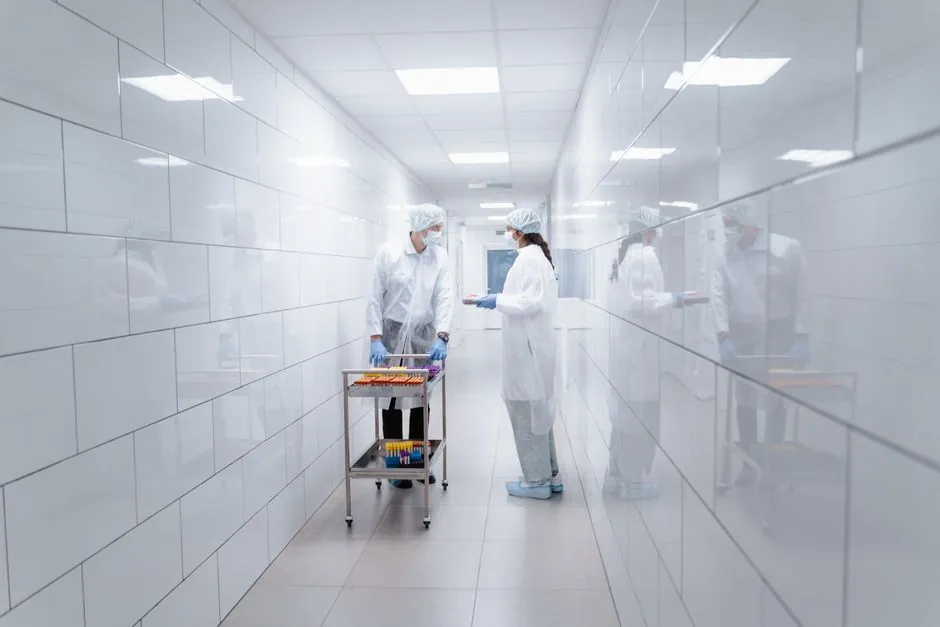
Porcelain tile, classified by ISO 13006 with water absorption below 0.5%, dominates hospital hard-surface specification because it combines a non-porous body with a through-body color layer that survives aggressive disinfectants and rolling loads [S1][S3]. Crossville's healthcare portfolio explicitly cites non-porous porcelain and the absence of VOCs, PVC, and formaldehyde as the baseline sanitary argument for patient rooms, lobbies, and operating-theatre adjuncts [S3].
Hospital tile selection is not one decision but a zone map: entrance ramps, corridors, labs, imaging rooms, and wet service areas each push a different pair of criteria, so the specifier needs a written matrix linking room function to slip rating, absorption class, chemical resistance, and jointing system before the first sample is requested [S1][S5].
Decision Criteria: What the Spec Sheet Must Show
Stain resistance is graded under ISO 10545-14, and hospitals should require class 5 for iodine, blood, and povidone-iodine exposure in trauma and phlebotomy zones; anything below class 3 will show permanent marking within months under daily quat-ammonium cleaning [S1][S4]. For the broad material context that drives those numbers, see the reference page on industrial ceramic and the deeper dive on alumina ceramic when abrasion is the dominant load.
Tile Type Comparison: Porcelain, Ceramic, and the Alternatives
Porcelain, glazed ceramic, and through-body color-body porcelain each have a different failure mode in a hospital, and the choice between them depends on the room's wet/dry mix and rolling-load intensity [S1][S4].
Forged from refined clay fired above 1200 °C, porcelain reaches water absorption below 0.5% and is the only ceramic body Sika's hospital finishes guide treats as viable for clinical zones, with the explicit caveat that the grout joint is the weak link rather than the tile itself [S4]. The relevant broader material context, including how porcelain compares to other advanced ceramics, is covered in the ceramic tile reference.
Against competing hard-surface systems on the same hospital floor, the comparison is sharper: vinyl composition tile (VCT) is the lowest first-cost option but carries the highest life-cycle maintenance because it needs periodic strip-and-wax cycles; luxury vinyl tile (LVT) cuts maintenance but introduces seams that trap microbes in wet zones; rubber sheet goods win on acoustic and wheeled mobility but cost more upfront; seamless resinous floors win on joint count but require expert installation [S4]. Porcelain's remaining weakness is the same one Sika flags, the cementitious grout line, which is solved by switching to epoxy or modified epoxy grout that is impervious to body fluids and quat-ammonium cleaners [S1][S4].
Zone-by-Zone Application Map
Corridors in a 24/7 hospital need a tile body rated for a minimum breaking strength of 1300 N at 8 mm thickness, with surface texture tuned to DCOF ≥ 0.42 wet and a through-body color so wheel scuffing does not expose a contrasting layer [S1][S3]. For ramps and entrance vestibules where water tracks in from outside, the spec should step up to DCOF ≥ 0.55 wet and pair the tile with tactile indicators for visually impaired users, a feature Emato International explicitly lists as a corridor-and-ramp requirement in its healthcare tile design guide [S5].
Wet service areas, including bathrooms, scrub rooms, and soiled utility rooms, should run unglazed porcelain with epoxy grout, a coefficient of friction that does not fall below 0.42 when wet, and a coved tile base rather than a vinyl base for infection-control audit pass [S1][S4]. Hospital laboratories need acid- and alkali-resistant tile bodies and grouts capable of taking repeated exposure to concentrated disinfectants; a glazed surface will etch under strong acids and is therefore wrong for this zone [S5]. For specialized rooms such as server closets, meter rooms, and X-ray suites, anti-static porcelain with a surface resistance between 1×10⁶ and 1×10⁹ Ω is the safe pick, a sub-class that overlaps with the anti-static equipment spec logic used in chemical plants.
Jointing, Edge, and Installation Constraints
Epoxy grout is the hospital default because it is non-porous, chemical-resistant, and does not harbor microbes the way cementitious grout does; Sika's hospital guide flags cementitious grout as the single biggest maintenance burden in any ceramic installation [S4]. Joint width should sit between 2 mm and 3 mm for rectified porcelain, with movement joints every 6 m to 8 m of continuous run to absorb thermal movement and avoid tenting at the slab interface [S1][S3].
Lippage between adjacent tiles must stay below 0.5 mm for wheeled stretcher and IV-pole traffic; any greater deviation becomes a snag point for casters and a fall hazard for staff moving at speed [S4]. The substrate below is equally load-bearing: a cracked or hollow-sounding tile in service is almost always a substrate problem rather than a tile-body problem, and hospital slab prep should hit a concrete moisture vapor emission rate below 3.0 lb/1000 ft²/24 h before any porcelain is set [S1][S4].
Standards, Sourcing, and Verification Signals
Indoor-air-quality claims should reference VOC emissions rather than absence statements, and third-party FloorScore or UL Greenguard Gold certificates are the practical way to verify that no formaldehyde or PVC is being released into an occupied patient room [S3].
For projects where tile is being compared to other engineered ceramic surfaces, the zirconia ceramic and ceramic bearing reference pages give context on how the same family of materials behaves under sliding and impact wear. The most reliable tracking signal for an in-flight hospital tile project is the published wet DCOF value on the actual production-run data sheet, not the catalog number; if that number is missing or older than the production date, the tile has not been re-verified and should be rejected at goods-in.