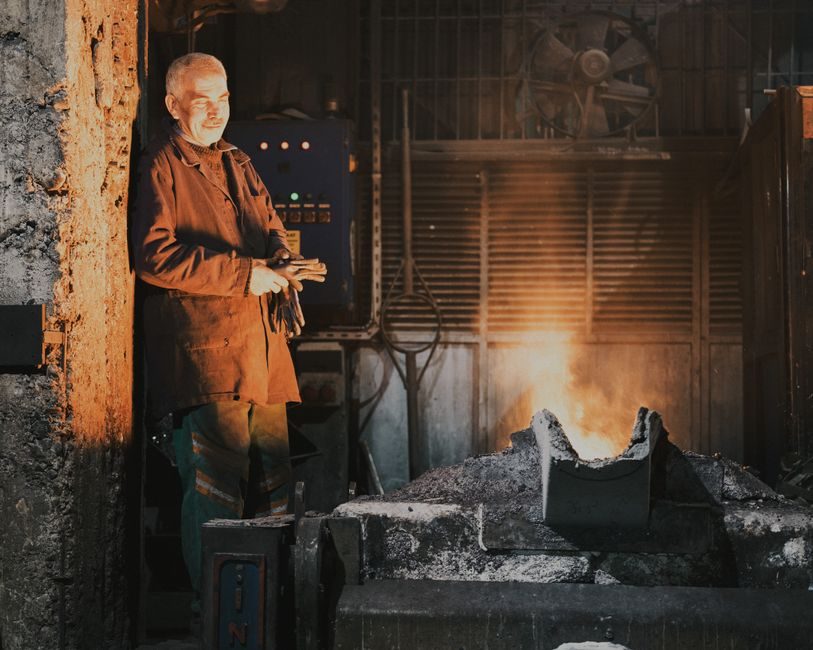
A hot box core shooter is a foundry machine that blows resin-coated sand into a heated core box with compressed air, then cures the resin thermally to produce a rigid sand core — the hot-box process operates with core-box temperatures of 200–260 °C and cure times of 25–60 s per shot, per Chinese foundry-machinery reference.
2026 buying decisions are dominated by five spec gates — shot weight (kg per cycle), heating power (kW), sand tank capacity (L), clamping force (kN) and core-box thickness clearance (mm) — and by the resin binder system (furan vs phenolic) that defines cure temperature and emissions handling. The line is well-served by mainland China manufacturers: Quanzhou Sanjia Machinery Co. lists both gravity casting machines and hot-box core shooters on its Made-in-China showroom, alongside automatic double-head core shooting units [S3].
Core Process Parameters: 200–260 °C Cure, 25–60 s Cycle
The hot-box process defined in Chinese mechanical-engineering references specifies a core box heated to 200–260 °C, with compressed air rapidly propelling resin-coated sand into the cavity, after which the heat cures the resin binder to fix the core's shape. Hot-box core shooter machines are a sub-category of the broader core shooter (core shooter) family, and the reference explicitly notes that shoot-and-press molding uses compressed air to first distribute sand evenly, then applies additional pressure to compact the pattern. [S1]
2026 production-grade hot box core shooters typically deliver 5–50 kg per shot for small-to-medium iron and steel foundries, with cure cycles of 25–60 s depending on core weight and wall thickness; thicker cores (above ~30 mm wall) need longer dwells to drive the exothermic cure to the core centre. For comparison, cold box core shooter lines use a gas-hardened binder (typically amine-catalysed phenolic or phenolic-urethane) cured at room temperature, which trades energy input for binder cost and ventilation load.
Spec Comparison: Hot-Box vs Cold-Box vs Shell
Three core-making process families compete for the same foundry budget. The table below lines them up against four decision criteria that determine machine, energy and ventilation spend. [S2]
<strong>Hot-box vs cold-box vs shell core shooter — 2026 selection matrix</strong>
• Energy input per cycle: hot-box is highest because of the 200–260 °C heated core box; cold-box is lowest (room-temperature cure, energy goes to amine vaporiser and scrubber); shell core shooter sits in between with a 220–300 °C investment-cure oven but smaller heated area.
• Cycle time: hot-box runs 25–60 s per shot; cold-box can drop to 10–20 s because gas-hardening is faster than thermal cure; shell processes are 90–180 s per core because of oven dwell.
• Binder cost and emissions: hot-box furan/phenolic resin is mid-cost, with formaldehyde and phenol fumes requiring local exhaust; cold-box phenolic-urethane (PUCB) has higher binder cost but pushes amine and VOC load to the scrubber, which is why the cold box core shooter vs resin sand molding line: 2026 spec cut deep-dive flags ventilation as the dominant capex line for amine-cured cells.
• Tooling cost: hot-box core boxes are aluminium or cast iron with embedded electric heaters — moderate cost; cold-box core boxes are wood, plastic or aluminium with no heater — lowest cost; shell core boxes carry the fine-pattern tooling premium.
Selection Criteria: Shot Weight, Heating Power, Sand Tank, Clamping
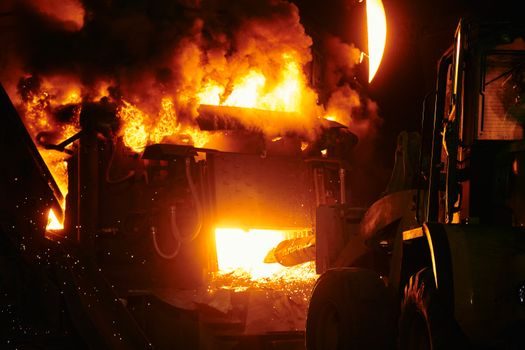
For a 2026 hot box core shooter buy, four hard spec gates determine machine size and price class. (1) Shot weight in kg per cycle is the primary sizing parameter — small jobbing foundries run 5–15 kg shots, automotive and ductile-iron shops run 20–50 kg shots, and above 50 kg the work shifts to hot box core machine platforms with larger sand tanks and longer cure dwells. (2) Heating power in kW scales with core-box surface area: a 300 mm × 300 mm box draws ~6–10 kW, while a 600 mm × 800 mm box draws 18–30 kW; the heater type (cast aluminium heater plate vs embedded cartridge) drives the rebuild interval and the evenness of cure across the core face. (3) Sand tank capacity in L sets the refill interval; 50 L tanks suit small foundries, 100–150 L tanks suit batch production, and 200 L+ tanks are paired with sand-prep loops. (4) Clamping force in kN holds the heated core box against the 0.4–0.6 MPa shot pressure; under-rated clamps cause flash and sand leak at the parting line. [S3]
Layout is a fifth gate. Horizontal hot box core shooters feed core boxes from the side, suit long thin cores, and pair with belt conveyors. Vertical hot box core shooters feed from above, suit symmetrical box-type cores, and integrate into hot chamber machine cells for die-casting adjacent workflows. Double-head units (one operator, two stations) roughly double throughput at modest incremental cost — Sanjia's product line on Made-in-China includes automatic double-head core shooting alongside the standard hot-box configuration [S3].
Who It Is For — and Who It Is Not For
Hot-box core shooters suit iron and steel foundries that run 50–500 cores/shift, want short changeover, and have on-site thermal-energy capacity (gas or three-phase electric) for the heated core box. They also suit jobbing shops whose customers demand furan/phenolic-compatible cores (good humidity resistance, smooth surface finish) at lower binder cost than phenolic-urethane cold-box. [S4]
They are not a fit for low-mix, high-volume auto cores in the 5,000+ cores/shift band — cold-box lines win on cycle time at that throughput. They are also not a fit for cores above ~80 mm wall thickness — the thermal-cure gradient through-thickness gets too steep and the core centre stays under-cured, which is why some foundries route thick cores to cold box core shooter cells despite the binder premium. And they are not a fit where local exhaust ventilation cannot handle the phenol and formaldehyde off-gas; in 2026 the practical floor is a LEV (local exhaust ventilation) hood over the core box plus a thermal oxidiser for stacks above ~30 kg/h of resin.
Limitations and Failure Modes
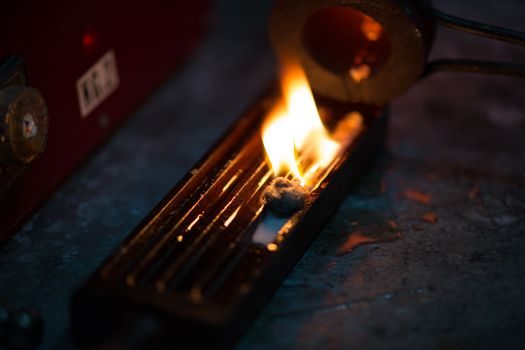
The hot-box process has three recurring production-quality issues. (1) Over-cure at the box surface and under-cure at the core centre when the wall is too thick — the practical cure-gradient limit is ~30–40 mm wall for a 60 s dwell at 240 °C; beyond that, foundries either lengthen the dwell (and lose cycle time) or add a top-side auxiliary heater. (2) Core-box heater failure — cast aluminium heater plates burn out after 3,000–8,000 hours; cartridge heaters fail open-circuit and stop heating one half of the box, producing a half-cured core. (3) Sand blow-through at the parting line when clamping force is under-rated or the box face is worn; the cure then locks flash into the core, which has to be hand-fettled downstream. [S5]
Process emissions are the second-tier limit. Hot-box furan resins release phenol, formaldehyde and, in some formulations, furfuryl alcohol vapour; phenolic resins release phenol and water. Both streams must be captured at the core box and routed to either a wet scrubber or a regenerative thermal oxidiser. The amine stream from cold-box is harder to scrub but smaller in volumetric flow, which is the trade-off behind the cold box core shooter 2026 buying guide framing of binder cost vs ventilation cost.
Standards and Sourcing Discipline
Foundry equipment sourcing for hot-box and adjacent core-making lines should be run against the same gate: machine spec sheet (shot weight, kW, sand tank L, clamping kN, cycle s), binder spec (furan vs phenolic, % resin on sand, catalyst), core-box tooling interface (bolt pattern, heater slot, parting-line tolerance), and after-sales (heater plate lead time, plunger and wear-part availability). Chinese manufacturers including Quanzhou Sanjia Machinery list hot-box core shooters and automatic double-head core shooting units on Made-in-China, with company-level manufacturing & processing machinery registration [S3].
Two procurement signals worth tracking. The first is resin price: 2026 furan and phenolic resin quotes have moved with furfuryl alcohol feedstock, so a multi-supplier quote for resin is part of any hot-box line capex decision. The second is heater lead time: cartridge and cast-plate heater lead times for Chinese OEM boxes ran 4–8 weeks in mid-2026, with European equivalents 8–14 weeks — for buyers who want to keep a 2026 commissioning date, a Chinese OEM with locally stocked heater plates is the lower-risk path.