Cooling capacity, not server availability, now sets the binding constraint on 2026 AI data center build-outs, with rack densities of 50-100 kW common and individual GPUs such as NVIDIA Blackwell drawing up to 1,200 W each [S3].
When cooling falls behind heat load, the symptoms show up fast: thermal throttling, reduced uptime, and shortened hardware life, and each of those failures cascades into delayed rack energization across the whole hall [S5]. Air cooling alone now consumes up to 40% of facility electricity, and grids built decades ago are being asked to feed that load continuously [S3].
What Density Numbers Now Define the Build Envelope
Ten to twenty kW per rack was the planning baseline a few years ago, but in 2026 AI halls the 30-60 kW range is routine, and the next generation is targeting beyond 100 kW per rack, which is why hot/cold aisle containment alone can no longer carry the thermal budget [S5]. Ceiling height directly affects inlet and exhaust behavior: a low ceiling traps heat at the rack face, while a higher ceiling gives cold supply air room to mix before reaching the inlet, a trade-off quantified in published CFD studies of raised-floor and overhead supply topologies [S7].
Chip-level heat flux drives the per-rack number. A single 1,200 W Blackwell GPU concentrates more thermal load into a smaller footprint than prior generations, and ASHRAE's AI data center guidance flags energy and thermal efficiency as central to facility viability rather than secondary [S3][S9].
Compressed Schedules Force Cooling to Ship Before It Is Fully Validated
AI demand has condensed construction timelines to 12-18 months for many hyperscale and colocation builds, and the cooling plant is often installed under extreme time pressure, which means design margin that would normally be earned through prototype testing gets compressed into commissioning windows [S4]. The result is cooling systems deployed at or beyond their optimal design parameters, accelerating wear on chillers, pumps, and CDUs from day one [S3].
Hyperscale share of global data center capacity reached 41% in 2025 and is expected to exceed 60% by 2029, and that consolidation concentrates schedule risk: a single delayed cooling skid on a 100 MW campus can idle thousands of GPU racks [S3].
Water, Power, and Grid Constraints Reshape Where Racks Can Go
Liquid cooling at hyperscale is forecast to consume 1.7 trillion gallons of water annually by 2027, with individual sites drawing 50 million gallons or more per year, much of it lost to evaporation, which is pushing new builds toward water-scarce regions to fail permitting [S3]. The flip side is that air cooling at AI densities can eat 40% of facility power, starving the IT bus for compute, so the choice between PUE and WUE is now a siting decision, not just an engineering one [S3].
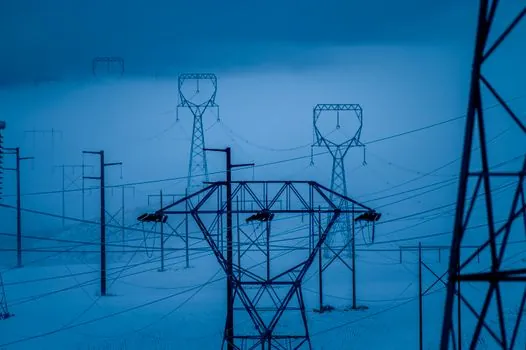
Grid-side constraints compound the picture. Average U.S. large power transformer age exceeds 40 years, these units handle roughly 90% of national electricity flow, and AI training loads running 24/7 outside historical demand patterns force voltage and frequency variation that degrades chiller and pump performance, with documented facility-wide cooling instability as a downstream risk [S3]. In Ireland, data centers consumed about 20% of national electricity in 2024, which triggered a halt on new Dublin builds, a precedent that is reshaping pipeline planning across other constrained metros [S3].
Cooling Technology Options, Lined Up Against Density and Schedule
Air cooling with hot/cold aisle separation remains the cheapest path and still handles the legacy 10-20 kW baseline with reasonable fan energy, but it scales poorly above 30 kW and is the main reason hyperscale operators are moving to liquid or hybrid [S6]. Direct-to-chip cold plates and rear-door heat exchangers step in around 30-60 kW, delivering targeted heat removal without overhauling the white space, while full immersion and single-phase dielectric bath cooling target 60-100+ kW cabinets at the cost of fluid handling, leak detection, and a much heavier maintenance regime [S5].
Hybrid designs that overlay liquid cooling onto an existing air-cooled room let operators phase capex, a practical answer when lead times on chillers, CDUs, and dry coolers push the cooling skid to the critical path of the rack energization sequence.
Where Equipment Lead Times Collide with Rack Bring-Up

Supply chain friction now extends to nearly every cooling subassembly, and the 12-18 month construction window leaves little buffer when a chiller or CDU slips by 8-12 weeks, so procurement teams are warehousing long-lead cooling skids months ahead of mechanical completion [S8]. Lead times on transformers, busways, and switchgear have become a separate bottleneck, and the Power Equipment Lead Times Now Gate 2026 Data Center Builds reality is that even a perfectly spec'd cooling plant cannot energize racks without the upstream medium-voltage feed.
Operators are responding with two-tier procurement strategies: standard air-cooled skids stocked for fast follow-on halls, and bespoke liquid-cooled skids ordered 9-15 months ahead for flagship AI rooms, a pattern visible across the Cooling Tower Lead Times 2026 market split.
Failure Modes When Cooling Falls Behind Heat Load
When cooling capacity is undersized or arrives late, the failure chain is predictable: inlet temperatures climb, GPUs throttle to protect silicon, effective FLOPS per watt collapses, and the rack energization date moves right even though the servers are already racked and stacked on the floor [S5]. Sustained over-temperature operation shortens capacitor and fan bearing life, which converts a one-time schedule slip into a multi-year reliability tax on the hall [S5].
Voltage and frequency sags on the utility feed push chillers and pumps off their design curves, lowering COP and sometimes tripping the chiller controller, which can blank out a full row of racks until the cooling loop recovers, a risk that grows as average grid asset age climbs past 40 years [S3].
Who This Affects and Who It Does Not

This is a problem for any operator planning AI-density racks above roughly 30 kW per cabinet, for colocation wholesalers retrofitting white space for GPU tenants, and for hyperscale builders racing 12-18 month schedules, where a single delayed cooling skid can idle thousands of GPUs worth of capex [S3][S4]. It is largely not a problem for edge micro-sites under 50 kW total, for traditional enterprise rooms still in the 5-15 kW per rack band, or for operators in regions with surplus water, surplus grid capacity, and a 24+ month build horizon, where the air-cooled hot/cold aisle configuration still pays back [S6].
Trackable signals for the next planning cycle include ASHRAE's evolving AI thermal guidance, transformer and chiller lead-time movement in the Dry cooler and chiller lead times 2026 procurement data, and any new municipal moratoriums modeled on Dublin's 2024 grid strain.