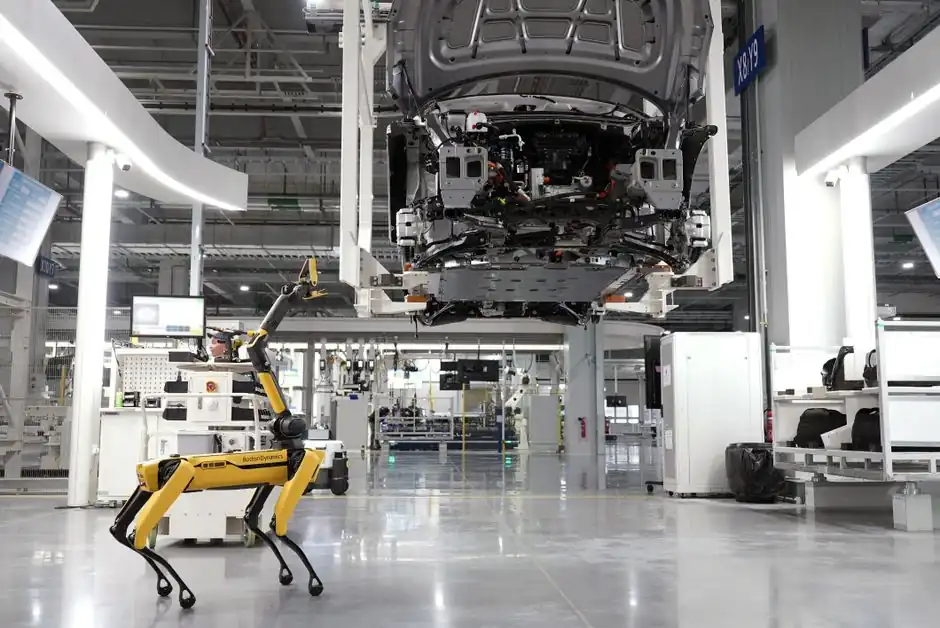
Industrial automation lead times on robots, PLCs, and IoT gateways have stretched from a pre-2024 baseline of roughly 90 days to more than 26 weeks as of October 2026, with HBM, DDR5, and sub-7 nm wafer capacity remaining fully allocated to hyperscale AI buyers [S1][S4].
The crunch is driven by data-center build-outs consuming the same TSMC, Samsung, and SK Hynix output that feeds factory automation, leaving operations leaders to compete with cloud operators for identical silicon [S1][S4]. Lead-time data from the prior 2020 to 2023 cycle shows how fast a 15-week baseline can balloon: Broadcom's average stretched from 12.2 weeks in February 2020 to 22.2 weeks by April 2021, and the current cycle is on a similar slope, only larger [S2].
Why AI Demand Is Squeezing Automation Silicon
Generative-AI data centers are absorbing the bulk of advanced-node output at TSMC, Samsung, and SK Hynix, with the three largest memory and logic suppliers running multi-year backlogs that leave industrial buyers at the back of the queue [S1][S4]. The same HBM stacks, DDR5 modules, and custom AI accelerators that feed LLM servers share wafer starts with the application processors, motor-control MCUs, and Ethernet PHYs used in factory hardware, so any reallocation upstream shows up downstream as missing BOM lines [S4].
Deloitte's analysis of the 2020 to 2023 episode projected cumulative revenue impact above US$500 billion globally from 2020 to 2022, with lead times for some components pushing into 2023, and the consultancy's structural read of the industry still applies: wafer capacity is added in lumpy, multi-year waves because fab construction runs 24 to 36 months from groundbreaking to first wafer-out [S3]. New fabs that will ease 2026 to 2027 demand are not coming online in volume until at least the 2025 to 2027 window, which is too late to relieve near-term industrial orders [S4].
Which Automation Hardware Is Hit Hardest
Warehouse robotics, autonomous mobile robots (AMRs), and AI-enabled picking systems are the most exposed because they depend on the same high-performance CPUs, GPUs, and vision SoCs that data-center buyers stockpile first [S1]. IoT sensor networks are second, since a single cold-chain monitoring rollout or predictive-maintenance deployment can require hundreds or thousands of node processors, and each missing node stalls commissioning just as effectively as a missing robot [S1].
PLC and industrial camera platforms are third-tier exposed: the MCU and image-sensor packages they ride on are older nodes, but the supporting Ethernet, Wi-Fi, and 5G modem silicon is competing for the same constrained back-end test capacity that advanced-node parts use [S1][S4]. Motor drives, linear actuator controllers, and HMI panels are the least exposed because their silicon is mostly mature-node, but their delivery still slips when assembly lines are re-prioritized toward higher-margin AI hardware [S1].
Comparing 2020 to 2023 vs 2024 to 2026 Shortage Cycles
The 2020 to 2023 cycle peaked at a 15-week industry average lead time in February 2021, the longest reading since 2017, with specific Broadcom lines at 22.2 weeks by April 2021 and roughly 169 downstream industries affected [S2]. The current cycle is structurally worse on two axes: the upstream demand pool is dominated by hyperscale AI capex rather than diffused PC and auto demand, and the affected product mix (HBM, DDR5, sub-7 nm logic) has fewer qualified second sources than the auto-grade MCUs that bottlenecked last time [S1][S4].
Forecast horizon is also longer: Deloitte flagged in late 2021 that future shortages were a near-certainty within the decade because fab capacity is intrinsically lumpy, and the present cycle matches that read with GPU and memory tightness projected to persist through at least 2026 [S3][S4]. The 2020 to 2023 episode ended with global car production up roughly 3% by 2023 as capacity caught up, but that recovery took more than 24 months from the initial disruption, which is the realistic lower bound for the current cycle as well [S2][S3].
What Operations and Procurement Teams Should Do Now
Lock in hardware purchase orders 90 days earlier than the pre-2024 norm; if a robotics or controls rollout is on the 2027 plan, place the PO in 2026, since lead times above 26 weeks cannot be compressed by any single buyer [S1]. Build buffer into commissioning schedules so a late PLC or vision system does not cascade into missed software-validation windows and idle integration crews [S1].
Qualify second sources for every processor above 28 nm, including the Ethernet switch silicon and the image-sensor SoCs inside industrial camera modules, and maintain dual firmware builds so a swap does not require a full re-validation cycle [S1]. Use a mix of mature-node and advanced-node parts in new designs wherever motion-control and linear actuator duty allows, because mature nodes are still deliverable on shorter cycles [S3].
What to Track Over the Next Two Quarters
Watch quarterly TSMC and Samsung capex prints and the 2026 HBM and DDR5 mix at SK Hynix and Micron, since these are the leading indicators of when industrial-grade allocation will loosen [S4]. Track whether any 2025 to 2027 fab cluster (Arizona, Kumamoto, Taylor) hits first-wafer milestones earlier than the published 2026 to 2027 window, which would pull the cycle's end forward [S3][S4]. For readers tracking adjacent bottlenecks, control valve actuator electronics are already sitting at 55-week lead times, confirming that the chip crunch is propagating into the discrete-instrument layer of the plant.